

Major powers are accelerating independent defense networks and leadership reshuffles, challenging U.S. hegemony in satellite communications, maritime security, and Middle Eastern diplomacy.
The landscape of global power is undergoing a rapid recalibration as nations move to insulate their military and technological capabilities from American influence. From the deployment of sovereign satellite constellations in Europe to the consolidation of hardline security leadership in Tehran, the trend toward strategic autonomy is now a functional reality. As the U.S. Senate navigates domestic hurdles—including the 50-49 confirmation of Attorney General Todd Blanche on August 8—the international community is building architectures that bypass Washington.
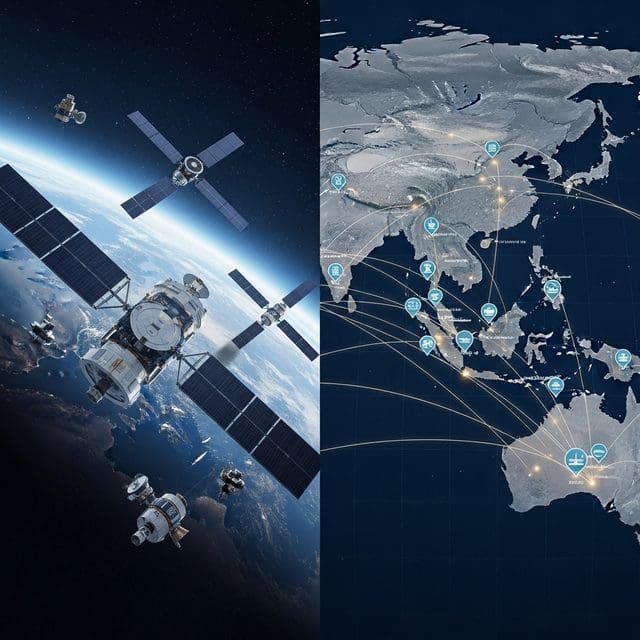
In Brussels, the European Union has moved its IRIS² secure satellite constellation into full-scale deployment. By signing an implementation agreement with the SpaceRISE consortium on August 7, the EU is adding 66 satellites to a planned 348-unit network. Valued at approximately $18 billion, the project is explicitly designed to provide a hardened communications backbone for military operations. EU officials frame the move as a necessary step toward reducing dependence on U.S. systems like Starlink, ensuring European defense remains operational even if transatlantic priorities diverge. The first launches are set for 2029, aiming to increase secure governmental capacity by 60%.
While Europe looks to the skies, China is refining its ability to dominate the Western Pacific. Recent analysis of Beijing’s televised military capabilities highlights a sophisticated “kill chain”—a sensor-to-shooter network designed to track and hold U.S. forces at risk. Pentagon planners are increasingly focused not just on missiles, but on the integrated data-fusion and ISR architecture that allows China to generate firing solutions across the first and second island chains. This network is supported by state-steered capital, with Chinese firms raising $217 billion via domestic markets to fund the AI and advanced computing necessary to underpin these military systems.
In the Middle East, the Iranian regime has signaled a hardening of its stance by appointing Mohsen Rezaei, a 71-year-old former IRGC commander, as secretary of the Supreme National Security Council. Rezaei, a close ally of Supreme Leader Mojtaba Khamenei, takes the helm as Tehran negotiates with Oman over the reopening of the Strait of Hormuz. The appointment suggests a consolidation of IRGC influence over foreign policy. Iran announced on August 8 that a deal to reopen the Strait is nearing, but remains dependent on U.S. compensation. This leadership shift follows the assassination of former council head Ali Larijani and reflects a tightening of regime control during a period of regional volatility.
These developments coincide with intense legislative friction in Washington. The U.S. Senate recently passed a bipartisan Russia sanctions bill in an 86-11 vote, a measure negotiated by the late Senator Lindsey Graham. The bill imposes harsher penalties on Moscow and the top five buyers of Russian oil while extending sanctions on Iran. However, the Trump administration’s broader regional strategy faces resistance. Prime Minister Benjamin Netanyahu rejected a 15-point plan for Gaza on August 9, asserting Israel will not disarm Hamas or accept a Palestinian government, despite German suggestions that the plan offered a viable path forward.
As the U.S. navigates these challenges, the emergence of independent technological and security architectures suggests a future where American power is no longer the default guarantor of global stability. The stakes for the Pentagon and NATO now involve countering the rapid proliferation of sovereign networks that operate outside the traditional Western orbit. From the inauguration of Abelardo de la Espriella in Colombia to the shifting naval dynamics in the Pacific, the realist view reveals a world increasingly comfortable with multipolarity.

Olivia Kendall serves as the Senior Correspondent for Geopolitics, Defense, and Foreign Policy at Just Right News, where she provides a principled, conservative perspective on the complex forces shaping the global stage. With a career dedicated to deconstructing the intricacies of international relations, Kendall has become a trusted voice for readers who value national sovereignty, a robust military, and a foreign policy that prioritizes American interests above all else.
A native of Washington, D.C., Kendall’s professional journey is deeply rooted in her upbringing within the nation’s capital. Growing up in the epicenter of American political life, she developed an early and profound understanding of how policy is crafted and, more importantly, how it often fails to account for the values of the American heartland. This unique vantage point allowed her to witness firsthand the rise of globalist bureaucracies, fueling her commitment to reporting that champions the constitutional foundations of the United States. Her background as a British White American further informs her worldview, providing her with a keen appreciation for the Western tradition and the enduring importance of the “Special Relationship” in maintaining global stability.
Now based in Arlington, Virginia, Kendall operates from the doorstep of the Pentagon and the heart of the nation’s defense establishment. Her proximity to the decision-makers in the military and intelligence communities allows her to provide boots-on-the-ground reporting that is both timely and deeply informed. For Kendall, Arlington is more than just a base of operations; it is a daily reminder of the sacrifices made by the men and women in uniform. This connection to the defense community drives her rigorous coverage of military readiness and her advocacy for a “peace through strength” approach to diplomacy.
At Just Right News, Kendall is perhaps best known for her acclaimed feature series, “The World’s Shadow on America.” In this ongoing project, she explores the direct correlation between international developments and the daily lives of American citizens. Whether she is analyzing the encroachment of foreign adversaries in domestic supply chains or the impact of international treaties on local economies, Kendall’s work serves as a vital bridge between distant geopolitical shifts and their consequences at home. She rejects the notion that foreign policy is an abstract concern for elites, instead proving that what happens in the corridors of power in Brussels or Beijing has a tangible “shadow” that falls across every American doorstep.
Throughout her tenure, Kendall has remained a steadfast critic of international overreach and a vocal proponent of a clear-eyed, realistic foreign policy. She brings a sharp analytical mind to her beat, often challenging the prevailing narratives of the mainstream media to uncover the underlying truths that affect national security. Her reporting is characterized by a refusal to compromise on the truth and a dedication to the idea that a strong, secure America is the world’s best hope for liberty. As a Senior Correspondent, Olivia Kendall continues to lead the charge in providing the essential context and conservative insight necessary to navigate an increasingly volatile world.