

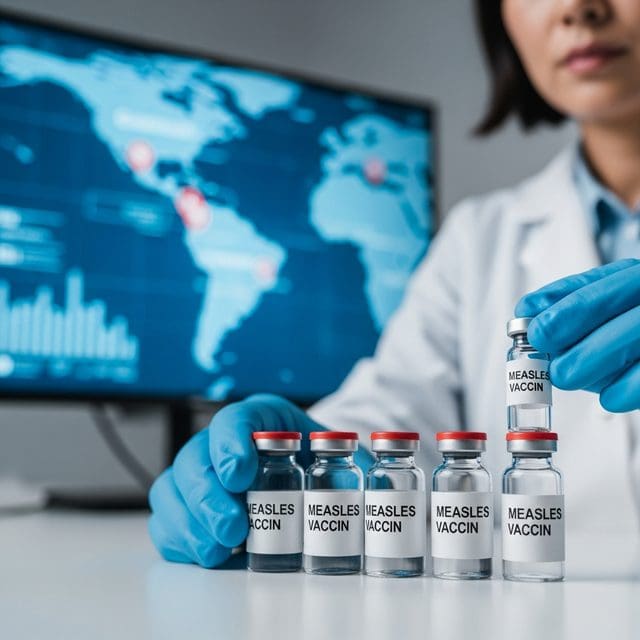
Surging measles cases in the U.S. and Canada prompt a critical look at public health surveillance as the WHO increasingly pivots toward a climate-centric global health agenda.
The resurgence of measles across North America is testing the limits of domestic health surveillance and the efficacy of international coordination. As of August 8, 2026, the CDC confirmed 2,465 measles cases in the United States this year. While South Carolina recently declared its largest outbreak in 35 years over—following a 42-day period without new cases after a peak of nearly 1,000 infections—the broader regional trend remains upward, signaling a persistent vulnerability in the domestic health landscape.
Data from the World Health Organization (WHO) and the Pan American Health Organization (PAHO) indicate a significant spike across the Americas, with 47,459 cases and 45 deaths reported through mid-July. This represents a tripling of last year’s figures, with the majority of fatalities in Guatemala and Mexico. The burden is particularly pronounced in Canada, where 1,107 cases have been confirmed despite a population one-tenth that of the U.S. Having lost its measles elimination status in late 2025, Canada now reports heavy concentrations in Manitoba and Alberta, highlighting the difficulty of regaining ground once public health benchmarks slip.
While North American authorities grapple with these localized outbreaks, the WHO’s African office has intensified its focus on the intersection of climate change and health. A new brief released August 9 emphasizes climate-resilient health systems, framing environmental shifts as the primary threat to low-resource settings. This pivot reflects a broader institutional trend toward development policy that prioritizes climate adaptation over traditional, targeted disease eradication. The WHO underscores that the Americas are seeing their highest measles numbers in two decades, yet institutional energy is increasingly diverted toward climate-centric frameworks like the Harare Declaration.
This divergence in focus raises questions for American taxpayers regarding the allocation of foreign aid. As the WHO urges countries to strengthen rapid outbreak responses, its global strategy appears bifurcated. For domestic observers, the contrast is stark: while international bodies focus on long-term climate modeling in Africa, the immediate challenge of preventable viral transmission is reclaiming territory in the West. Global measles cases reached 186,000 by July, a 12 percent increase over the previous year, suggesting a systemic failure in maintaining basic immunization coverage.
Economic dimensions of global health development continue to evolve toward market-driven models. FinDev Canada recently issued a EUR 40 million loan to NSIA Banque Côte d’Ivoire to bolster financial inclusion, illustrating a preference for private-sector tools over bureaucratic intervention. Similarly, technological innovations like the whole-blood drone delivery program recently enabled by ArcherFRS in Florida demonstrate that localized solutions often provide more immediate utility than expansive global mandates. These advancements offer a blueprint for resilience that relies on innovation rather than international treaty expansion.
As the U.S. navigates political transitions—including the confirmation of Todd Blanche as Attorney General and new executive limits on birthright citizenship—the role of international health bodies remains a point of contention. The current measles data serves as a reminder that robust national surveillance must be balanced against the administrative reach of global institutions. When the WHO frames climate change as the preeminent global health threat, it risks marginalizing the fundamental duty of infectious disease control, leaving sovereign nations to manage the fallout of resurgent pathogens.

Rachel Vaughn serves as a Senior Correspondent for Just Right News, where she leads the network’s coverage of Global Health, Climate, and Development. With a career defined by intellectual rigor and a commitment to principled reporting, Rachel provides a vital conservative perspective on some of the most complex and high-stakes issues facing the world today. Her work is characterized by a refusal to accept bureaucratic narratives at face value, focusing instead on how international policies impact national sovereignty, individual liberty, and the American taxpayer.
Raised in New Haven, Connecticut, Rachel grew up in an environment dominated by elite academic discourse. This upbringing provided her with a front-row seat to the inner workings of the American establishment, but it also instilled in her a healthy skepticism of the “ivory tower” consensus. She learned early on that while academic theories may sound promising in a lecture hall, they often fail to account for the practical realities of the working class. This background drives her to bridge the gap between high-level policy discussions and the common-sense concerns of everyday citizens, ensuring that her reporting remains grounded and accessible.
Now based in Burlington, Vermont, Rachel operates from a unique vantage point within one of the nation’s most progressive political landscapes. Living and working in a region that often serves as a testing ground for radical social and environmental experiments allows her to witness the real-world consequences of these policies firsthand. From her base in the Green Mountain State, she provides Just Right News readers with essential “boots on the ground” reporting, documenting the friction between local mandates and the constitutional freedoms of the individual. Her presence in Burlington ensures that her critiques of globalist agendas are informed by a direct understanding of how those ideologies manifest at the local level.
In her acclaimed feature series, “Planetary Stakes,” Rachel explores the intersection of international development and environmental stewardship. She rejects the alarmism often found in mainstream media, opting instead for a sober analysis of the economic and geopolitical costs of global climate agreements. Her reporting frequently highlights the importance of market-driven innovation and the role of American leadership in fostering global health without ceding authority to unelected international bodies. Through “Planetary Stakes,” she has become a leading voice for those who believe that true conservation and public health are best achieved through transparency, accountability, and the protection of private property rights.
Throughout her tenure at Just Right News, Rachel has distinguished herself as a journalist who is unafraid to ask difficult questions of global institutions. Whether she is investigating the influence of non-governmental organizations on domestic policy or analyzing the fiscal transparency of international health initiatives, her goal remains the same: to provide her audience with the facts necessary to navigate an increasingly interconnected world. Her blend of East Coast intellectual heritage and her current immersion in the political heart of the Northeast makes her an indispensable asset to the newsroom and a trusted source for readers seeking a principled, conservative take on the issues that define our era.