

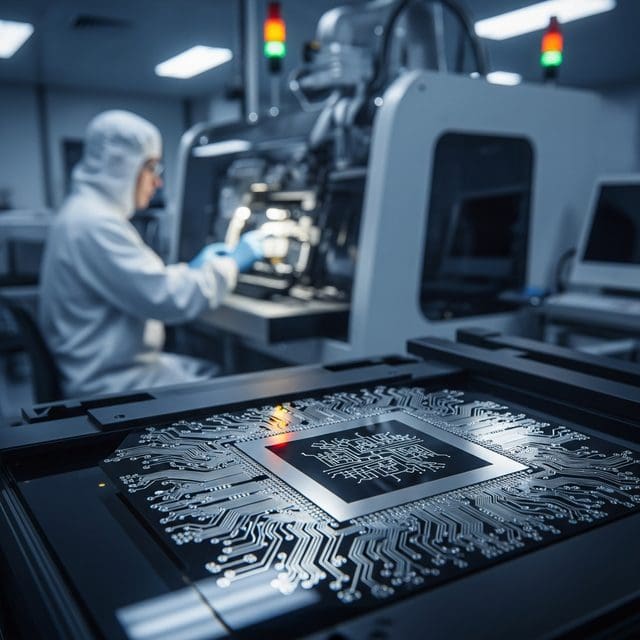
Researchers at Princeton and Brookhaven National Laboratory have shattered coherence records using tantalum on silicon, creating qubits that last fifteen times longer than current industry standards.
The pursuit of a functional, fault-tolerant quantum computer has long been hindered by the fragile nature of qubits, which typically lose their data-carrying state in a fraction of a millisecond. This week, the U.S. Department of Energy’s Co-design Center for Quantum Advantage (C2QA) announced a significant leap forward, reporting that a Princeton-led team has developed superconducting qubits with coherence times exceeding 1.68 milliseconds. This represents a fifteenfold improvement over current industry standards and marks a turning point for American leadership in the global quantum race.
For decades, the industry relied on aluminum circuits atop sapphire or silicon. While functional, these materials are prone to surface defects—often called quantum junk—that disrupt the delicate quantum states required for calculation. In the 1990s, early superconducting qubits could only maintain coherence for a mere 3 nanoseconds. While the industry eventually pushed this into the microsecond range, the “millisecond barrier” remained a formidable wall. The new breakthrough centers on the use of tantalum, a robust superconductor, layered onto high-resistivity silicon. This specific material stack suppresses interface losses and reduces the defective oxide layers that have plagued earlier designs from tech giants like IBM and Google.
This development is not merely a laboratory curiosity; it is a strategic victory for decentralized innovation and domestic manufacturing. By proving that tantalum-on-silicon is compatible with standard semiconductor fabrication workflows, the researchers have provided a roadmap for scaling quantum hardware without abandoning the existing infrastructure of the American electronics industry. The DOE frames this as a materials-first success, moving the conversation from theoretical physics to practical engineering. The team, led by Andrew Houck at Princeton, optimized the tantalum surface processing to ensure that coherence is no longer the dominant bottleneck in the system.
The implications for national sovereignty and data security are substantial. As foreign adversaries like ByteDance pour resources into massive AI models with 10 trillion parameters, the ability to maintain stable quantum states is the primary gatekeeper to achieving quantum advantage. Longer coherence times allow for more complex gate operations, meaning error correction protocols can finally reduce errors faster than they are created—a threshold known as fault tolerance. According to the DOE-supported team, integrating these improved qubits into leading processors could make them run more than 1,000 times better than current iterations.
While some recent findings from Science suggest that classical laptops can still simulate certain quantum problems using advanced tensor-network techniques, the Princeton and Brookhaven achievement addresses the physical hardware limits that classical machines cannot replicate. The classical simulation of many-body problems on a laptop proves that algorithmic efficiency is vital, but it does not replace the need for the raw power of a fault-tolerant quantum processor. By extending the life of a qubit into the millisecond regime, the U.S. research apparatus has moved the goalposts, ensuring that the next generation of computing remains grounded in transparent, high-performance American hardware.
Looking ahead, the C2QA and the Superconducting Quantum Materials and Systems Center, which involve 28 institutions, will continue to refine this tantalum-silicon stack. The goal is to move beyond the single-chip demonstration to full-scale integration. Because the design is drop-in compatible with existing superconducting transmon processors, major vendors could theoretically swap these materials into their 1,000-qubit machines to achieve reliability gains of up to a billion-fold in effective performance. This transition from fragile experimental setups to robust, silicon-compatible hardware signals that the era of practical quantum utility is closer than previously estimated, secured by American materials science.

Mason Reed serves as a Staff Writer for Just Right News, where he spearheads the Future Frontiers & Special Projects desk. In an era defined by rapid technological shifts and evolving social landscapes, Mason provides a steady, principled voice, examining the innovations of tomorrow through the lens of traditional American values. His work is most prominently featured in his signature series, “The Next Horizon,” where he explores the intersection of emerging technology, national sovereignty, and the preservation of individual liberty.
A native of San Diego, California, Mason’s worldview was shaped by the unique culture of his hometown. Growing up in a region defined by its strong military presence and its history of maritime industry, he developed a deep-seated respect for the institutions that provide national stability and the entrepreneurial spirit that drives the American economy. This upbringing instilled in him a belief that true progress is not found in discarding the past, but in building upon a foundation of proven principles. His reporting often reflects this San Diego influence, emphasizing the importance of a robust national defense and the necessity of maintaining a competitive edge in the global marketplace.
Now based in San Francisco, Mason operates from the heart of the world’s technological engine. Living and working in the Bay Area provides him with a front-row seat to the advancements—and the ideological challenges—emanating from Silicon Valley. While many in the region embrace a “move fast and break things” mentality, Mason’s reporting serves as a vital counterweight. He offers Just Right News readers a “boots on the ground” perspective, documenting how radical local policies and the concentration of tech power impact the everyday lives of citizens. His proximity to the industry allows him to cut through the marketing jargon of big tech to uncover the real-world implications for privacy, free speech, and the nuclear family.
In his “Future Frontiers” beat, Mason tackles complex subjects ranging from the ethics of artificial intelligence to the burgeoning private space race. He approaches these topics with a healthy skepticism toward centralized bureaucracy, championing instead the decentralized innovations that empower individuals. Through “The Next Horizon,” he highlights the pioneers and thinkers who are working to ensure that the future remains a place where human dignity and constitutional rights are protected. He believes that the rapid pace of change requires more than just technical expertise; it requires a moral compass rooted in the Western tradition.
Throughout his tenure at Just Right News, Mason has remained committed to the idea that the future is something to be shaped, not merely accepted. His writing is characterized by a rigorous defense of American exceptionalism and a belief that the country’s best days lie ahead, provided it remains true to its founding ideals. Whether he is investigating the impact of automation on the American workforce or profiling the next generation of aerospace engineers, Mason Reed ensures that his readers are equipped with the insights they need to navigate a changing world with confidence and clarity.