

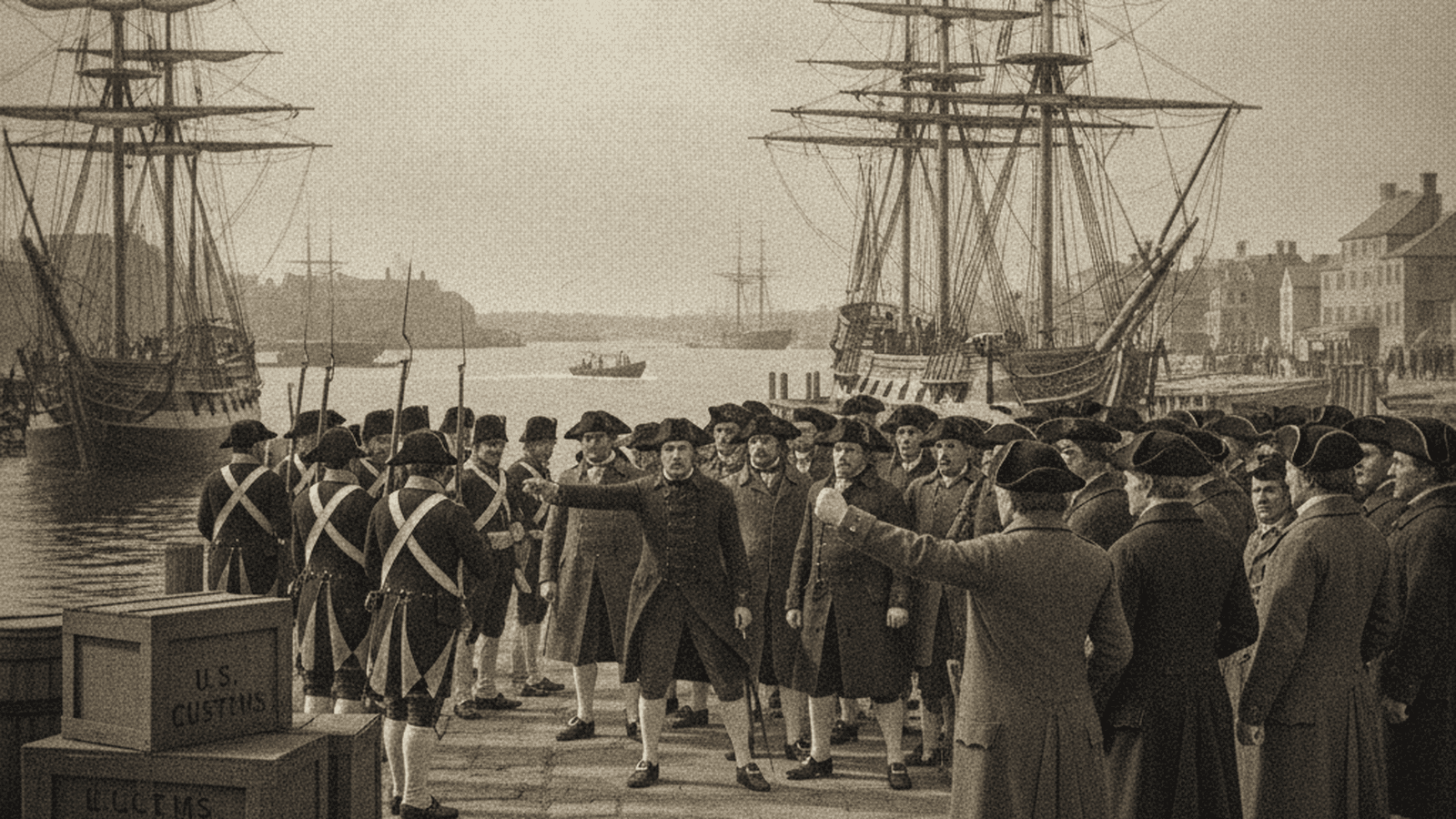
In 1808, President Thomas Jefferson’s administration faced a constitutional crisis as New England states resisted the federal enforcement of the Embargo Act. The conflict tested the limits of executive power in the United States and highlighted the tension between federal trade policy and regional economic interests.
TLDR: The 1808 Embargo Act enforcement crisis saw President Jefferson use federal military power to suppress New England trade, sparking a constitutional showdown over executive authority. The resistance from state legislatures and local officials forced a reevaluation of federal reach, eventually leading to the act’s repeal in 1809.
In the final years of Thomas Jefferson’s presidency, the United States faced a profound test of executive authority that threatened to fracture the young republic. The Embargo Act of 1807, originally intended as a peaceful alternative to war during the Napoleonic conflict, prohibited all American exports to foreign ports. By 1808, this foreign policy tool had transformed into a domestic enforcement crisis. In New England, where the economy was inextricably linked to maritime trade, the federal government’s efforts to stifle commerce met with fierce and organized resistance.
Jefferson, a man who had built his political career on the principles of limited federal government and strict constructionism, found himself wielding expansive executive power to ensure compliance. As smuggling became rampant along the rugged coastlines of Massachusetts, Connecticut, and Rhode Island, the administration pushed for increasingly draconian enforcement measures. The climax of this legislative expansion was the Enforcement Act of early 1809, often referred to as Giles’s Bill. This legislation granted federal customs collectors the unprecedented power to seize goods without warrants based on the mere suspicion that a merchant intended to evade the embargo. It effectively shifted the burden of proof onto the citizen, a move that many viewed as a direct violation of the Fourth Amendment.
The deployment of the United States Navy and federal marshals to patrol domestic waters and ports sparked outrage across the Northeast. In port towns like Gloucester, Salem, and Bath, local officials and citizens openly defied federal agents. The tension escalated significantly when Jefferson requested the authority to use the regular army to enforce civil laws. To the people of New England, this was not merely a trade dispute; it was the emergence of a military despotism. The sight of federal troops patrolling American streets to prevent Americans from trading was a bitter irony for a generation that remembered the British occupation of Boston.
State legislatures became the primary venues for constitutional pushback. The Connecticut General Assembly passed defiant resolutions declaring the enforcement acts unconstitutional and instructed state officials to refuse assistance to federal agents. In Massachusetts, the legislature invoked the spirit of the American Revolution, suggesting that the federal government had exceeded its delegated powers and that the states had a duty to interpose. This period saw the rise of “town meeting” protests, where citizens drafted petitions comparing Jefferson to King George III. The Federalist Party, nearly dormant after the election of 1800, found new life as the champion of regional interests and civil liberties.
The crisis reached a boiling point during the winter of 1808-1809. Reports of violent skirmishes between federal troops and local “insurgents” in the Champlain Valley and along the Maine coast flooded Washington. In some instances, local juries refused to convict smugglers, effectively nullifying federal law at the local level. Jefferson’s own Democratic-Republican party began to splinter as the political and social costs of the embargo became unbearable. The President eventually realized that the domestic cost—both economic and constitutional—far outweighed any potential diplomatic leverage against Britain or France.
Just days before James Madison’s inauguration in March 1809, Jefferson signed the repeal of the Embargo Act, replacing it with the less restrictive Non-Intercourse Act. The episode left a lasting mark on the American political landscape, serving as an early and potent warning of the dangers of executive overreach. It prompted later legal and political reforms regarding the use of the military in domestic law enforcement and solidified the role of the states as a critical check on federal power. The legacy of the 1808 crisis continues to inform modern debates over the balance between national security, executive prerogative, and individual liberties.

Miles Harrington serves as the Senior Correspondent for Federal Systems & Executive Power at Just Right News, where he brings a disciplined, constitutionalist lens to the inner workings of the American government. With a focus on the mechanics of the federal bureaucracy and the limits of executive authority, Harrington has established himself as a vital voice for readers who value transparency, accountability, and the preservation of the separation of powers.
A native of Richmond, Virginia, Harrington’s perspective is deeply rooted in the traditions of the Old Dominion. Growing up in a city defined by its historical significance and its role as a center of American jurisprudence, he developed an early appreciation for the foundational principles of the Republic. His upbringing in Richmond—a place where the legacy of the Founding Fathers is woven into the landscape—instilled in him a belief that the federal government should remain within its constitutional bounds. This background informs his skepticism of centralized overreach and his commitment to reporting on the ways in which the administrative state impacts the lives of everyday citizens.
In his current role, Harrington specializes in the complexities of federal systems. He doesn’t just report on the headlines of the day; he digs into the structural shifts within the executive branch that often go unnoticed by the mainstream press. Whether he is analyzing the implications of a new federal regulation or investigating the expansion of agency jurisdiction, his work is characterized by a rigorous adherence to the facts and a dedication to the rule of law.
Harrington is perhaps best known for his signature feature series, “How Washington Works.” Through this ongoing project, he demystifies the often-opaque processes of the nation’s capital, pulling back the curtain on the “Deep State” and the unelected officials who wield significant influence over national policy. By breaking down complex legislative maneuvers and executive orders, he empowers Just Right News readers to understand the true levers of power in Washington. His reporting serves as a necessary check on the federal government, ensuring that the actions of those in power are held up to the light of public scrutiny.
Now based in Washington, D.C., Harrington operates at the epicenter of the political world, yet he remains intentionally distanced from the “Beltway bubble.” His proximity to the halls of power allows him to maintain a robust network of sources across the federal landscape, but his heart remains in the principled conservatism of his Virginia roots. He views his role not merely as a reporter, but as a steward of the public trust, dedicated to providing the clarity and context that conservative voters need to navigate an increasingly complex political environment.
Through his sharp analysis and unwavering commitment to the truth, Miles Harrington continues to be a cornerstone of the Just Right News team. His work ensures that the principles of limited government and executive restraint remain at the forefront of the national conversation, providing a crucial service to those who believe in a government that is truly of, by, and for the people.