

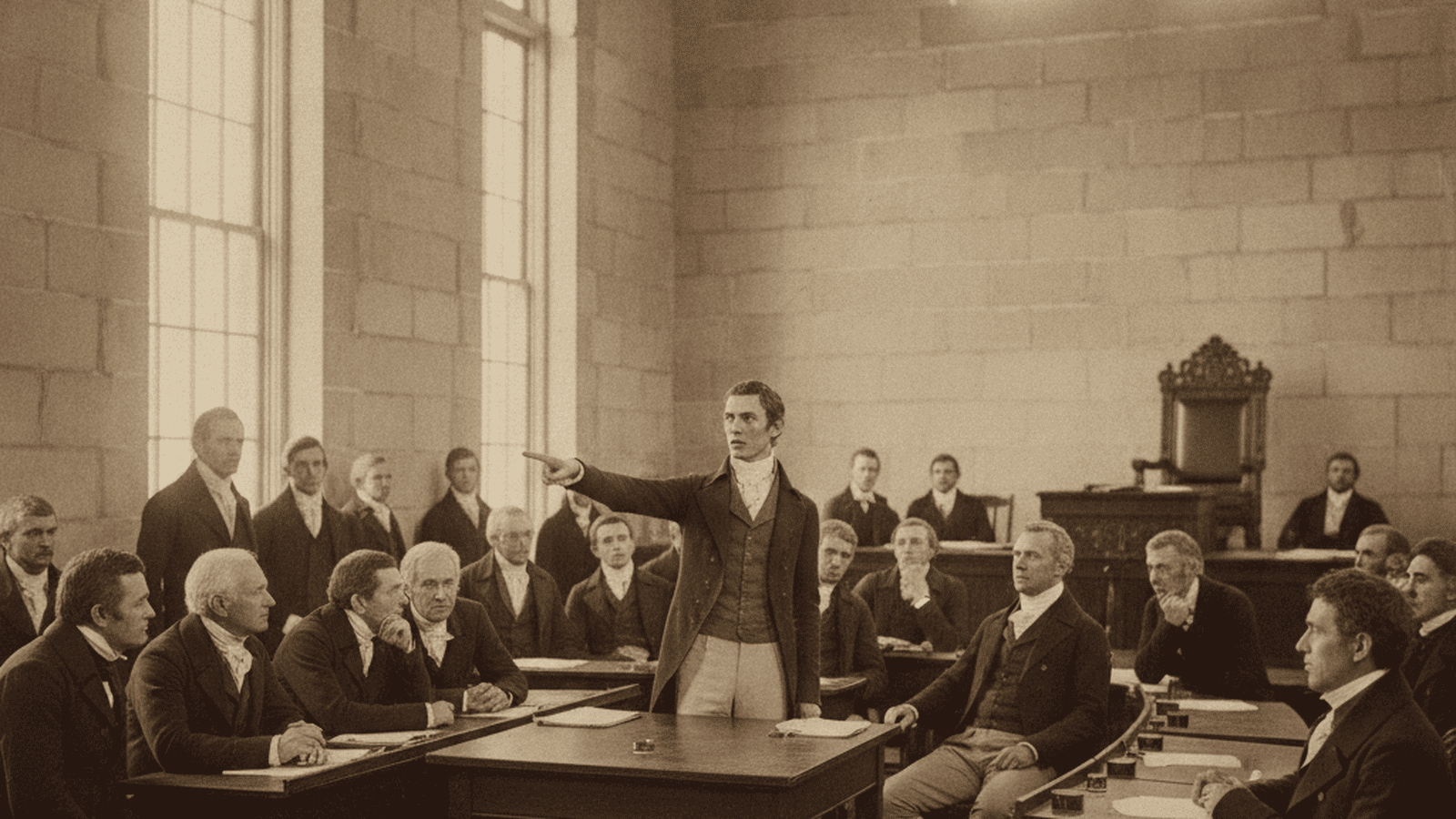
In 1806, a faction of Democratic-Republicans known as the Tertium Quids broke away from President Thomas Jefferson’s administration under the leadership of John Randolph of Roanoke. This internal realignment within the United States political landscape challenged the executive branch’s pragmatism and defended strict constructionist principles.
TLDR: Led by John Randolph of Roanoke, the Tertium Quids emerged in 1806 as a third faction within the United States Democratic-Republican Party. Opposing President Jefferson’s expansion of executive power and the Yazoo land compromise, this group reshaped parliamentary dynamics by championing rigid states’ rights and fiscal conservatism.
The year 1806 marked a significant shift in the internal dynamics of the United States government as the Democratic-Republican Party experienced its first major internal fracture. John Randolph of Roanoke, a brilliant but volatile Virginian who served as the Chairman of the House Ways and Means Committee, spearheaded a movement that came to be known as the Tertium Quids. This “third something” represented a parliamentary realignment that pitted “Old Republican” purists against the increasingly pragmatic policies of President Thomas Jefferson’s administration.
The primary catalyst for the schism was the Yazoo land scandal, a massive fraudulent land sale in Georgia that the federal government sought to settle through compromise. Randolph viewed any federal intervention or compensation for the fraudulent claims as a violation of moral principle and a betrayal of states’ rights. He believed that the federal government had no constitutional authority to resolve a state-level corruption issue with national funds. He further broke with the administration over the secret “Two Million Dollar Bill,” which Jefferson requested to facilitate the purchase of Florida from Spain. Randolph denounced the request as an executive overreach and an attempt to bribe foreign powers, leading to a public and permanent break with his former allies.
Randolph’s defiance transformed the Ninth Congress into a battleground of ideological purity. As the leader of the Quids, he utilized his mastery of parliamentary procedure and his sharp, often insulting oratory to obstruct administration goals. This realignment meant that the Jeffersonian majority could no longer count on a unified front. Instead, the administration was forced to build shifting coalitions with more moderate Republicans and even occasional Federalists to pass essential legislation. The Quids effectively acted as a third party within the legislature, holding the balance of power on several key votes.
The Quids championed a philosophy of strict constructionism, arguing that the federal government should be strictly limited to the powers explicitly granted by the Constitution. They viewed the administration’s willingness to use executive influence and federal funds for territorial expansion as a drift toward the very “monarchical” tendencies they had fought against in the 1790s. While the Quids were concentrated in the South, particularly Virginia, their influence resonated with those who feared the centralization of power in Washington. They argued that the “Revolution of 1800” was being undone by the very men who had led it.
Despite Randolph’s charisma, the Tertium Quids struggled to expand their influence beyond a dedicated core of followers. The faction lacked a formal party structure and was often seen as a vehicle for Randolph’s personal grievances and eccentricities. By the election of 1808, the movement attempted to run James Monroe for the presidency against Jefferson’s handpicked successor, James Madison. They hoped to capitalize on dissatisfaction with the Embargo Act, but the effort failed to gain traction outside of Virginia. The failure of this bid signaled the decline of the Quids as a potent parliamentary force, as the majority of the party rallied behind Madison.
The legacy of the Tertium Quid realignment established a recurring pattern in United States political history where ideological factions within a dominant party challenge the executive branch. This internal dissent forced later administrations to consider the limits of executive power and the importance of maintaining party discipline. The movement also foreshadowed the sectional and constitutional debates that would eventually lead to the realignment of the American party system in the mid-nineteenth century. Subsequent legislative reforms regarding land claims and executive transparency can be traced back to the scrutiny initiated by Randolph’s faction, ensuring that the principles of the early republic remained a central part of the national dialogue.

Miles Harrington serves as the Senior Correspondent for Federal Systems & Executive Power at Just Right News, where he brings a disciplined, constitutionalist lens to the inner workings of the American government. With a focus on the mechanics of the federal bureaucracy and the limits of executive authority, Harrington has established himself as a vital voice for readers who value transparency, accountability, and the preservation of the separation of powers.
A native of Richmond, Virginia, Harrington’s perspective is deeply rooted in the traditions of the Old Dominion. Growing up in a city defined by its historical significance and its role as a center of American jurisprudence, he developed an early appreciation for the foundational principles of the Republic. His upbringing in Richmond—a place where the legacy of the Founding Fathers is woven into the landscape—instilled in him a belief that the federal government should remain within its constitutional bounds. This background informs his skepticism of centralized overreach and his commitment to reporting on the ways in which the administrative state impacts the lives of everyday citizens.
In his current role, Harrington specializes in the complexities of federal systems. He doesn’t just report on the headlines of the day; he digs into the structural shifts within the executive branch that often go unnoticed by the mainstream press. Whether he is analyzing the implications of a new federal regulation or investigating the expansion of agency jurisdiction, his work is characterized by a rigorous adherence to the facts and a dedication to the rule of law.
Harrington is perhaps best known for his signature feature series, “How Washington Works.” Through this ongoing project, he demystifies the often-opaque processes of the nation’s capital, pulling back the curtain on the “Deep State” and the unelected officials who wield significant influence over national policy. By breaking down complex legislative maneuvers and executive orders, he empowers Just Right News readers to understand the true levers of power in Washington. His reporting serves as a necessary check on the federal government, ensuring that the actions of those in power are held up to the light of public scrutiny.
Now based in Washington, D.C., Harrington operates at the epicenter of the political world, yet he remains intentionally distanced from the “Beltway bubble.” His proximity to the halls of power allows him to maintain a robust network of sources across the federal landscape, but his heart remains in the principled conservatism of his Virginia roots. He views his role not merely as a reporter, but as a steward of the public trust, dedicated to providing the clarity and context that conservative voters need to navigate an increasingly complex political environment.
Through his sharp analysis and unwavering commitment to the truth, Miles Harrington continues to be a cornerstone of the Just Right News team. His work ensures that the principles of limited government and executive restraint remain at the forefront of the national conversation, providing a crucial service to those who believe in a government that is truly of, by, and for the people.