

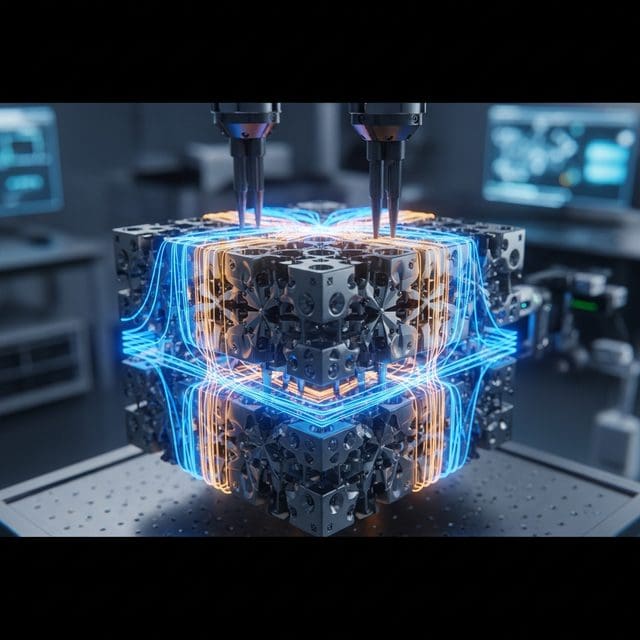
Recent discoveries in magnetic tuning and subatomic gluon behavior are paving the way for room-temperature quantum devices and more efficient domestic semiconductor architectures.
The landscape of condensed matter physics underwent a significant shift this week as researchers at Rice University demonstrated a sophisticated new method to control electron flow using altermagnetism. Recently recognized as a third fundamental class of magnetism, altermagnetism offers a distinct advantage over traditional ferromagnets. By applying uniaxial strain to hexagonal manganese telluride, the team found they could tune the anomalous Hall effect, creating a mechanical knob for spin-transport applications. This discovery is particularly relevant for the development of next-generation computer memory, as the study revealed that a mere one percent of strain is equivalent to a temperature change of 150 Kelvin.
In the global race for technological sovereignty, the ability to manipulate electron spin with minimal energy could lead to a new generation of non-volatile memory devices that do not rely on the volatile power cycles of current silicon-based architecture. The Rice University team demonstrated they could reverse electron-flow polarity in the Hall signal at approximately 230 Kelvin. This level of control suggests that altermagnets could serve as the bedrock for stable, high-speed hardware that remains resilient under varying physical conditions, a vital requirement for both industrial and defense-related computing.
Parallel to these developments in materials science, the subatomic world is becoming clearer through new measurements at CERN. A study involving University of Kansas physicists has successfully distinguished between two rival theories regarding gluon behavior inside atomic nuclei. Gluons, the particles responsible for the strong nuclear force, have long remained elusive in their collective dynamics. By smashing atomic nuclei together at nearly the speed of light, researchers created the hottest fluid in the universe, allowing them to observe the hidden forces driving these particles. This experimental milestone provides a more accurate map of the internal structure of the atom, grounding theoretical particle physics in observable reality.
Further breakthroughs in quantum optics suggest that the requirement for extreme cooling may soon be a thing of the past. Researchers at Louisiana State University reported a gold metacrystal capable of sorting and transporting quantum states of light at room temperature. This is the first room-temperature quantum material intrinsically sensitive to many-body quantum coherence. If scalable, this technology could remove the need for the energy-intensive cryogenic refrigeration systems that currently house quantum processors. Similarly, UCLA researchers have shown that phonons in boron arsenide can carry heat in focused, ray-like paths at room temperature, allowing for the precise routing of heat away from sensitive chip regions.
As these experimental successes mount, the industry is also facing a necessary period of self-reflection regarding quantum advantage. A recent assessment published via Phys.org calls for more realistic benchmarks for quantum algorithms, noting that practical quantum advantage remains undemonstrated for many common applications. While the theoretical potential for quantum computers to outperform classical machines remains high, experts warn that the field must move beyond narrow, laboratory-specific tasks. For the American innovator, these findings suggest that while the future is undeniably quantum, the path forward requires rigorous verification and a focus on materials like altermagnets and magnons that function in the real world.
The demonstration of spontaneous magnons synchronizing with external signals at room temperature, as reported by an Argonne-UIUC group, further reinforces this shift toward practical application. These magnetic disturbances could serve as efficient information carriers, potentially replacing traditional electronic currents in signal-processing tasks. By integrating these effects at the quantum limit, scientists are moving closer to a decentralized innovation model where high-performance computing is no longer tethered to a centralized, liquid-helium-cooled bureaucracy, but is instead accessible through robust, room-temperature hardware.

Mason Reed serves as a Staff Writer for Just Right News, where he spearheads the Future Frontiers & Special Projects desk. In an era defined by rapid technological shifts and evolving social landscapes, Mason provides a steady, principled voice, examining the innovations of tomorrow through the lens of traditional American values. His work is most prominently featured in his signature series, “The Next Horizon,” where he explores the intersection of emerging technology, national sovereignty, and the preservation of individual liberty.
A native of San Diego, California, Mason’s worldview was shaped by the unique culture of his hometown. Growing up in a region defined by its strong military presence and its history of maritime industry, he developed a deep-seated respect for the institutions that provide national stability and the entrepreneurial spirit that drives the American economy. This upbringing instilled in him a belief that true progress is not found in discarding the past, but in building upon a foundation of proven principles. His reporting often reflects this San Diego influence, emphasizing the importance of a robust national defense and the necessity of maintaining a competitive edge in the global marketplace.
Now based in San Francisco, Mason operates from the heart of the world’s technological engine. Living and working in the Bay Area provides him with a front-row seat to the advancements—and the ideological challenges—emanating from Silicon Valley. While many in the region embrace a “move fast and break things” mentality, Mason’s reporting serves as a vital counterweight. He offers Just Right News readers a “boots on the ground” perspective, documenting how radical local policies and the concentration of tech power impact the everyday lives of citizens. His proximity to the industry allows him to cut through the marketing jargon of big tech to uncover the real-world implications for privacy, free speech, and the nuclear family.
In his “Future Frontiers” beat, Mason tackles complex subjects ranging from the ethics of artificial intelligence to the burgeoning private space race. He approaches these topics with a healthy skepticism toward centralized bureaucracy, championing instead the decentralized innovations that empower individuals. Through “The Next Horizon,” he highlights the pioneers and thinkers who are working to ensure that the future remains a place where human dignity and constitutional rights are protected. He believes that the rapid pace of change requires more than just technical expertise; it requires a moral compass rooted in the Western tradition.
Throughout his tenure at Just Right News, Mason has remained committed to the idea that the future is something to be shaped, not merely accepted. His writing is characterized by a rigorous defense of American exceptionalism and a belief that the country’s best days lie ahead, provided it remains true to its founding ideals. Whether he is investigating the impact of automation on the American workforce or profiling the next generation of aerospace engineers, Mason Reed ensures that his readers are equipped with the insights they need to navigate a changing world with confidence and clarity.