

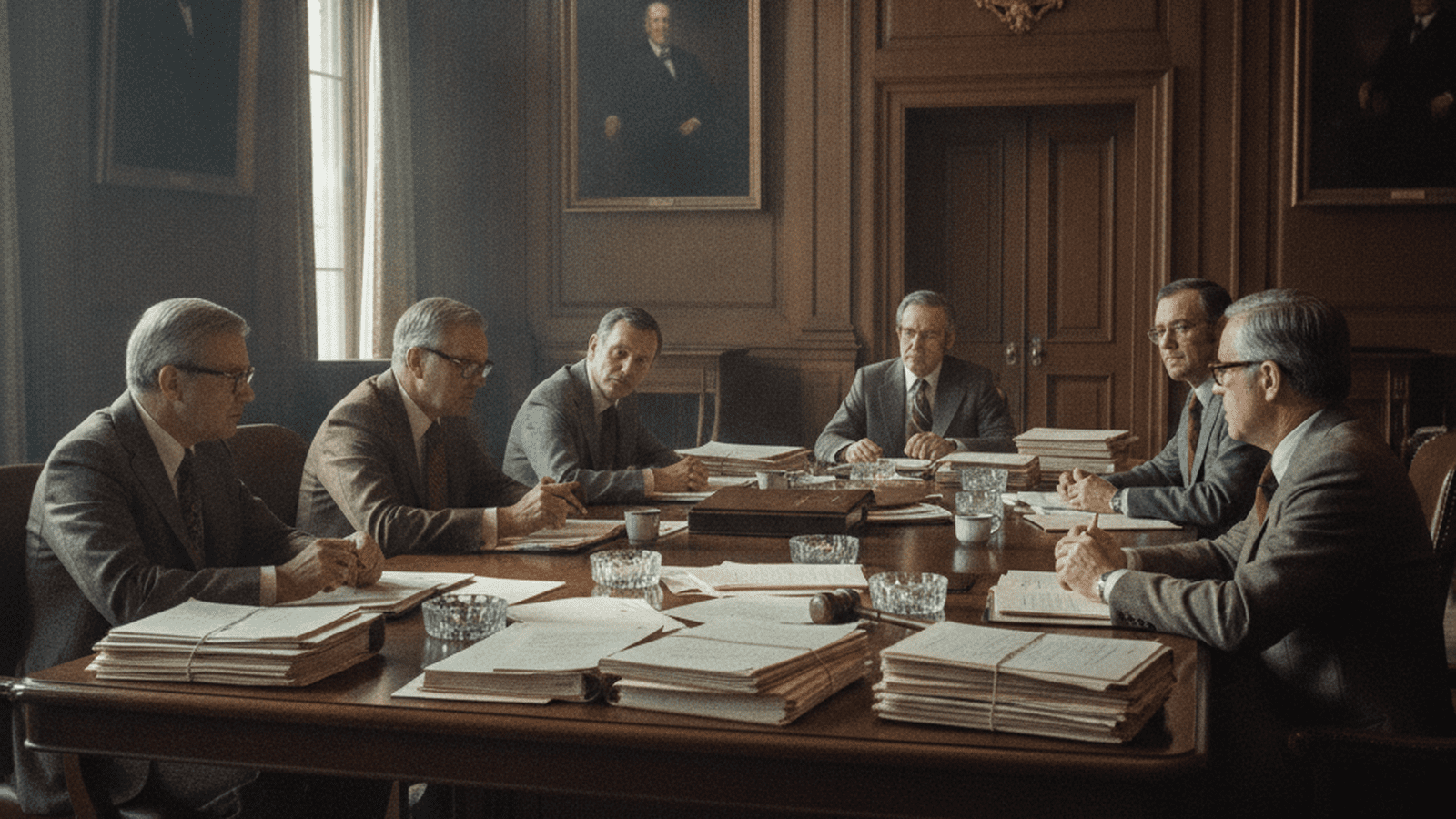
The 1970 Legislative Reorganization Act overhauled the internal procedures of the United States Congress to increase transparency and weaken the seniority system. By introducing recorded teller votes and opening committee hearings, the law shifted power away from entrenched committee chairmen.
TLDR: In 1970, the United States passed the Legislative Reorganization Act, a landmark reform that ended anonymous voting on amendments and weakened the absolute power of committee chairs. This parliamentary realignment increased transparency and accountability, fundamentally changing how federal legislation is debated and passed in Washington, D.C.
The 1970 Legislative Reorganization Act arrived at a moment of intense institutional friction within the United States government. Since the previous major overhaul in 1946, the internal mechanics of Congress had become increasingly rigid, favoring a small cadre of senior members. These individuals, often referred to as the “Old Guard,” leveraged the seniority system to maintain control over the most influential committees. Because committee chairs were appointed solely based on their length of service, they were effectively immune to the will of the party leadership or the broader membership. This structure allowed a minority of conservative members to stall or kill legislation that had broad public support, particularly regarding civil rights and environmental protections.
One of the most controversial tools of this era was the “unrecorded teller vote.” During the amendment process in the House of Representatives, members would walk down the center aisle to be counted by tellers as either for or against a proposal. However, their individual names were never recorded in the official record. This lack of transparency allowed representatives to vote for popular bills on final passage while secretly supporting amendments that rendered those same bills toothless. This practice shielded politicians from accountability and allowed special interests to exert significant influence behind closed doors.
The push for reform was driven by a bipartisan coalition of younger members who felt stifled by the existing hierarchy. Representatives like Richard Bolling and Barber Conable argued that the lack of transparency was eroding public trust in the United States legislative process. They sought a parliamentary realignment that would democratize the institution. The resulting Legislative Reorganization Act of 1970, signed into law by President Richard Nixon, introduced several transformative changes. Most notably, it mandated that teller votes be recorded upon the request of a small number of members, effectively ending the era of anonymous amendment voting.
Beyond voting procedures, the Act mandated that committee hearings and business meetings be open to the public unless a majority of the committee voted in a public session to close them. It also required that committee reports be made available to the public at least three days before a bill was considered on the floor. To further professionalize the branch, the law significantly increased the number of staff members assigned to committees and created the Congressional Research Service from the former Legislative Reference Service. These changes were designed to give Congress the analytical tools necessary to compete with the growing expertise of the executive branch.
The immediate impact of the 1970 Act was a surge in member participation and a shift in the balance of power. With their votes now public, members were forced to align their actions with their public rhetoric. The decentralization of power continued throughout the 1970s, leading to the Subcommittee Bill of Rights in 1973, which further stripped committee chairs of their unilateral authority. These reforms ensured that power was distributed more broadly among subcommittees, allowing for a more diverse range of voices to influence federal policy.
In the long term, the 1970 Legislative Reorganization Act set the stage for the modern era of congressional oversight and transparency. While some critics argue that the decentralization of power contributed to increased partisanship and legislative gridlock, the reforms successfully ended the autocratic rule of committee chairs. The shift toward recorded votes and open meetings remains a cornerstone of the United States democratic process, ensuring that the actions of elected officials are visible to the citizenry they represent. This parliamentary realignment remains one of the most significant internal transformations in the history of the American legislature.

Miles Harrington serves as the Senior Correspondent for Federal Systems & Executive Power at Just Right News, where he brings a disciplined, constitutionalist lens to the inner workings of the American government. With a focus on the mechanics of the federal bureaucracy and the limits of executive authority, Harrington has established himself as a vital voice for readers who value transparency, accountability, and the preservation of the separation of powers.
A native of Richmond, Virginia, Harrington’s perspective is deeply rooted in the traditions of the Old Dominion. Growing up in a city defined by its historical significance and its role as a center of American jurisprudence, he developed an early appreciation for the foundational principles of the Republic. His upbringing in Richmond—a place where the legacy of the Founding Fathers is woven into the landscape—instilled in him a belief that the federal government should remain within its constitutional bounds. This background informs his skepticism of centralized overreach and his commitment to reporting on the ways in which the administrative state impacts the lives of everyday citizens.
In his current role, Harrington specializes in the complexities of federal systems. He doesn’t just report on the headlines of the day; he digs into the structural shifts within the executive branch that often go unnoticed by the mainstream press. Whether he is analyzing the implications of a new federal regulation or investigating the expansion of agency jurisdiction, his work is characterized by a rigorous adherence to the facts and a dedication to the rule of law.
Harrington is perhaps best known for his signature feature series, “How Washington Works.” Through this ongoing project, he demystifies the often-opaque processes of the nation’s capital, pulling back the curtain on the “Deep State” and the unelected officials who wield significant influence over national policy. By breaking down complex legislative maneuvers and executive orders, he empowers Just Right News readers to understand the true levers of power in Washington. His reporting serves as a necessary check on the federal government, ensuring that the actions of those in power are held up to the light of public scrutiny.
Now based in Washington, D.C., Harrington operates at the epicenter of the political world, yet he remains intentionally distanced from the “Beltway bubble.” His proximity to the halls of power allows him to maintain a robust network of sources across the federal landscape, but his heart remains in the principled conservatism of his Virginia roots. He views his role not merely as a reporter, but as a steward of the public trust, dedicated to providing the clarity and context that conservative voters need to navigate an increasingly complex political environment.
Through his sharp analysis and unwavering commitment to the truth, Miles Harrington continues to be a cornerstone of the Just Right News team. His work ensures that the principles of limited government and executive restraint remain at the forefront of the national conversation, providing a crucial service to those who believe in a government that is truly of, by, and for the people.