

Recent discoveries by American and Chinese researchers have shattered records in quantum computing coherence and confirmed the existence of a long-sought particle made of pure force.
The landscape of modern physics shifted this week as two major international milestones were reached, signaling a new era for both quantum computing and our fundamental understanding of matter. From the laboratories of Princeton to the high-energy colliders in Beijing, researchers are finally providing experimental proof for theories that have remained elusive for half a century. These developments arrive at a critical juncture for national sovereignty in the technological frontier, as the race to master the subatomic world defines the next generation of innovation.
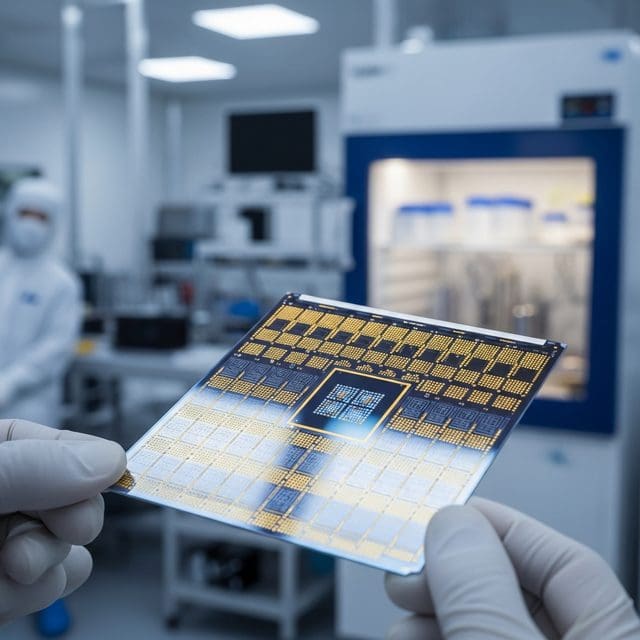
At the forefront of the quantum race, scientists from Princeton University and Brookhaven National Laboratory announced a breakthrough in superconducting qubits. By utilizing optimized tantalum surface processing on silicon substrates, the team developed a quantum computing chip with coherence times reaching 1.68 milliseconds. This represents a nearly 15-fold improvement over current industry standards. In a field where the fragility of quantum information is the primary barrier to progress, extending the life of a qubit—the basic unit of quantum information—is essential for building machines capable of solving real-world problems. The work builds on macroscopic quantum behavior first demonstrated in the mid-1980s, finally reaching a scale that researchers describe as large enough to physically manipulate.
This achievement, supported by the Department of Energy’s Co-design Center for Quantum Advantage (C2QA), moves quantum technology out of the realm of fragile lab curiosities and closer to a reliable infrastructure. By reducing energy leakage at the material level through a sapphire-to-silicon swap rather than just tweaking circuit geometry, the researchers have provided a scalable roadmap for the next generation of processors. This focus on materials engineering reflects a principled approach to innovation, ensuring that the foundations of future American computing power are built on durable, high-performance hardware that can withstand the noise of the real world.
Simultaneously, the world of particle physics celebrated the conclusion of a 15-year search. The BESIII international collaboration, led by the Chinese Academy of Sciences and the Institute of High Energy Physics (IHEP), reported the first experimental certification of the ‘glueball.’ Predicted by the Standard Model nearly 50 years ago, a glueball is a unique form of matter composed entirely of gluons—the particles responsible for the strong nuclear force. Unlike ordinary matter, which is built from quarks, the glueball X(2370) is a flavor-singlet particle, meaning it carries no quark identity. It is, in essence, matter made of pure force.
This discovery, drawn from an analysis of over 10 billion J/ψ events at the Beijing Electron Positron Collider II, confirms that force carriers can indeed bind together to form stable matter. The researchers identified multiple new decay modes of X(2370), providing the clearest experimental result in the search for glueballs over nearly five decades. It provides a stringent test of Quantum Chromodynamics (QCD) and fills a significant gap in the map of the subatomic world. While the discovery originated in China, it serves as a global benchmark for hadron spectroscopy and the limits of the Standard Model, signaling that the era of theoretical speculation is giving way to hard experimental reality.
These dual advancements underscore a pivotal moment for the scientific community. As American labs push the boundaries of quantum error correction and international teams solve decades-old puzzles of the universe, the race for scientific leadership continues to intensify. The ability to stabilize the quantum world and decode the building blocks of reality will define the geopolitical and economic landscape of the coming decade. For those who value decentralized innovation and national excellence, these breakthroughs represent more than just academic success; they are the building blocks of a future where American ingenuity leads the way in a complex, high-tech world.

Mason Reed serves as a Staff Writer for Just Right News, where he spearheads the Future Frontiers & Special Projects desk. In an era defined by rapid technological shifts and evolving social landscapes, Mason provides a steady, principled voice, examining the innovations of tomorrow through the lens of traditional American values. His work is most prominently featured in his signature series, “The Next Horizon,” where he explores the intersection of emerging technology, national sovereignty, and the preservation of individual liberty.
A native of San Diego, California, Mason’s worldview was shaped by the unique culture of his hometown. Growing up in a region defined by its strong military presence and its history of maritime industry, he developed a deep-seated respect for the institutions that provide national stability and the entrepreneurial spirit that drives the American economy. This upbringing instilled in him a belief that true progress is not found in discarding the past, but in building upon a foundation of proven principles. His reporting often reflects this San Diego influence, emphasizing the importance of a robust national defense and the necessity of maintaining a competitive edge in the global marketplace.
Now based in San Francisco, Mason operates from the heart of the world’s technological engine. Living and working in the Bay Area provides him with a front-row seat to the advancements—and the ideological challenges—emanating from Silicon Valley. While many in the region embrace a “move fast and break things” mentality, Mason’s reporting serves as a vital counterweight. He offers Just Right News readers a “boots on the ground” perspective, documenting how radical local policies and the concentration of tech power impact the everyday lives of citizens. His proximity to the industry allows him to cut through the marketing jargon of big tech to uncover the real-world implications for privacy, free speech, and the nuclear family.
In his “Future Frontiers” beat, Mason tackles complex subjects ranging from the ethics of artificial intelligence to the burgeoning private space race. He approaches these topics with a healthy skepticism toward centralized bureaucracy, championing instead the decentralized innovations that empower individuals. Through “The Next Horizon,” he highlights the pioneers and thinkers who are working to ensure that the future remains a place where human dignity and constitutional rights are protected. He believes that the rapid pace of change requires more than just technical expertise; it requires a moral compass rooted in the Western tradition.
Throughout his tenure at Just Right News, Mason has remained committed to the idea that the future is something to be shaped, not merely accepted. His writing is characterized by a rigorous defense of American exceptionalism and a belief that the country’s best days lie ahead, provided it remains true to its founding ideals. Whether he is investigating the impact of automation on the American workforce or profiling the next generation of aerospace engineers, Mason Reed ensures that his readers are equipped with the insights they need to navigate a changing world with confidence and clarity.