

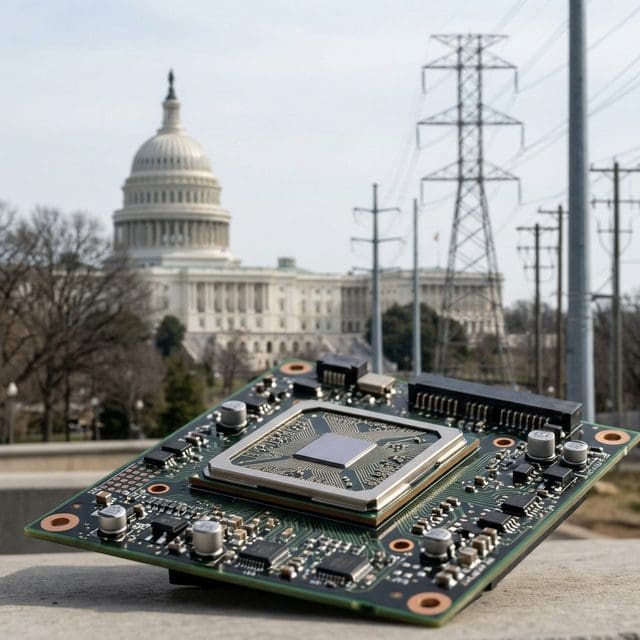
Nvidia’s board is investigating a reported foreign-intelligence risk as lawmakers press for tighter chip controls, while a Senate energy bill would make large data centers pay for added power infrastructure.
Nvidia’s board has opened an independent investigation into whether CEO Jensen Huang was targeted by a foreign-intelligence operation, intensifying pressure on the company as Congress weighs new restrictions on advanced artificial-intelligence chips. The central policy question is whether the episode will prompt changes to who controls exports and how they are enforced.
Reuters reported Wednesday that Nvidia’s independent directors hired outside counsel to conduct the inquiry. The company said the board has found no reason to believe national security or company secrets were compromised. President Donald Trump said the FBI was “looking into it in terms of something else,” according to POLITICO; the available reporting does not establish the scope or status of a federal investigation.
The response is crossing party lines. Sen. Kevin Cramer, a Republican whose Banking Committee has jurisdiction over legislation restricting Nvidia-chip sales to China, said Huang should resign, citing the potential for extortion involving someone with access to sensitive technology. Rep. Michael McCaul urged the administration to pause advanced-AI-chip shipments to China while the matter is investigated.
Democrats want the National Defense Authorization Act to include the AI Overwatch Act, the Chip Security Act and the MATCH Act. The proposals would give Congress a role in advanced-chip export licenses, require chip tracking and press U.S. allies to restrict sales of semiconductor manufacturing equipment to China, Reuters reported. The measures could mean additional checks and compliance costs for chipmakers, equipment suppliers and overseas partners. They have not been enacted.
A Reuters report on procurement records highlights a potential enforcement gap: a Chinese university with deep ties to the People’s Liberation Army bought Nvidia H200 chips in October despite being on the U.S. export blacklist. The report raises questions about how restricted buyers obtain controlled technology, but does not establish how the chips were acquired or whether Nvidia violated export rules. Tracking requirements and stronger enforcement could address some gaps, without resolving the broader trade-off between limiting China’s access and protecting U.S. companies’ market position.
The administration’s wider policy agenda is also shifting. HHS Secretary Robert F. Kennedy Jr. called Stephen Miller, newly elevated to White House chief of staff, the administration’s strongest Make America Healthy Again supporter and said the appointment would “unleash the Kraken.” MAHA allies see an opening to advance food, pesticide and vaping policies. The reporting identifies no specific policy action or timetable, so the change signals priorities rather than new requirements for consumers or businesses.
Energy costs present a more immediate potential consequence. The Senate voted 73-25 on Nov. 9 to advance the Bipartisan American Affordability and Jobs Act. It would shorten federal reviews of energy projects, expand federal authority over interstate transmission and require large data centers to pay for electricity infrastructure added to serve them. If enacted, the provision could shift some grid-expansion costs from other ratepayers to data-center operators, including companies building facilities for AI. The vote advanced the bill; it did not make the proposed requirements law.
Trump has backed the measure but said he would not allow more wind projects, complicating the permitting bargain and potentially undercutting Democratic support. The next test is whether lawmakers can reconcile those positions as the bill moves through Congress.
The source material also reports that the Consumer Price Index rose 0.4 percent in October, slower than in September but still reflecting continued consumer price pressure. It provides no further breakdown, limiting what the figure alone can say about the burden on households or particular industries.

Ryan Mitchell serves as a Staff Writer for Just Right News, where he anchors the desk for Cyber, Technology Policy, and Digital Sovereignty. In an era where the digital landscape has become as much a battlefield as any physical territory, Ryan provides a critical conservative lens on the forces shaping the future of American innovation and national security. His work is defined by a commitment to the idea that American leadership in the digital age is not just a matter of economic success, but a necessity for the preservation of global liberty.
Born and raised in Austin, Texas, Ryan’s perspective is deeply rooted in the Lone Star State’s tradition of independence and skepticism of centralized authority. Growing up in a city that transformed from a quiet state capital into a global technology hub, he witnessed firsthand the disruptive power of the tech industry. This upbringing instilled in him a firm belief in free-market principles and the necessity of protecting individual liberties from both government overreach and corporate overstep. His Texan background serves as a foundational compass, guiding his reporting toward stories that emphasize national resilience and the preservation of constitutional values in an increasingly virtual world.
Now based in San Francisco, California, Ryan operates from the epicenter of the very industry he scrutinizes. Living and working in the heart of Silicon Valley allows him to provide “boots on the ground” reporting that few conservative journalists can match. He navigates the cultural and political complexities of the Bay Area to bring Just Right News readers an inside look at the boardrooms and coding labs where the next generation of digital policy is forged. For Ryan, being stationed in San Francisco is a strategic choice; it allows him to challenge the prevailing ideological monoculture of the tech elite from within their own backyard, ensuring that the concerns of middle America are represented in the conversation about our digital future.
His beat—Cyber, Technology Policy, and Digital Sovereignty—covers the high-stakes world of data privacy, artificial intelligence, and the infrastructure of the modern web. Ryan is particularly focused on the concept of digital sovereignty, arguing that for a nation to remain truly free, it must maintain control over its own technological destiny and critical infrastructure. He frequently explores how international regulations and domestic policies impact the ability of American firms to compete without sacrificing the privacy or security of their citizens.
Central to his current body of work is his featured series, “The New Cold War.” Through this project, Ryan examines the escalating technological rivalry between the United States and its global adversaries. He delves into the complexities of state-sponsored hacking, the global race for semiconductor dominance, and the ideological struggle to define the rules of the internet. Ryan views this competition not merely as a commercial race, but as a fundamental defense of Western values against authoritarian digital models. Through his rigorous reporting and principled analysis, Ryan Mitchell ensures that the readers of Just Right News stay informed about the invisible forces defining the 21st century, always advocating for a future where technology serves the cause of freedom.