

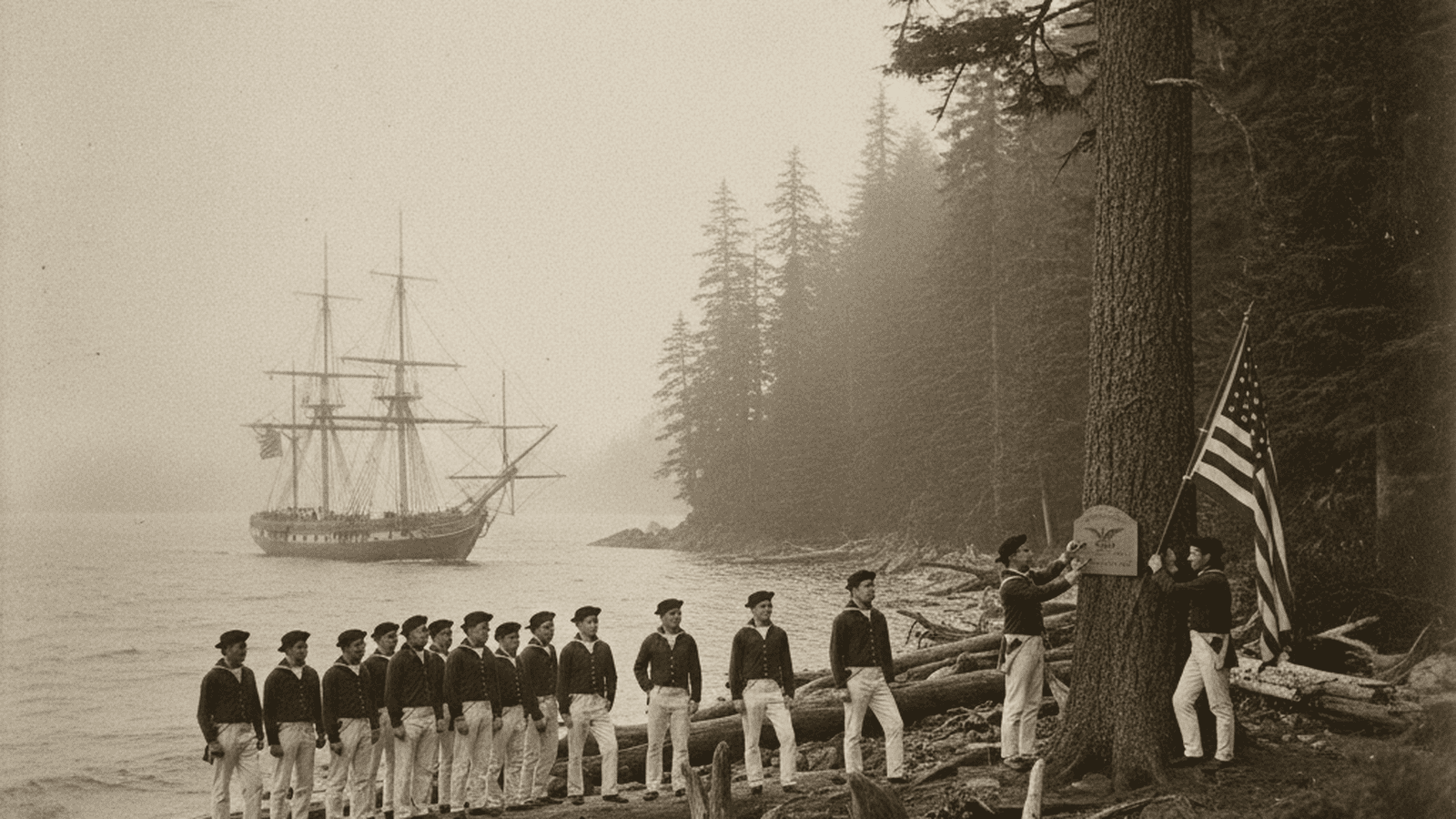
In 1817, President James Monroe exercised executive authority by dispatching the USS Ontario to the Pacific Coast to reclaim American territory at the mouth of the Columbia River. This mission asserted United States sovereignty in a region contested by Great Britain and laid the groundwork for future territorial expansion.
TLDR: President James Monroe’s 1817 decision to send the USS Ontario to the Columbia River marked a pivotal use of executive power to secure Pacific claims. By bypassing formal legislative debate, Monroe utilized the Navy to force diplomatic recognition of American interests, eventually leading to the joint occupation agreement with Britain.
In the aftermath of the War of 1812, the United States faced the daunting task of re-establishing its presence in the far-flung corners of the North American continent. While the Treaty of Ghent had technically ended hostilities with Great Britain, the status of the Pacific Northwest remained precariously undefined. In 1817, President James Monroe took a decisive step to resolve this ambiguity, utilizing his executive power as Commander-in-Chief to dispatch the USS Ontario on a mission to the mouth of the Columbia River. This move bypassed the slow-moving deliberations of Congress and signaled a new era of assertive American foreign policy.
The primary objective of the mission was to reclaim Astoria, a fur-trading post established by John Jacob Astor that had been sold to the British North West Company under duress during the war. Under the terms of the Treaty of Ghent, all territory captured during the conflict was to be restored to its original owner. However, the British argued that Astoria had been a private sale rather than a military capture. Monroe, guided by Secretary of State John Quincy Adams, viewed the site not merely as a commercial hub but as a vital anchor for American claims to the entire Oregon Country.
Captain James Biddle, commanding the USS Ontario, received his orders in September 1817. The instructions were explicit: he was to proceed to the Columbia River and assert the United States’ right of sovereignty. The voyage was long and arduous, taking the vessel around Cape Horn and into the vast expanse of the Pacific. Biddle arrived at the mouth of the river in August 1818. Without waiting for British officials to arrive from nearby Fort George, Biddle landed a party of sailors and marines. In a brief but significant ceremony, he raised the American flag, nailed a leaden plate to a tree claiming the territory for the United States, and fired a federal salute.
This unilateral executive action created an immediate diplomatic stir. When the British government learned of Biddle’s actions, they initially protested the perceived encroachment. However, the presence of a United States naval vessel and the formal declaration of sovereignty forced the British to the negotiating table. The mission effectively compelled the British to acknowledge that the United States had a legitimate, if contested, interest in the region. This tension eventually culminated in the restoration of the post to American hands later that year, though the British maintained their own presence nearby.
The USS Ontario mission served as a catalyst for the Convention of 1818. This treaty established a policy of “joint occupation,” allowing both American and British citizens to settle and trade in the Oregon Country for a period of ten years. By taking the initiative through the Navy, the Monroe administration had successfully prevented the Pacific Northwest from becoming a de facto British province. It was a clear demonstration of how executive control over the military could be leveraged to achieve long-term geopolitical goals without an immediate legislative mandate.
Monroe’s use of the USS Ontario established a precedent for the “executive-first” approach to territorial expansion that would characterize much of the 19th century. It highlighted the President’s ability to create facts on the ground that diplomats would later have to codify into law. This event laid the foundation for the eventual settlement of the Oregon boundary dispute in 1846 and the formal incorporation of the Pacific Northwest into the United States. Later oversight of such executive actions would become a recurring theme in Congressional debates over the limits of presidential authority in foreign affairs.

Miles Harrington serves as the Senior Correspondent for Federal Systems & Executive Power at Just Right News, where he brings a disciplined, constitutionalist lens to the inner workings of the American government. With a focus on the mechanics of the federal bureaucracy and the limits of executive authority, Harrington has established himself as a vital voice for readers who value transparency, accountability, and the preservation of the separation of powers.
A native of Richmond, Virginia, Harrington’s perspective is deeply rooted in the traditions of the Old Dominion. Growing up in a city defined by its historical significance and its role as a center of American jurisprudence, he developed an early appreciation for the foundational principles of the Republic. His upbringing in Richmond—a place where the legacy of the Founding Fathers is woven into the landscape—instilled in him a belief that the federal government should remain within its constitutional bounds. This background informs his skepticism of centralized overreach and his commitment to reporting on the ways in which the administrative state impacts the lives of everyday citizens.
In his current role, Harrington specializes in the complexities of federal systems. He doesn’t just report on the headlines of the day; he digs into the structural shifts within the executive branch that often go unnoticed by the mainstream press. Whether he is analyzing the implications of a new federal regulation or investigating the expansion of agency jurisdiction, his work is characterized by a rigorous adherence to the facts and a dedication to the rule of law.
Harrington is perhaps best known for his signature feature series, “How Washington Works.” Through this ongoing project, he demystifies the often-opaque processes of the nation’s capital, pulling back the curtain on the “Deep State” and the unelected officials who wield significant influence over national policy. By breaking down complex legislative maneuvers and executive orders, he empowers Just Right News readers to understand the true levers of power in Washington. His reporting serves as a necessary check on the federal government, ensuring that the actions of those in power are held up to the light of public scrutiny.
Now based in Washington, D.C., Harrington operates at the epicenter of the political world, yet he remains intentionally distanced from the “Beltway bubble.” His proximity to the halls of power allows him to maintain a robust network of sources across the federal landscape, but his heart remains in the principled conservatism of his Virginia roots. He views his role not merely as a reporter, but as a steward of the public trust, dedicated to providing the clarity and context that conservative voters need to navigate an increasingly complex political environment.
Through his sharp analysis and unwavering commitment to the truth, Miles Harrington continues to be a cornerstone of the Just Right News team. His work ensures that the principles of limited government and executive restraint remain at the forefront of the national conversation, providing a crucial service to those who believe in a government that is truly of, by, and for the people.