

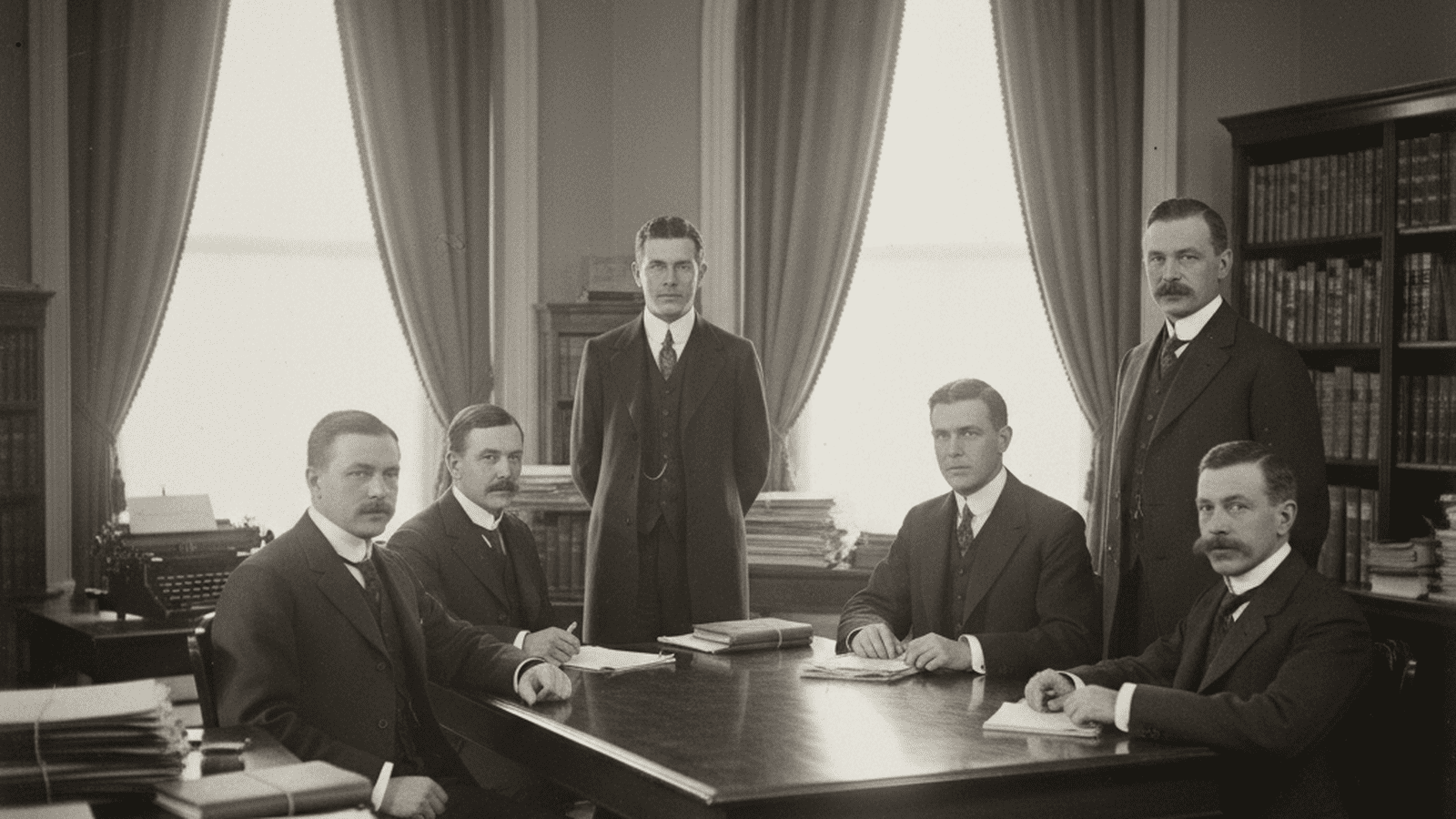
In 1905, President Theodore Roosevelt established the Keep Commission to modernize and streamline the United States federal bureaucracy. This executive-led initiative introduced scientific management to government operations, asserting the President’s role as the chief administrator of the U.S. government.
TLDR: Theodore Roosevelt’s Keep Commission (1905-1909) marked the first major effort to reorganize the U.S. executive branch for efficiency. By bypassing Congress to implement corporate-style management, Roosevelt established a lasting precedent for presidential authority over federal administrative systems and departmental oversight.
In 1905, President Theodore Roosevelt initiated a fundamental shift in the operation of the United States federal government by establishing the Committee on Department Methods, popularly known as the Keep Commission. Named after its chairman, Assistant Secretary of the Treasury Charles H. Keep, the commission represented an unprecedented exercise of executive authority aimed at modernizing a sprawling and often inefficient bureaucracy. Roosevelt’s directive was clear: he sought to apply the principles of scientific management to the public sector, ensuring that the federal government functioned with the precision of a modern corporation.
The commission was composed of five high-ranking administrative officials: Charles Keep, Lawrence O. Murray, James R. Garfield, Gifford Pinchot, and Frank H. Hitchcock. This internal structure allowed the group to bypass legislative oversight during its initial investigations, as it relied on the expertise of those already within the executive branch. Roosevelt’s decision to form the commission via executive order, without seeking a specific appropriation or mandate from Congress, signaled his belief that the President possessed inherent authority to manage the administrative machinery of the state. The commission’s mandate covered everything from the standardization of paper sizes and filing systems to the procurement of supplies and the management of personnel.
One of the primary targets of the Keep Commission was the redundant and archaic record-keeping practices that had plagued federal agencies since the mid-19th century. Investigators found that departments often maintained duplicate sets of records, leading to massive waste in both labor and materials. By recommending the adoption of vertical filing systems and the use of typewriters over hand-written ledgers, the commission dragged the federal bureaucracy into the 20th century. These changes were not merely clerical; they were designed to make government data more accessible and its operations more transparent to the executive branch.
Beyond office supplies, the Keep Commission delved into the professionalization of the civil service. It advocated for uniform accounting procedures and more rigorous standards for government contracting. The commission’s work highlighted the tension between the executive and legislative branches regarding the “power of the purse.” While Roosevelt viewed these reforms as essential for efficiency, some members of Congress viewed the commission as an executive encroachment on their traditional role of overseeing departmental expenditures and structures. They argued that the President was creating a “government within a government” that answered only to the White House.
The political friction culminated in 1909 when Congress passed the Tawney Amendment to the Sundry Civil Appropriation Act. This legislation prohibited the use of public funds for any commission or board not specifically authorized by law, effectively ending the Keep Commission’s work and attempting to rein in Roosevelt’s use of executive orders. Representative James Tawney of Minnesota, the amendment’s namesake, was a vocal critic of what he termed “executive usurpation.” He believed that the commission’s existence bypassed the constitutional requirement that Congress determine the structure and funding of the executive departments.
Despite this legislative pushback, the commission had already produced dozens of reports that laid the groundwork for future administrative reforms. It proved that the executive branch could—and perhaps should—take the lead in self-correction and organizational design. The commission’s findings on the “red tape” of the era provided a roadmap for the Taft and Wilson administrations. The legacy of the Keep Commission is visible in the subsequent creation of the Bureau of the Budget in 1921 and the eventual establishment of the Office of Management and Budget. It established the precedent that the President is the “Chief Administrator” of the United States, asserting executive control over the minutiae of departmental operations and transforming the presidency into a modern managerial office.

Miles Harrington serves as the Senior Correspondent for Federal Systems & Executive Power at Just Right News, where he brings a disciplined, constitutionalist lens to the inner workings of the American government. With a focus on the mechanics of the federal bureaucracy and the limits of executive authority, Harrington has established himself as a vital voice for readers who value transparency, accountability, and the preservation of the separation of powers.
A native of Richmond, Virginia, Harrington’s perspective is deeply rooted in the traditions of the Old Dominion. Growing up in a city defined by its historical significance and its role as a center of American jurisprudence, he developed an early appreciation for the foundational principles of the Republic. His upbringing in Richmond—a place where the legacy of the Founding Fathers is woven into the landscape—instilled in him a belief that the federal government should remain within its constitutional bounds. This background informs his skepticism of centralized overreach and his commitment to reporting on the ways in which the administrative state impacts the lives of everyday citizens.
In his current role, Harrington specializes in the complexities of federal systems. He doesn’t just report on the headlines of the day; he digs into the structural shifts within the executive branch that often go unnoticed by the mainstream press. Whether he is analyzing the implications of a new federal regulation or investigating the expansion of agency jurisdiction, his work is characterized by a rigorous adherence to the facts and a dedication to the rule of law.
Harrington is perhaps best known for his signature feature series, “How Washington Works.” Through this ongoing project, he demystifies the often-opaque processes of the nation’s capital, pulling back the curtain on the “Deep State” and the unelected officials who wield significant influence over national policy. By breaking down complex legislative maneuvers and executive orders, he empowers Just Right News readers to understand the true levers of power in Washington. His reporting serves as a necessary check on the federal government, ensuring that the actions of those in power are held up to the light of public scrutiny.
Now based in Washington, D.C., Harrington operates at the epicenter of the political world, yet he remains intentionally distanced from the “Beltway bubble.” His proximity to the halls of power allows him to maintain a robust network of sources across the federal landscape, but his heart remains in the principled conservatism of his Virginia roots. He views his role not merely as a reporter, but as a steward of the public trust, dedicated to providing the clarity and context that conservative voters need to navigate an increasingly complex political environment.
Through his sharp analysis and unwavering commitment to the truth, Miles Harrington continues to be a cornerstone of the Just Right News team. His work ensures that the principles of limited government and executive restraint remain at the forefront of the national conversation, providing a crucial service to those who believe in a government that is truly of, by, and for the people.