

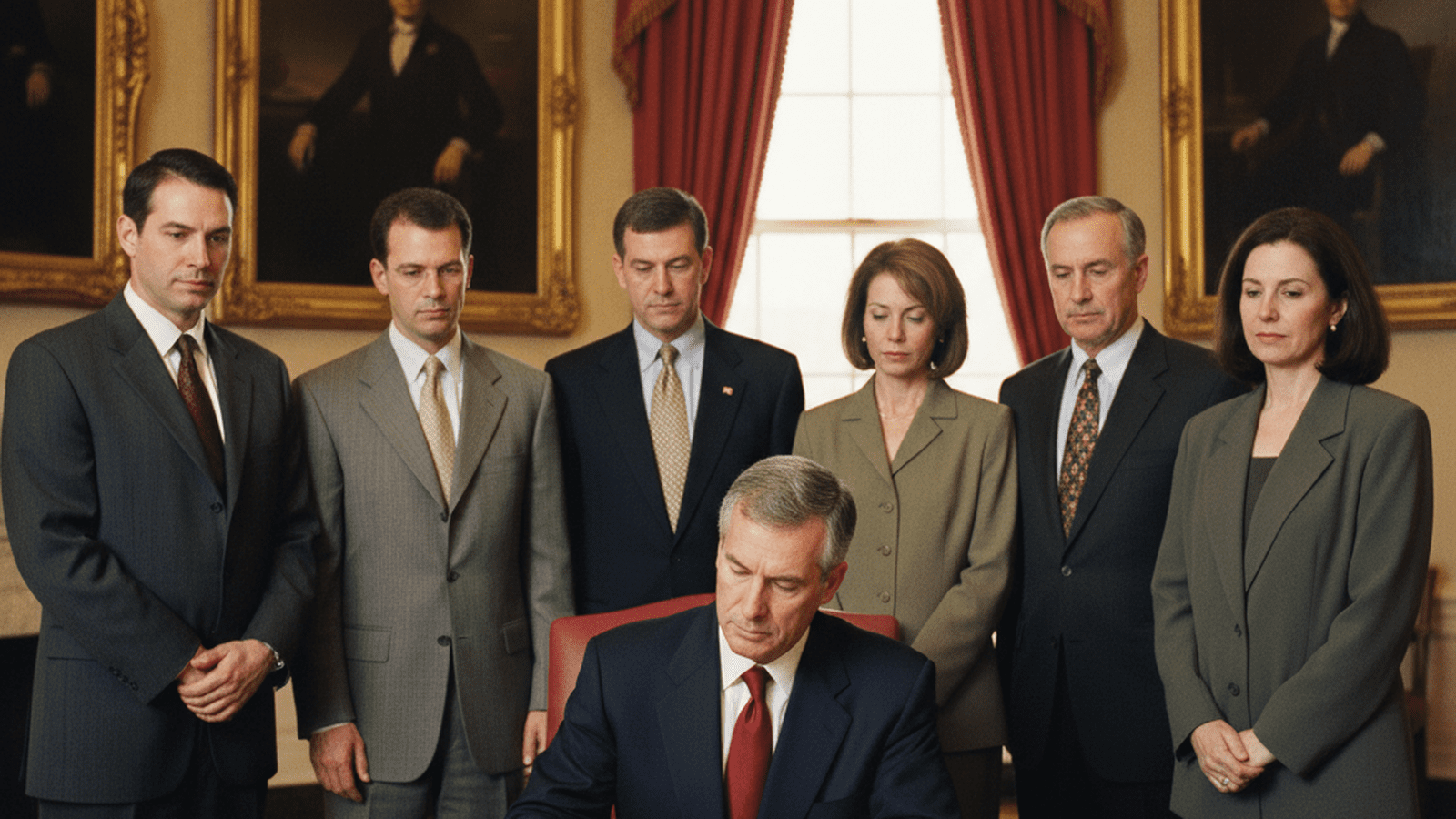
In 2002, the United States government underwent its most significant reorganization in over half a century with the passage of the Homeland Security Act. This legislation consolidated 22 federal agencies into the Department of Homeland Security, centralizing executive authority over domestic defense and emergency response.
TLDR: Following the September 11 attacks, the United States passed the Homeland Security Act of 2002, creating a massive new federal department. By merging 22 disparate agencies under a single Cabinet-level secretary, the law significantly expanded executive oversight of domestic security, border control, and emergency management systems.
In the immediate aftermath of the September 11, 2001, terrorist attacks, the United States federal government faced unprecedented pressure to address systemic failures in intelligence sharing and domestic coordination. The resulting legislative response culminated in the Homeland Security Act of 2002, a landmark piece of legislation that fundamentally altered the structure of the executive branch and redefined the relationship between national security and federal bureaucracy. Signed into law by President George W. Bush on November 25, 2002, the act established the Department of Homeland Security (DHS), marking the most significant reorganization of the U.S. government since the National Security Act of 1947.
The primary objective of this massive reorganization was to consolidate the nation’s disparate security efforts into a single, unified framework. Before the act, domestic security responsibilities were scattered across more than 40 different agencies, a fragmentation that many experts believed contributed to the intelligence gaps prior to 9/11. The new department ultimately absorbed 22 different federal entities, including the U.S. Customs Service, the Immigration and Naturalization Service (INS), the Federal Emergency Management Agency (FEMA), the Transportation Security Administration (TSA), the United States Secret Service, and the U.S. Coast Guard. This consolidation brought approximately 180,000 federal employees under the authority of a newly created Cabinet-level Secretary, creating a behemoth dedicated to preventing terrorist attacks within the United States.
The legislative path to the act’s passage was fraught with political tension and intense debate over the extent of executive power. While there was broad bipartisan support for the concept of a homeland security department, a major impasse developed in the Senate regarding personnel management and labor rights. The Bush administration insisted on broad authority to bypass traditional civil service rules for DHS employees, arguing that the exigencies of national security required greater managerial flexibility in hiring, firing, and shifting staff. Labor unions and many Democratic lawmakers resisted these provisions, fearing they would dismantle decades of hard-won worker protections. The deadlock was only broken after the 2002 midterm elections, which saw Republicans gain seats, providing the political momentum necessary to pass the administration’s version of the bill.
Beyond labor issues, the creation of DHS raised profound questions about the centralization of authority. Critics from both the left and right expressed concerns that such a massive, multi-layered bureaucracy would be prone to inefficiency and that the concentration of power could threaten civil liberties. The act established several key directorates, including Information Analysis and Infrastructure Protection, which was intended to serve as a central hub for synthesizing threat data. However, the integration of these agencies proved difficult. The early years of DHS were characterized by significant logistical hurdles, as disparate institutional cultures and incompatible IT systems had to be merged into a cohesive unit.
The department’s efficacy was put to a severe test in 2005 during the response to Hurricane Katrina. The perceived failures in coordination and emergency relief led many observers to argue that the department’s heavy focus on counterterrorism had marginalized FEMA’s traditional disaster-response capabilities. This sparked further legislative refinements, such as the Post-Katrina Emergency Management Reform Act of 2006, which sought to bolster FEMA’s autonomy within the DHS structure and improve the federal response to natural disasters.
In the decades since its inception, the Department of Homeland Security has become a permanent and powerful fixture of the American executive branch. While it succeeded in centralizing many functions, it continues to face scrutiny regarding its vast jurisdiction, particularly in areas of border enforcement, surveillance technologies, and cybersecurity. The 2002 reorganization remains a pivotal moment in American political history, illustrating how national crises can drive rapid expansions of executive authority and fundamentally reshape the machinery of the state.

Miles Harrington serves as the Senior Correspondent for Federal Systems & Executive Power at Just Right News, where he brings a disciplined, constitutionalist lens to the inner workings of the American government. With a focus on the mechanics of the federal bureaucracy and the limits of executive authority, Harrington has established himself as a vital voice for readers who value transparency, accountability, and the preservation of the separation of powers.
A native of Richmond, Virginia, Harrington’s perspective is deeply rooted in the traditions of the Old Dominion. Growing up in a city defined by its historical significance and its role as a center of American jurisprudence, he developed an early appreciation for the foundational principles of the Republic. His upbringing in Richmond—a place where the legacy of the Founding Fathers is woven into the landscape—instilled in him a belief that the federal government should remain within its constitutional bounds. This background informs his skepticism of centralized overreach and his commitment to reporting on the ways in which the administrative state impacts the lives of everyday citizens.
In his current role, Harrington specializes in the complexities of federal systems. He doesn’t just report on the headlines of the day; he digs into the structural shifts within the executive branch that often go unnoticed by the mainstream press. Whether he is analyzing the implications of a new federal regulation or investigating the expansion of agency jurisdiction, his work is characterized by a rigorous adherence to the facts and a dedication to the rule of law.
Harrington is perhaps best known for his signature feature series, “How Washington Works.” Through this ongoing project, he demystifies the often-opaque processes of the nation’s capital, pulling back the curtain on the “Deep State” and the unelected officials who wield significant influence over national policy. By breaking down complex legislative maneuvers and executive orders, he empowers Just Right News readers to understand the true levers of power in Washington. His reporting serves as a necessary check on the federal government, ensuring that the actions of those in power are held up to the light of public scrutiny.
Now based in Washington, D.C., Harrington operates at the epicenter of the political world, yet he remains intentionally distanced from the “Beltway bubble.” His proximity to the halls of power allows him to maintain a robust network of sources across the federal landscape, but his heart remains in the principled conservatism of his Virginia roots. He views his role not merely as a reporter, but as a steward of the public trust, dedicated to providing the clarity and context that conservative voters need to navigate an increasingly complex political environment.
Through his sharp analysis and unwavering commitment to the truth, Miles Harrington continues to be a cornerstone of the Just Right News team. His work ensures that the principles of limited government and executive restraint remain at the forefront of the national conversation, providing a crucial service to those who believe in a government that is truly of, by, and for the people.