

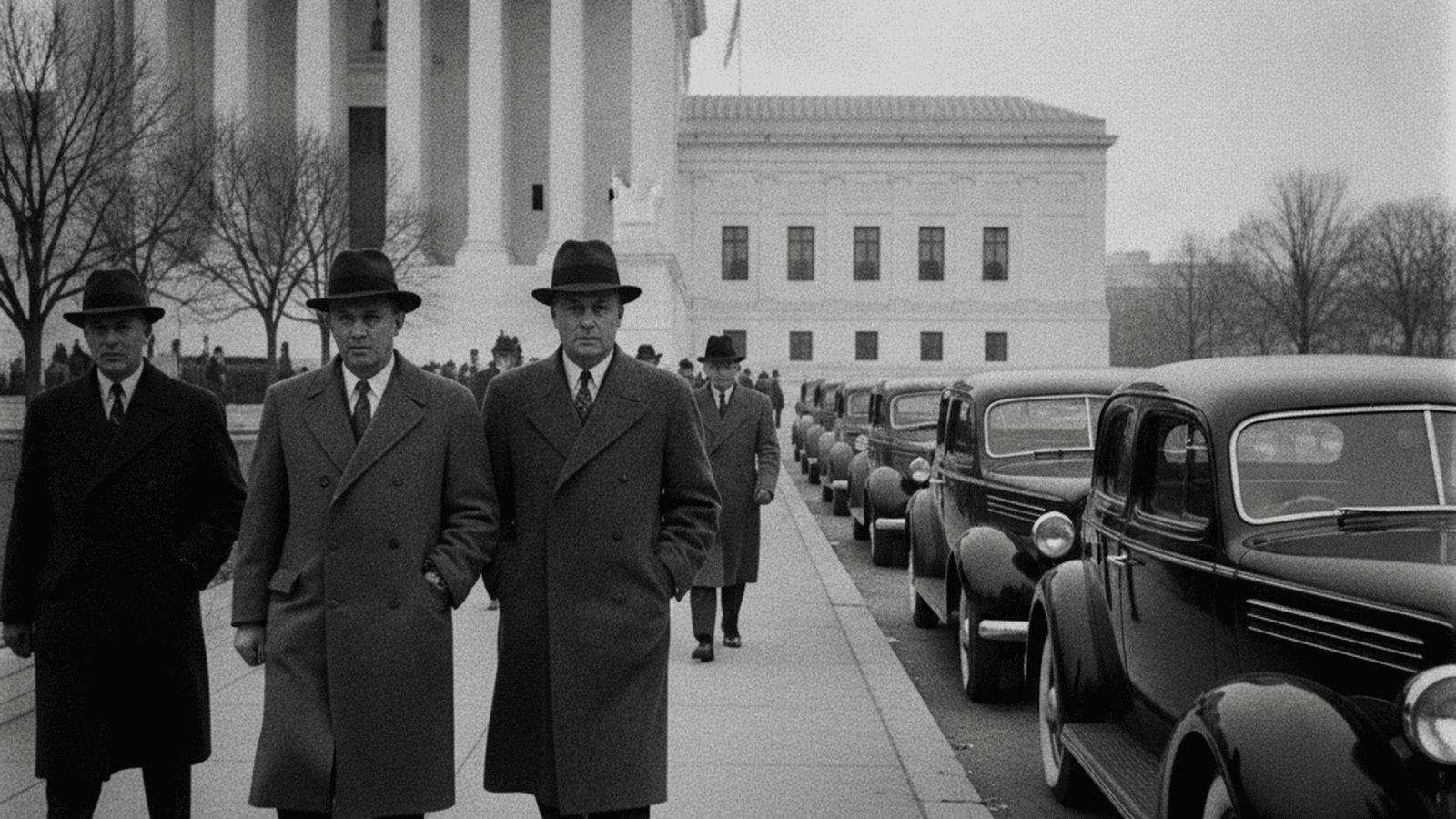
The 1935 Supreme Court case Schechter Poultry Corp. v. United States invalidated the National Industrial Recovery Act, a pillar of the New Deal. The unanimous ruling determined that the United States federal government had unconstitutionally delegated legislative power to the President and exceeded its authority under the Commerce Clause.
TLDR: In 1935, the U.S. Supreme Court struck down the National Industrial Recovery Act in the “Sick Chicken Case.” The unanimous decision ruled that President Roosevelt’s administration had been granted unconstitutional legislative authority. This landmark ruling established lasting limits on executive power and the delegation of congressional duties to federal agencies.
In May 1935, the United States Supreme Court delivered a unanimous blow to the centerpiece of President Franklin D. Roosevelt’s New Deal. The case, A.L.A. Schechter Poultry Corp. v. United States, centered on the National Industrial Recovery Act (NIRA), which had granted the executive branch sweeping powers to regulate the economy. By striking down the “Live Poultry Code,” the Court established a critical boundary for executive authority and the delegation of legislative power.
The NIRA was designed to combat the Great Depression by allowing the President to approve “codes of fair competition” for various industries. These codes regulated wages, hours, and trade practices across the nation. The Schechter brothers, who operated a wholesale poultry business in Brooklyn, New York, were convicted of violating the poultry code. Their infractions included selling “unfit” chickens to local butchers and ignoring minimum wage and maximum hour requirements established by the executive branch.
The Schechters appealed their conviction, arguing that the NIRA was an unconstitutional delegation of legislative power from Congress to the President. They also contended that their business was local and did not fall under the federal government’s power to regulate interstate commerce. The case reached the Supreme Court at a time of intense friction between the Roosevelt administration and a judiciary skeptical of rapid federal expansion. The administration argued that the economic emergency of the Depression justified a broader interpretation of executive and federal power.
Chief Justice Charles Evans Hughes, writing for the unanimous Court, agreed with the Schechters. The Court found that the NIRA failed to provide sufficient standards or “intelligible principles” to guide the President’s discretion. Hughes famously noted that the law allowed for “delegation running riot.” Because the President was essentially given the power to make laws rather than just execute them, the NIRA violated the separation of powers established by the Constitution.
Furthermore, the Court ruled that the Schechters’ activities had only an “indirect” effect on interstate commerce. Since the poultry was sold locally in New York after being shipped from other states, the federal government exceeded its authority under the Commerce Clause. This distinction between direct and indirect effects became a focal point of legal debate for years to follow, as the administration sought other ways to regulate the national economy.
The decision, often called the “Sick Chicken Case,” infuriated President Roosevelt, who felt the judiciary was obstructing necessary economic recovery. He complained that the Court was operating under a “horse-and-buggy” definition of the economy that failed to recognize the interconnected nature of modern industry. The ruling effectively dismantled the National Recovery Administration (NRA) and forced the administration to rethink its legislative strategy. It was one of several “Black Monday” decisions that eventually led Roosevelt to propose his controversial judicial reorganization plan in 1937, an attempt to add more sympathetic justices to the bench.
While the Supreme Court eventually adopted a much broader interpretation of the Commerce Clause during the late 1930s, the Schechter ruling remains a landmark in administrative law. It serves as the primary precedent for the non-delegation doctrine, which prevents Congress from transferring its lawmaking responsibilities to the executive branch without specific constraints. Modern legal challenges regarding the “major questions doctrine” and the power of federal agencies often trace their roots back to the limits established in this 1935 decision. The case continues to be cited in arguments concerning the balance of power between the three branches of the United States government.

Miles Harrington serves as the Senior Correspondent for Federal Systems & Executive Power at Just Right News, where he brings a disciplined, constitutionalist lens to the inner workings of the American government. With a focus on the mechanics of the federal bureaucracy and the limits of executive authority, Harrington has established himself as a vital voice for readers who value transparency, accountability, and the preservation of the separation of powers.
A native of Richmond, Virginia, Harrington’s perspective is deeply rooted in the traditions of the Old Dominion. Growing up in a city defined by its historical significance and its role as a center of American jurisprudence, he developed an early appreciation for the foundational principles of the Republic. His upbringing in Richmond—a place where the legacy of the Founding Fathers is woven into the landscape—instilled in him a belief that the federal government should remain within its constitutional bounds. This background informs his skepticism of centralized overreach and his commitment to reporting on the ways in which the administrative state impacts the lives of everyday citizens.
In his current role, Harrington specializes in the complexities of federal systems. He doesn’t just report on the headlines of the day; he digs into the structural shifts within the executive branch that often go unnoticed by the mainstream press. Whether he is analyzing the implications of a new federal regulation or investigating the expansion of agency jurisdiction, his work is characterized by a rigorous adherence to the facts and a dedication to the rule of law.
Harrington is perhaps best known for his signature feature series, “How Washington Works.” Through this ongoing project, he demystifies the often-opaque processes of the nation’s capital, pulling back the curtain on the “Deep State” and the unelected officials who wield significant influence over national policy. By breaking down complex legislative maneuvers and executive orders, he empowers Just Right News readers to understand the true levers of power in Washington. His reporting serves as a necessary check on the federal government, ensuring that the actions of those in power are held up to the light of public scrutiny.
Now based in Washington, D.C., Harrington operates at the epicenter of the political world, yet he remains intentionally distanced from the “Beltway bubble.” His proximity to the halls of power allows him to maintain a robust network of sources across the federal landscape, but his heart remains in the principled conservatism of his Virginia roots. He views his role not merely as a reporter, but as a steward of the public trust, dedicated to providing the clarity and context that conservative voters need to navigate an increasingly complex political environment.
Through his sharp analysis and unwavering commitment to the truth, Miles Harrington continues to be a cornerstone of the Just Right News team. His work ensures that the principles of limited government and executive restraint remain at the forefront of the national conversation, providing a crucial service to those who believe in a government that is truly of, by, and for the people.