

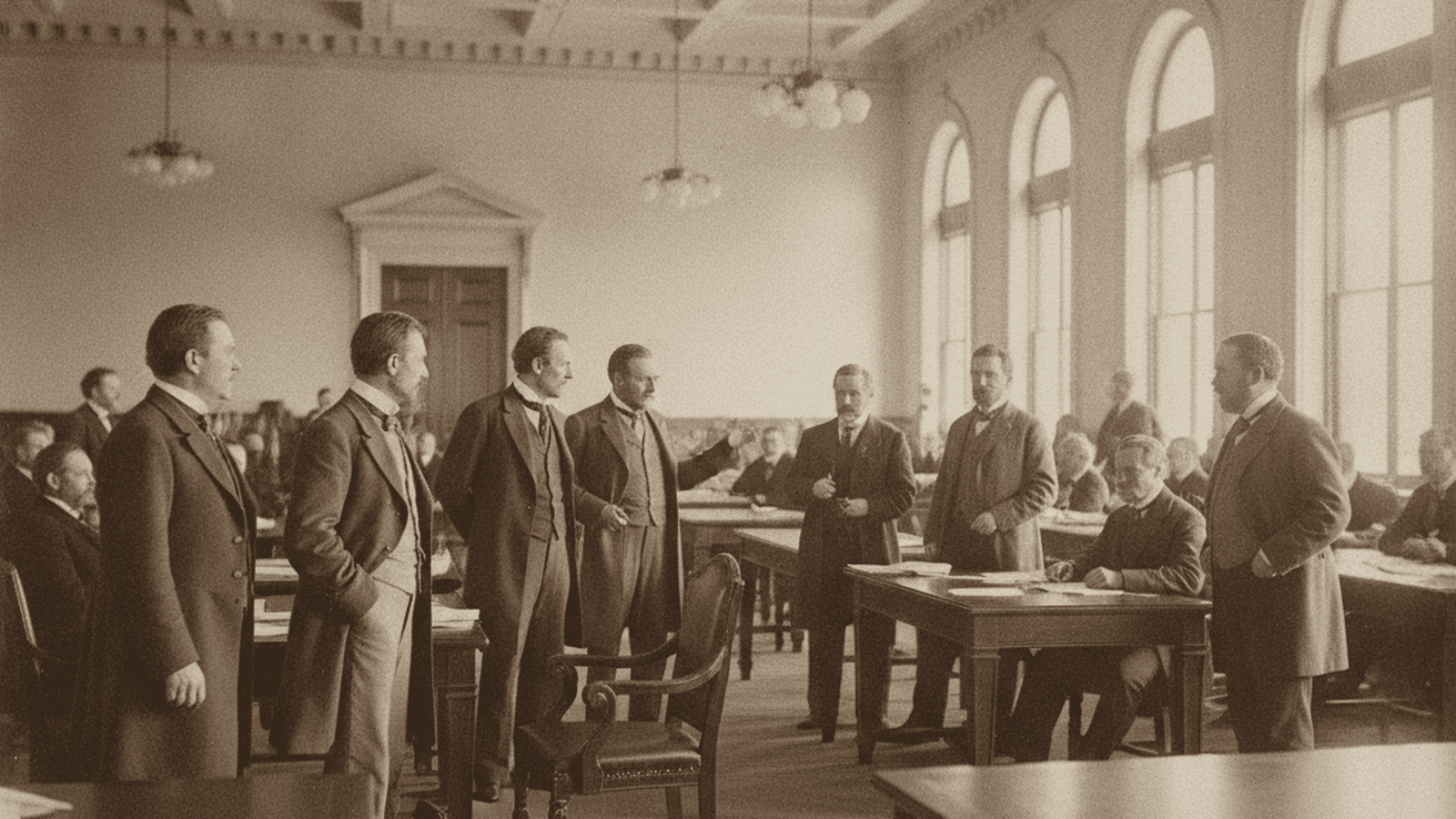
In 1893, the Wyoming Legislature descended into a month-long deadlock while attempting to elect a United States Senator. The impasse, fueled by the rise of the Populist Party and the aftermath of the Johnson County War, left one of the state’s federal seats vacant for two years and forced a major realignment of state political coalitions.
TLDR: The 1893 Wyoming legislative session failed to elect a U.S. Senator after 31 days of balloting. This deadlock, driven by Populist influence and agrarian unrest, left the state with a vacant Senate seat until 1895. The event catalyzed a shift toward fusion politics and highlighted the instability of the legislative election system.
The 1893 session of the Wyoming Legislature began under a cloud of intense partisan friction and social unrest. Having achieved statehood only three years prior, the young state was already grappling with the violent fallout of the Johnson County War and the economic anxieties of the Gilded Age. When the lawmakers convened in Cheyenne that January, their primary constitutional duty was to elect a United States Senator to fill the seat vacated by Francis E. Warren. However, the rise of the Populist Party had shattered the traditional two-party balance, creating a fractured chamber where no single group held a clear mandate.
Republicans entered the session with a plurality but lacked the necessary majority to confirm their preferred candidate. The Democrats and a small but disciplined bloc of Populists held the balance of power. These third-party insurgents, representing the interests of struggling farmers and laborers, refused to align with the Republican establishment. They sought a candidate who would champion the free coinage of silver and challenge the dominance of the powerful Wyoming Stock Growers Association.
Balloting commenced on January 24, but the results were immediately discouraging for the Republican leadership. Day after day, the clerk called the roll, and day after day, the tally fell short of a majority. The atmosphere in the Capitol grew increasingly tense as lobbyists and political fixers crowded the hallways. Rumors of bribery and backroom deals circulated through the local press, further eroding public confidence in the legislative process.
By the middle of February, the legislature had conducted over thirty ballots without a resolution. The Democrats and Populists occasionally attempted to fuse their votes behind a single candidate, but internal disagreements over patronage and policy prevented a stable coalition. The Republicans remained equally stubborn, refusing to abandon their incumbent interests. This paralysis effectively halted all other legislative business, as the senatorial contest consumed the energy and attention of every member.
The deadlock persisted until the mandatory adjournment date in late February. For the first time in the state’s short history, the legislature adjourned without fulfilling its federal obligation. This failure left Wyoming with only one representative in the United States Senate, significantly diminishing the state’s influence in Washington during a period of national economic crisis. Governor John E. Osborne, a Democrat, attempted to resolve the crisis by appointing a senator during the legislative recess, but the U.S. Senate ultimately refused to seat his appointee, citing the lack of legislative election.
The 1893 deadlock served as a turning point for Wyoming’s political landscape. It demonstrated that the Republican Old Guard could be successfully challenged by a coalition of agrarian and labor interests. In the following election cycles, the Populist-Democratic fusion became a potent force, reshaping the state’s policy priorities toward regulation and social reform. This era of realignment forced the traditional parties to adapt to a more diverse electorate and a more complex set of economic demands.
Beyond the borders of Wyoming, the 1893 impasse contributed to a growing national movement for electoral reform. Similar deadlocks in other states convinced many observers that the system of state legislatures electing senators was inherently prone to corruption and inefficiency. This sentiment eventually culminated in the ratification of the 17th Amendment in 1913, which established the direct election of U.S. Senators by the people. The vacancy in Wyoming remained a stark reminder of the costs of legislative dysfunction until the seat was finally filled in 1895.

Dylan Brooks serves as the Senior Correspondent for Statehouses and Local Governance at Just Right News, where he brings a principled, constitutionalist lens to the often-overlooked machinery of state-level politics. As the lead voice behind the acclaimed feature series “Fifty Laboratories of Power,” Dylan has dedicated his career to the idea that the most impactful governance happens closest to home. His reporting consistently champions the Tenth Amendment, exploring how individual states can serve as testing grounds for innovative, conservative policy solutions that prioritize personal liberty and fiscal responsibility.
A native of Des Moines, Iowa, Dylan’s journalistic philosophy was forged in the heart of the American Midwest. Growing up in a community where local school board meetings and town halls were the bedrock of civic life, he developed a deep appreciation for the “retail politics” of the heartland. This upbringing instilled in him a fundamental belief that the American experiment is best preserved when power is decentralized. He carries the values of his Iowa roots into every assignment, maintaining a healthy skepticism of federal overreach and a steadfast commitment to the concerns of everyday citizens over the interests of the administrative state.
Now based in Madison, Wisconsin, Dylan operates from one of the nation’s most pivotal political battlegrounds. His location in a state capital known for its rigorous policy debates allows him to provide Just Right News readers with a front-row seat to the legislative process. From Madison, he tracks the ripple effects of statehouse decisions on local municipalities, ensuring that the connection between high-level policy and community impact is never lost. His work often highlights the success of conservative governors and legislatures in fostering economic growth, protecting parental rights, and securing the integrity of local institutions.
As an African American man in the conservative media landscape, Dylan offers a vital perspective on how limited government and free-market principles empower individuals and families. He frequently reports on how deregulation and school choice initiatives provide new avenues for success in underserved communities, challenging the monolithic narratives often presented by legacy media outlets. Dylan’s work is characterized by a commitment to the facts and a refusal to shy away from the complex realities of modern governance.
Throughout his tenure at Just Right News, Dylan has become a trusted authority for readers who value a rigorous, principled approach to the news. Whether he is dissecting a complex state budget or profiling a local grassroots movement, his goal remains the same: to provide the American public with the information they need to hold their local leaders accountable. By focusing on the “Fifty Laboratories of Power,” Dylan Brooks ensures that the vital work being done in statehouses across the country receives the national attention it deserves, always through a lens that respects the traditions and sovereignty of the American people.