

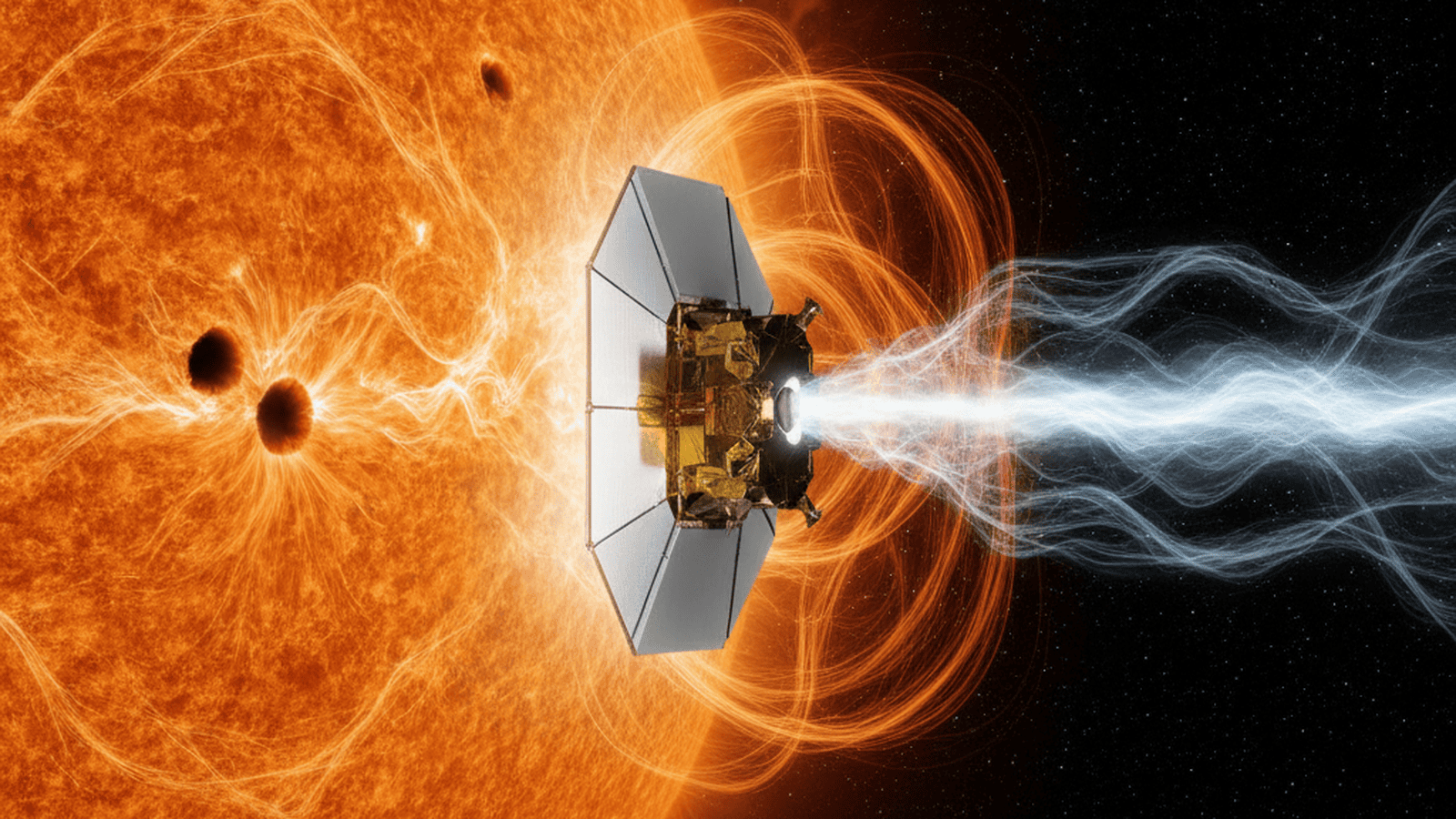
NASA’s Parker Solar Probe has identified the source of the fast solar wind within coronal holes on the Sun’s surface. The data shows that magnetic reconnection at the boundaries of supergranulation cells accelerates charged particles into space at extreme speeds.
TLDR: NASA’s Parker Solar Probe has traced the origin of the fast solar wind to magnetic reconnection events within coronal holes. By observing the Sun’s atmosphere at close range, the mission identified specific funnels that launch high-speed plasma, providing a breakthrough in understanding how solar energy impacts the entire solar system.
NASA’s Parker Solar Probe has successfully identified the origin of the “fast” solar wind, solving a long-standing mystery in heliophysics that has puzzled scientists for decades. Data collected during the spacecraft’s daring close encounters with the Sun reveal that high-speed streams of charged particles emerge from specific “funnels” within coronal holes. These holes are vast regions where the Sun’s magnetic field lines remain open to space rather than looping back to the surface, creating a highway for solar material to escape into the solar system.
Researchers at the University of California, Berkeley, and NASA’s Goddard Space Flight Center analyzed the probe’s measurements of magnetic field structures and plasma flows. They found that the fast solar wind is accelerated by a process known as magnetic reconnection. This occurs when magnetic field lines of opposite polarity collide and snap, releasing immense energy that flings particles away from the Sun at speeds exceeding 1.7 million miles per hour. This mechanism had been theorized but never observed with such clarity until Parker’s recent orbits.
The probe’s instruments, including the FIELDS suite and the Solar Wind Electrons Alphas and Protons investigation, detected “switchbacks”—S-shaped kinks in the magnetic field—that are more prevalent near the solar surface. These switchbacks appear to be the remnants of the reconnection events that power the solar wind. By flying within 13 million miles of the solar surface, Parker was able to observe the fine-scale structure of the solar wind before it became blurred by turbulence during its journey toward Earth.
The observations specifically pinpointed the “supergranulation” cells within coronal holes as the primary launch sites. These cells are large convection patterns on the solar surface, roughly 20,000 miles across, where magnetic fields are concentrated and pushed toward the edges. The reconnection happens at the boundaries of these cells, creating jets of plasma that feed into the broader solar wind stream. This discovery provides a physical mechanism for how the solar corona is heated to temperatures far exceeding the solar surface, a phenomenon known as the coronal heating problem.
Understanding the source of the solar wind is critical for predicting space weather and protecting human technology. High-speed solar streams can trigger intense geomagnetic storms on Earth, potentially disrupting satellite communications, GPS navigation, and terrestrial power grids. By mapping the origins of these streams, scientists can improve the accuracy of space weather forecasts and provide earlier warnings for solar events that could impact the global economy.
The Parker Solar Probe is designed to withstand the extreme environment near the Sun using a 4.5-inch-thick carbon-composite heat shield. This technology allows the spacecraft to maintain a room-temperature environment for its instruments while the exterior faces temperatures nearing 2,500 degrees Fahrenheit. The mission represents a significant engineering feat, enabling the first direct sampling of a star’s atmosphere and providing data that cannot be obtained from Earth-based telescopes.
Future orbits will take the Parker Solar Probe even closer to the Sun, eventually reaching within 4 million miles of the surface by late 2024. These upcoming passes will allow researchers to test whether the reconnection process remains the dominant driver of the solar wind during different phases of the solar cycle, particularly as the Sun approaches solar maximum. The mission continues to redefine the boundaries of solar science, offering a direct look at the engine driving the heliosphere and influencing the entire solar system.

Mason Reed serves as a Staff Writer for Just Right News, where he spearheads the Future Frontiers & Special Projects desk. In an era defined by rapid technological shifts and evolving social landscapes, Mason provides a steady, principled voice, examining the innovations of tomorrow through the lens of traditional American values. His work is most prominently featured in his signature series, “The Next Horizon,” where he explores the intersection of emerging technology, national sovereignty, and the preservation of individual liberty.
A native of San Diego, California, Mason’s worldview was shaped by the unique culture of his hometown. Growing up in a region defined by its strong military presence and its history of maritime industry, he developed a deep-seated respect for the institutions that provide national stability and the entrepreneurial spirit that drives the American economy. This upbringing instilled in him a belief that true progress is not found in discarding the past, but in building upon a foundation of proven principles. His reporting often reflects this San Diego influence, emphasizing the importance of a robust national defense and the necessity of maintaining a competitive edge in the global marketplace.
Now based in San Francisco, Mason operates from the heart of the world’s technological engine. Living and working in the Bay Area provides him with a front-row seat to the advancements—and the ideological challenges—emanating from Silicon Valley. While many in the region embrace a “move fast and break things” mentality, Mason’s reporting serves as a vital counterweight. He offers Just Right News readers a “boots on the ground” perspective, documenting how radical local policies and the concentration of tech power impact the everyday lives of citizens. His proximity to the industry allows him to cut through the marketing jargon of big tech to uncover the real-world implications for privacy, free speech, and the nuclear family.
In his “Future Frontiers” beat, Mason tackles complex subjects ranging from the ethics of artificial intelligence to the burgeoning private space race. He approaches these topics with a healthy skepticism toward centralized bureaucracy, championing instead the decentralized innovations that empower individuals. Through “The Next Horizon,” he highlights the pioneers and thinkers who are working to ensure that the future remains a place where human dignity and constitutional rights are protected. He believes that the rapid pace of change requires more than just technical expertise; it requires a moral compass rooted in the Western tradition.
Throughout his tenure at Just Right News, Mason has remained committed to the idea that the future is something to be shaped, not merely accepted. His writing is characterized by a rigorous defense of American exceptionalism and a belief that the country’s best days lie ahead, provided it remains true to its founding ideals. Whether he is investigating the impact of automation on the American workforce or profiling the next generation of aerospace engineers, Mason Reed ensures that his readers are equipped with the insights they need to navigate a changing world with confidence and clarity.