

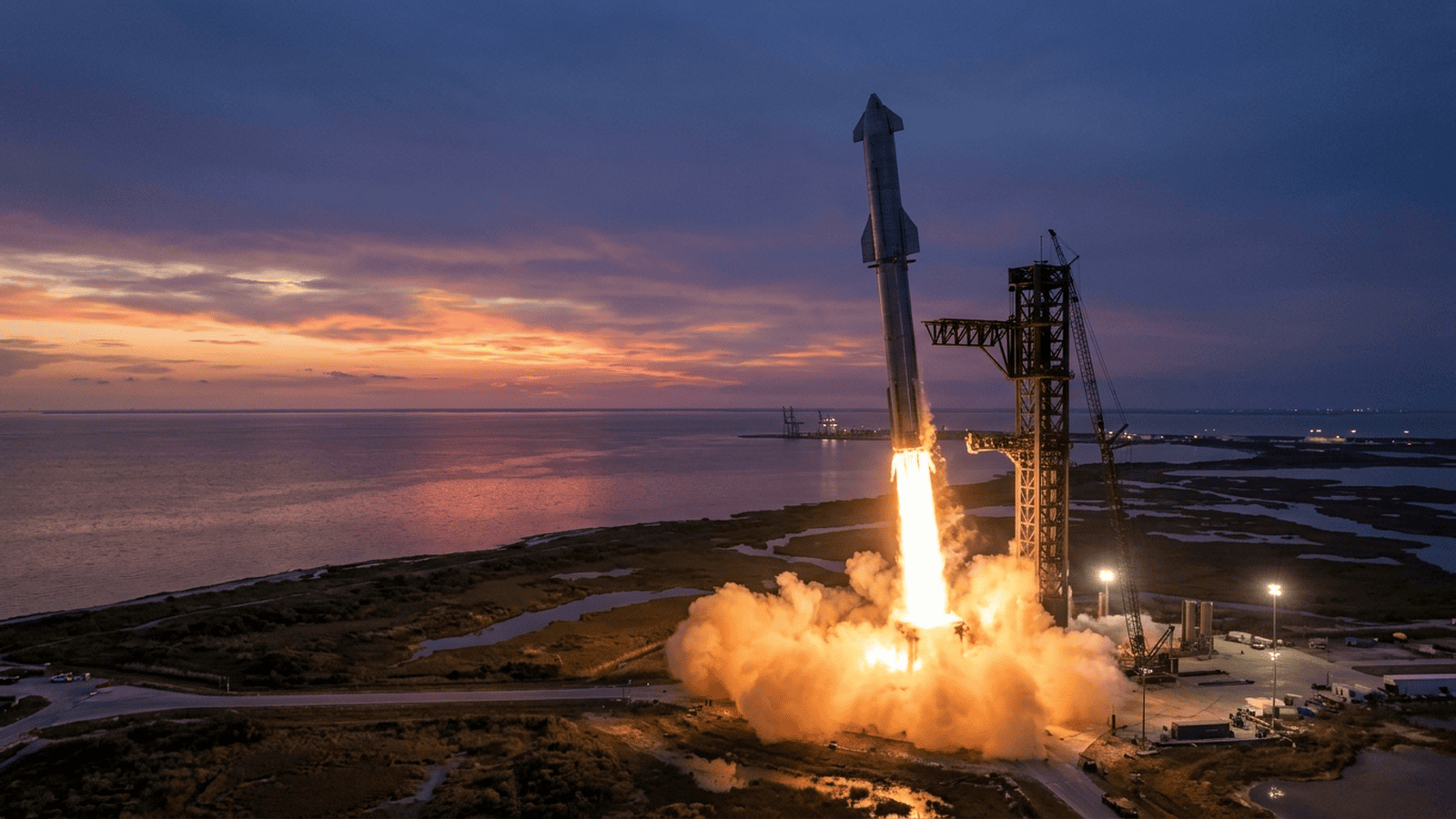
SpaceX launched Starship on its 15th test flight Friday, beginning a planned 22-hour mission aimed at advancing development of a fully reusable rocket. The Super Heavy booster did not return to its launch site and instead splashed down offshore, while the Starship’s planned flight and landing remained unconfirmed in the account. The plan included a possible orbit burn, deployment of the first of 26 upgraded Starlink satellites, and an attempted return to Starbase for a first pad catch. SpaceX described ocean splashdown options and ways to end re-entry if problems arose. NASA is counting on a Starship variant for a 2028 lunar mission but is also considering another lander depending on readiness.
TLDR: SpaceX’s 15th Starship test flight began a planned 22-hour mission, but its booster splashed down offshore instead of landing at Starbase. The spacecraft’s planned orbit, satellite deployment, and first return-to-pad attempt were not confirmed in the account.
SpaceX launched Starship on its 15th test flight Friday, beginning a planned 22-hour mission that could mark an important step toward a fully reusable rocket. The flight plan called for an attempt to return the spacecraft to its launch pad for a possible refurbishment and later relaunch. The Super Heavy booster did not make that return: it splashed down in the ocean offshore.
The stated purpose of the mission is to test Starship’s systems and advance development of a fully reusable, orbit-class rocket. SpaceX says reuse could allow vehicles to fly again on an airplane-like schedule. That goal is still under development, and the planned pad catch and return had not been confirmed in the provided account.
The rocket lifted off from SpaceX’s Starbase site on the Texas Gulf Coast at 5:45 p.m. EST. Its first stage stood 236 feet tall and used 33 methane-burning Raptor engines. The rocket carried about 8 million pounds of supercold liquid oxygen and methane fuel. The 407-foot-tall vehicle rose southeast, with the Super Heavy booster expected to separate after about two minutes and 20 seconds.
The 171-foot-tall Starship continued its climb using six of its own Raptor engines. The flight plan called for the booster to turn around, use 13 engines to reverse course, and head back toward Starbase. It did not land at the site and instead came down in the water offshore. That outcome marks a limit of this stage of the test, while the main spacecraft’s planned flight and return remained the focus of the mission account.
Starship was assigned a sub-orbital path before any planned push into orbit. The route was intended to let flight controllers assess the vehicle’s condition and provide for an ocean splashdown if problems arose. After an 18-minute coast, the plan called for one Raptor to restart for a 10-second burn. Eight and a half minutes later, the first of 26 upgraded Version 3 Starlink internet satellites was expected to deploy.
Those steps were plans, not reported results in the excerpt. Controllers were to monitor the spacecraft throughout the flight and assess whether it could be safely brought down. If conditions did not support a return to Starbase, SpaceX described options to end the mission early. Those included pre-cleared Pacific Ocean splashdown areas near Hawaii and several hundred kilometers off Chile’s coast.
A return to the launch pad would be a first for SpaceX’s Starship program. The planned landing called for the spacecraft to re-enter belly-first, use four control flaps to guide its path, and make small turns over sparsely populated parts of northern Mexico and southern Texas. The route was also designed to go around major cities in the Rio Grande Valley, pass north of South Padre Island, and travel over the Gulf before turning south toward Starbase.
The account said one Raptor was expected to fire at 3:21 p.m. Saturday, after a final return check, to lower the spacecraft’s orbit. The planned re-entry would last 56 minutes. Near the pad, the spacecraft was expected to turn upright, descend between the launch tower’s mechanical arms, and be caught by those arms while one engine slowed it nearly to a stop. Each maneuver depended on a problem-free descent, and the excerpt did not confirm that the catch occurred.
SpaceX also outlined alternatives if the return became unsafe. Flight controllers could end re-entry early and intentionally tumble the vehicle so it would break up in the atmosphere before reaching land. If a problem arose later, the company said the spacecraft could be directed into the Gulf rather than attempting a catch at Starbase. These safeguards mean the flight plan does not depend on a successful landing at any cost, though the account does not provide independent confirmation of the safeguards’ performance during this mission.
The practical impacts described here are operational rather than costs or paperwork. The people directly involved are SpaceX flight controllers, who must monitor the craft, make return decisions, and use planned alternatives if needed. The account gives no fees, forms, public compliance requirements, or government enforcement deadlines. Its immediate milestones are the scheduled return check and the planned Saturday engine burn; the flight’s final outcome remained unconfirmed in the provided excerpt.
NASA is counting on a Starship variant to carry Artemis astronauts to the lunar surface in 2028. But development has taken longer than first expected, and NASA has said it is open to Blue Origin’s Blue Moon Mark 2 lander depending on which spacecraft is ready. The next necessary steps are the remaining flight events and the continued assessment of the spacecraft’s performance. SpaceX’s stated monitoring and contingency plans are the available account of how the mission is being managed; the excerpt does not establish that the return or pad catch succeeded.

Sophie Carter serves as a Staff Writer for Just Right News, where she anchors the outlet’s critical coverage of Elections, Influence, and Democracy Infrastructure. In an era where the mechanics of voting and the flow of political capital are under constant scrutiny, Sophie provides a steady, principled voice dedicated to the preservation of American institutional integrity and the rule of law.
Raised in Charlotte, North Carolina, Sophie’s perspective was forged in a community that balances rapid modern growth with a deep respect for tradition and civic duty. Growing up in the Queen City, she witnessed firsthand how a robust local culture depends on the trust between the citizen and the state. This upbringing instilled in her a foundational belief that the right to vote is a sacred trust—one that must be protected from both administrative overreach and the encroaching influence of special interest groups. Her reporting reflects these North Carolina roots, emphasizing the importance of community-led governance and the preservation of the individual’s voice in the face of nationalized political movements.
Now based in Atlanta, Georgia, Sophie operates from the heart of one of the nation’s most pivotal and contested political landscapes. Her location allows her to report from the front lines of the debate over election security, legislative reform, and the modernization of voting systems. For Sophie, the “infrastructure” of democracy is not merely a matter of machines and ballots; it is the collection of laws, people, and transparent processes required to maintain public confidence. Her work often highlights the necessity of clear, enforceable standards that ensure every legal vote is counted fairly and that the machinery of our republic remains accountable to the taxpayers who fund it.
Central to her work at Just Right News is her acclaimed feature series, “The Price of a Vote.” Through this ongoing project, Sophie explores the complex web of influence that shapes modern campaigns and policy decisions. She delves into how high-level lobbying, non-governmental organizations, and shifting bureaucratic regulations impact the weight of an individual citizen’s ballot. By examining the financial and structural pressures placed on the electoral process, she provides readers with a comprehensive look at the forces vying for control over the American political system.
Sophie’s approach to journalism is rooted in a commitment to the constitutional framework. She views her role as a watchdog for the voter, ensuring that the systems meant to serve the public remain transparent and free from corruption. Whether she is analyzing the implementation of new voting technologies or investigating the influence of outside money on state-level policy, her work is characterized by a rigorous adherence to facts and a refusal to succumb to the sensationalism that often plagues modern political reporting.
At Just Right News, Sophie Carter continues to be a vital resource for readers who value clarity, conviction, and a defense of traditional American values. Her deep ties to the Southeast and her specialized focus on the mechanics of our republic make her an essential voice in the ongoing conversation about the future of American self-governance. Through her reporting, she remains dedicated to the idea that a secure and honest electoral system is the bedrock of a free and prosperous society.