

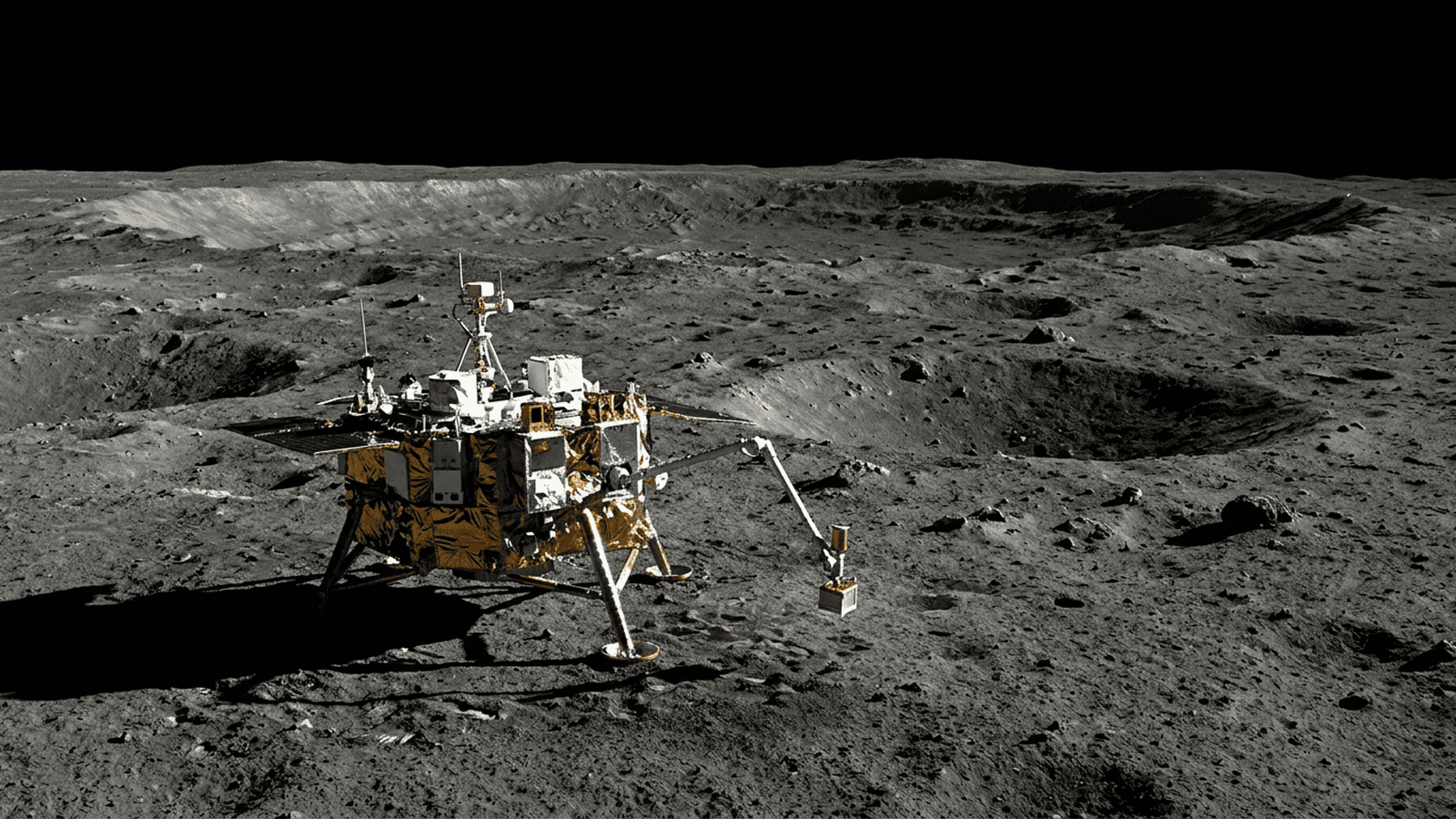
China’s Chang’e-6 mission returned the first samples collected from the Moon’s far side. Analysis dates basalt from the South Pole–Aitken basin to about 2.8 billion years ago and reveals a chemical composition that may help explain differences between the lunar hemispheres.
TLDR: Chang’e-6 brought back the first samples collected from the Moon’s far side in June 2024. Researchers dated basalt fragments to about 2.8 billion years old and found a composition low in several heat-producing elements. The results offer new evidence about lunar volcanism and the Moon’s contrasting hemispheres.
For the first time, scientists have analyzed rocks collected directly from the Moon’s far side. China’s Chang’e-6 mission brought 1,935.3 grams of lunar material back to Earth in June 2024, after landing in the South Pole–Aitken basin, an enormous impact crater. Laboratory dating of basalt fragments from the samples places a major episode of volcanic activity in the region at about 2.8 billion years ago. The result gives researchers a rare, physical record from a hemisphere that had previously been studied only from orbit or through meteorites whose original locations were uncertain. Returned rocks also allow direct mineral and isotope tests unavailable from orbit.
The landing site lies within a vast basin more than 2,400 kilometers across, formed by an ancient collision. The spacecraft collected soil and rock near the crater Apollo, using a robotic arm and a drill before an ascent vehicle carried the material to orbit and a return capsule delivered it to Earth. Researchers separated tiny fragments from the returned samples and used radiometric methods to estimate their ages. A study published in the journal Science reported an age of roughly 2.83 billion years for the basalt, evidence that lava flowed across this part of the lunar surface long after the basin itself formed. The basin’s scale makes it a key target for investigating the Moon’s earliest impacts and crust.
The date matters because most lunar samples collected during the Apollo and Luna missions came from the near side. Those rocks showed extensive volcanism, but their distribution left scientists unsure whether the far side followed the same timeline. Chang’e-6 provides the first direct test from the far side and reveals that volcanic activity continued there into the Moon’s middle history. The finding does not mean the entire far side was active at that time: the samples represent a small collection from one landing area, and the Moon’s volcanic history varied between regions.
Chemical measurements also point to a distinctive source for the lava. The basalt is low in certain heat-producing elements, including potassium, rare-earth elements and phosphorus, often grouped together by researchers as KREEP. That composition suggests the magma came from mantle material with less of these elements than sources associated with many near-side basalts. The difference offers a clue to why the near side has broad dark volcanic plains while much of the far side is more heavily cratered and has a thicker crust. These elements can generate heat through radioactive decay and influence mantle melting.
One proposed explanation is that the South Pole–Aitken impact altered the Moon’s deep interior. The collision may have heated or mixed mantle material, affecting where later melting could occur. But the Chang’e-6 samples alone cannot establish that the impact caused the observed chemistry or explain all the differences between the hemispheres. Scientists will compare the returned fragments with lunar meteorites, orbital measurements and samples from other missions, while checking how much the collection site represents the wider basin. Impact effects remain difficult to isolate.
The material’s scientific value extends beyond its age. Researchers can examine minerals, isotopes and traces of impact history in a controlled laboratory, with more precise instruments than can be carried on a lander. The samples may help refine models of lunar formation and the evolution of rocky worlds, while providing ground truth for remote sensing of the far side. Further studies and future sample-return missions will be needed to determine how widespread this volcanism was and what processes shaped the Moon’s two contrasting hemispheres.

Mason Reed serves as a Staff Writer for Just Right News, where he spearheads the Future Frontiers & Special Projects desk. In an era defined by rapid technological shifts and evolving social landscapes, Mason provides a steady, principled voice, examining the innovations of tomorrow through the lens of traditional American values. His work is most prominently featured in his signature series, “The Next Horizon,” where he explores the intersection of emerging technology, national sovereignty, and the preservation of individual liberty.
A native of San Diego, California, Mason’s worldview was shaped by the unique culture of his hometown. Growing up in a region defined by its strong military presence and its history of maritime industry, he developed a deep-seated respect for the institutions that provide national stability and the entrepreneurial spirit that drives the American economy. This upbringing instilled in him a belief that true progress is not found in discarding the past, but in building upon a foundation of proven principles. His reporting often reflects this San Diego influence, emphasizing the importance of a robust national defense and the necessity of maintaining a competitive edge in the global marketplace.
Now based in San Francisco, Mason operates from the heart of the world’s technological engine. Living and working in the Bay Area provides him with a front-row seat to the advancements—and the ideological challenges—emanating from Silicon Valley. While many in the region embrace a “move fast and break things” mentality, Mason’s reporting serves as a vital counterweight. He offers Just Right News readers a “boots on the ground” perspective, documenting how radical local policies and the concentration of tech power impact the everyday lives of citizens. His proximity to the industry allows him to cut through the marketing jargon of big tech to uncover the real-world implications for privacy, free speech, and the nuclear family.
In his “Future Frontiers” beat, Mason tackles complex subjects ranging from the ethics of artificial intelligence to the burgeoning private space race. He approaches these topics with a healthy skepticism toward centralized bureaucracy, championing instead the decentralized innovations that empower individuals. Through “The Next Horizon,” he highlights the pioneers and thinkers who are working to ensure that the future remains a place where human dignity and constitutional rights are protected. He believes that the rapid pace of change requires more than just technical expertise; it requires a moral compass rooted in the Western tradition.
Throughout his tenure at Just Right News, Mason has remained committed to the idea that the future is something to be shaped, not merely accepted. His writing is characterized by a rigorous defense of American exceptionalism and a belief that the country’s best days lie ahead, provided it remains true to its founding ideals. Whether he is investigating the impact of automation on the American workforce or profiling the next generation of aerospace engineers, Mason Reed ensures that his readers are equipped with the insights they need to navigate a changing world with confidence and clarity.