

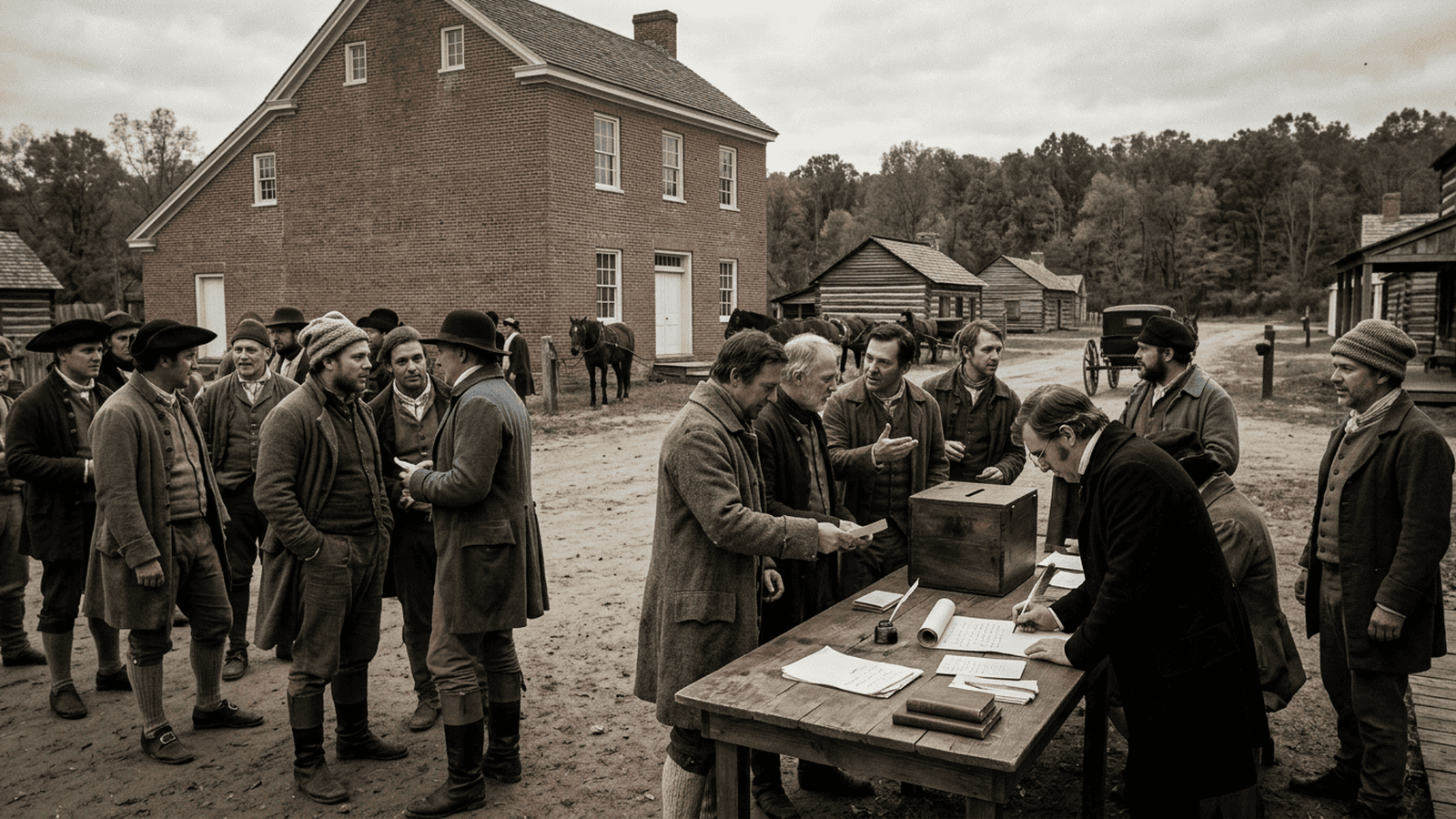
Ohio’s 1802 constitution established voting rules and elected offices as the territory prepared to become a state in the United States. It widened political participation for many white male settlers while excluding women, Indigenous people, and Black residents, and set a framework that shaped the state’s early elections.
TLDR: Ohio’s 1802 constitution created the election system for the new state, granting voting rights to qualifying white male residents aged 21 and older. Annual legislative elections and elected county offices brought regular voting into public life, while racial, gender, residency, and tax restrictions sharply limited who could participate.
When Ohio’s constitutional convention met in Chillicothe in November 1802, its delegates faced a practical question with national implications: who would choose the officers of a new state? The Northwest Territory was moving toward statehood, and its population had grown rapidly. The constitution they adopted on November 29 established rules for voting and representation before Ohio entered the Union in February 1803. Rather than leave elections to territorial officials, the charter created a state government whose legitimacy would rest on regular popular voting by a defined electorate. Congress’s Enabling Act of 1802 authorized the convention and specified the steps toward statehood, placing Ohio’s constitution within a process overseen by the federal government.
The constitution gave voting rights to white male inhabitants aged 21 and older who had lived in the state for a year and paid, or been charged with, a state or county tax. That rule placed elections within reach of many ordinary settlers, while excluding women, Indigenous people, and Black residents from the political community it defined. The franchise was broader than property qualifications used in some states, but it was not universal. Its terms reflected a central tension in early American democracy: expanding participation among white men while drawing firm racial and gender boundaries around political membership.
Ohio’s lawmakers were elected by district, with representatives chosen annually. Voters also elected county officers, including sheriffs and coroners, making elections consequential beyond the statehouse. The constitution assigned the legislature a central role in setting the details of election administration, including the time and manner of voting. By leaving practical election procedures to lawmakers, the charter allowed the legislature to adjust how voting was conducted without calling another constitutional convention. This framework linked local communities to state government and gave the new legislature power to shape the machinery through which political competition operated. Elections were not a single event, but a recurring process that connected state policy to county-level administration.
The convention’s design also placed limits on direct popular control. Voters selected the governor, but the constitution provided for a two-year term, while the legislature elected judges and several other officials. Ohio’s system therefore combined popular elections with appointments made by representatives. Annual legislative contests offered frequent opportunities for voters to reward or reject lawmakers, while the governor’s longer term provided a measure of continuity. The arrangement belonged to a broader early-republic debate over how much authority should be entrusted directly to voters and how much should pass through elected institutions.
The constitution emerged from a convention shaped by political argument, not a neutral administrative exercise. Delegates debated the structure of government, the reach of the franchise, and the balance between executive and legislative power. The final charter helped secure statehood, but it also established a political order in which participation depended on race, sex, residence, and tax status. For settlers arriving in a rapidly changing region, the rules determined who could help choose the officials governing land, courts, roads, and local public affairs. Those boundaries were part of the founding settlement, not a later technical detail.
Ohio’s 1802 constitution thus made election rules foundational to the state’s entry into the Union. Its annual legislative elections and elected county offices gave voting a regular role in public life, while its exclusions exposed the limits of the era’s democratic claims. Later constitutional changes altered Ohio’s institutions and expanded political participation, but the original framework remained an important reference point in the state’s political development. The episode also illustrates how early statehood conventions turned broad ideals of popular government into specific rules about eligibility, officeholding, and oversight.

Sophie Carter serves as a Staff Writer for Just Right News, where she anchors the outlet’s critical coverage of Elections, Influence, and Democracy Infrastructure. In an era where the mechanics of voting and the flow of political capital are under constant scrutiny, Sophie provides a steady, principled voice dedicated to the preservation of American institutional integrity and the rule of law.
Raised in Charlotte, North Carolina, Sophie’s perspective was forged in a community that balances rapid modern growth with a deep respect for tradition and civic duty. Growing up in the Queen City, she witnessed firsthand how a robust local culture depends on the trust between the citizen and the state. This upbringing instilled in her a foundational belief that the right to vote is a sacred trust—one that must be protected from both administrative overreach and the encroaching influence of special interest groups. Her reporting reflects these North Carolina roots, emphasizing the importance of community-led governance and the preservation of the individual’s voice in the face of nationalized political movements.
Now based in Atlanta, Georgia, Sophie operates from the heart of one of the nation’s most pivotal and contested political landscapes. Her location allows her to report from the front lines of the debate over election security, legislative reform, and the modernization of voting systems. For Sophie, the “infrastructure” of democracy is not merely a matter of machines and ballots; it is the collection of laws, people, and transparent processes required to maintain public confidence. Her work often highlights the necessity of clear, enforceable standards that ensure every legal vote is counted fairly and that the machinery of our republic remains accountable to the taxpayers who fund it.
Central to her work at Just Right News is her acclaimed feature series, “The Price of a Vote.” Through this ongoing project, Sophie explores the complex web of influence that shapes modern campaigns and policy decisions. She delves into how high-level lobbying, non-governmental organizations, and shifting bureaucratic regulations impact the weight of an individual citizen’s ballot. By examining the financial and structural pressures placed on the electoral process, she provides readers with a comprehensive look at the forces vying for control over the American political system.
Sophie’s approach to journalism is rooted in a commitment to the constitutional framework. She views her role as a watchdog for the voter, ensuring that the systems meant to serve the public remain transparent and free from corruption. Whether she is analyzing the implementation of new voting technologies or investigating the influence of outside money on state-level policy, her work is characterized by a rigorous adherence to facts and a refusal to succumb to the sensationalism that often plagues modern political reporting.
At Just Right News, Sophie Carter continues to be a vital resource for readers who value clarity, conviction, and a defense of traditional American values. Her deep ties to the Southeast and her specialized focus on the mechanics of our republic make her an essential voice in the ongoing conversation about the future of American self-governance. Through her reporting, she remains dedicated to the idea that a secure and honest electoral system is the bedrock of a free and prosperous society.