

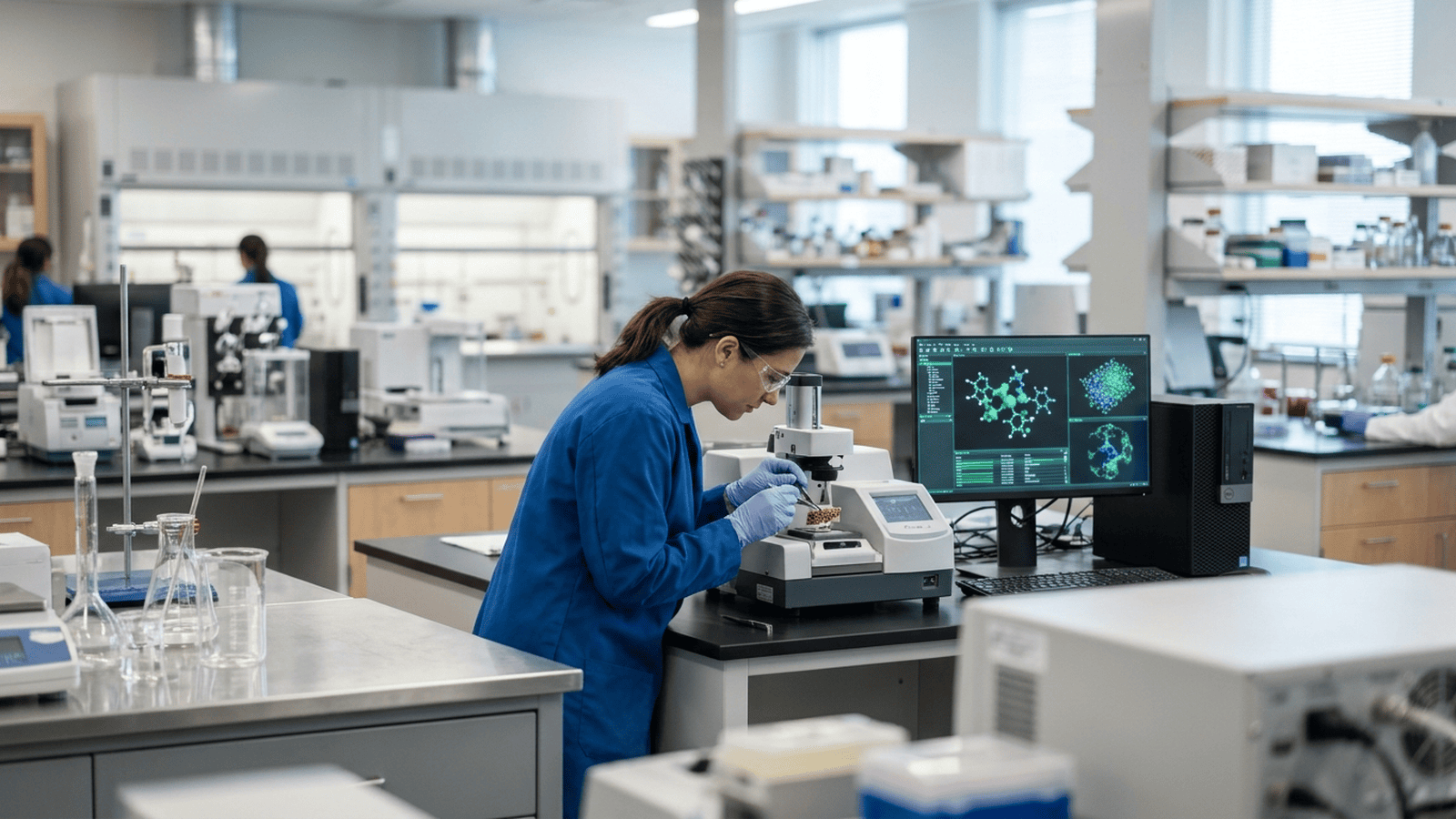
Toyota Research Institute and MIT researchers reported a machine-learning approach to help prioritize materials for energy-storage research. The method combines computational predictions with laboratory testing, but it does not represent a finished battery or a product ready for market.
TLDR: Toyota Research Institute and MIT developed a machine-learning approach to help researchers choose promising energy-storage materials for laboratory testing. By linking predictions with experimental results, the method could make materials searches more efficient. Any candidate still needs extensive testing before it can become a practical battery component.
A research team at Toyota Research Institute and the Massachusetts Institute of Technology has developed a machine-learning method to help scientists identify promising materials for energy storage. The work, published in the journal Nature in 2023, targets a familiar bottleneck: researchers can calculate or imagine enormous numbers of possible compounds, but testing them in a laboratory takes time and resources. The approach uses artificial intelligence to narrow that search and guide experiments toward materials that could be useful in batteries and other energy technologies. In conventional workflows, researchers rely on calculations and expertise to decide which candidates merit synthesis, leaving many possibilities unexplored.
The method links computational predictions with laboratory testing. Researchers first used machine-learning models to estimate how candidate materials might perform, then used those predictions to select which substances to make and examine. Results from the experiments could, in turn, inform later predictions. This feedback loop is intended to make each round of testing more useful than a process that simply synthesizes candidates one after another. This is particularly useful when experimental measurements are scarce, since model estimates can help rank options rather than claim certainty.
Materials discovery is challenging because a small change in chemical composition or atomic arrangement can produce a large change in performance. A compound may conduct ions well but be unstable, or offer desirable properties only under conditions that are difficult to achieve in a working device. Battery researchers must weigh several characteristics at once, including energy storage, safety, durability, cost and the availability of constituent elements. Predicting a promising candidate is therefore only an early step; its properties must still be measured and ultimately tested in a device. Those trade-offs vary with specific battery chemistry and application.
The Toyota-MIT collaboration focused on using data-driven tools to help prioritize that work. Rather than treating a model’s estimate as a final answer, the researchers combined predictions with experimental evidence. That distinction matters because machine-learning systems can be confident and wrong, especially when asked to assess compounds unlike those represented in their training data. Laboratory measurements provide a check on the calculations and help reveal where the models need improvement.
The project reflects a broader change in materials research. Researchers are increasingly combining computational screening, machine learning and automated or carefully planned experiments to explore chemical possibilities more efficiently. Such systems can help direct expert attention toward candidates worth investigating, but they do not remove the need for materials scientists to design experiments, interpret results and assess practical constraints. Nor does identifying an interesting compound establish that it can be manufactured economically or perform reliably at commercial scale.
The work is relevant to battery development because improved materials could help address limits in energy density, lifespan, safety or cost. Yet the study does not announce a new commercial battery or demonstrate a product ready for consumers. Moving from a predicted or laboratory-tested material to a useful battery typically requires further evaluation, including tests of stability, manufacturing processes and performance over repeated charging cycles.
For Toyota, whose business includes vehicles and energy-related technologies, faster materials research could eventually support the search for better storage systems. For the wider field, the key measure will be whether machine-learning predictions repeatedly lead to useful experimental results across different material families, not just whether an algorithm can generate many candidates. The next steps include validating promising materials, expanding the quality of the underlying data and determining whether the approach can shorten real development timelines. AI can help researchers search more strategically, but practical breakthroughs will depend on careful experiments and engineering.

Mason Reed serves as a Staff Writer for Just Right News, where he spearheads the Future Frontiers & Special Projects desk. In an era defined by rapid technological shifts and evolving social landscapes, Mason provides a steady, principled voice, examining the innovations of tomorrow through the lens of traditional American values. His work is most prominently featured in his signature series, “The Next Horizon,” where he explores the intersection of emerging technology, national sovereignty, and the preservation of individual liberty.
A native of San Diego, California, Mason’s worldview was shaped by the unique culture of his hometown. Growing up in a region defined by its strong military presence and its history of maritime industry, he developed a deep-seated respect for the institutions that provide national stability and the entrepreneurial spirit that drives the American economy. This upbringing instilled in him a belief that true progress is not found in discarding the past, but in building upon a foundation of proven principles. His reporting often reflects this San Diego influence, emphasizing the importance of a robust national defense and the necessity of maintaining a competitive edge in the global marketplace.
Now based in San Francisco, Mason operates from the heart of the world’s technological engine. Living and working in the Bay Area provides him with a front-row seat to the advancements—and the ideological challenges—emanating from Silicon Valley. While many in the region embrace a “move fast and break things” mentality, Mason’s reporting serves as a vital counterweight. He offers Just Right News readers a “boots on the ground” perspective, documenting how radical local policies and the concentration of tech power impact the everyday lives of citizens. His proximity to the industry allows him to cut through the marketing jargon of big tech to uncover the real-world implications for privacy, free speech, and the nuclear family.
In his “Future Frontiers” beat, Mason tackles complex subjects ranging from the ethics of artificial intelligence to the burgeoning private space race. He approaches these topics with a healthy skepticism toward centralized bureaucracy, championing instead the decentralized innovations that empower individuals. Through “The Next Horizon,” he highlights the pioneers and thinkers who are working to ensure that the future remains a place where human dignity and constitutional rights are protected. He believes that the rapid pace of change requires more than just technical expertise; it requires a moral compass rooted in the Western tradition.
Throughout his tenure at Just Right News, Mason has remained committed to the idea that the future is something to be shaped, not merely accepted. His writing is characterized by a rigorous defense of American exceptionalism and a belief that the country’s best days lie ahead, provided it remains true to its founding ideals. Whether he is investigating the impact of automation on the American workforce or profiling the next generation of aerospace engineers, Mason Reed ensures that his readers are equipped with the insights they need to navigate a changing world with confidence and clarity.