

An international team reported direct spectroscopic evidence of altermagnetic behavior in manganese telluride, a material with no net magnetization but distinctive spin-dependent electronic properties. The result supports further research into whether altermagnets could enable spintronic devices, though practical applications will require reliable control and testing in device settings.
TLDR: Researchers used spin-sensitive spectroscopy to find an electronic signature consistent with altermagnetism in manganese telluride. Altermagnets combine zero net magnetization with direction-dependent electronic behavior, potentially useful for spintronics. The result strengthens evidence for this emerging materials class, but device applications remain a research goal, not a demonstrated technology.
An international research team has obtained direct evidence of an unusual magnetic state in manganese telluride, a crystalline material whose properties challenge the familiar division between ferromagnets and antiferromagnets. The result, reported in 2024, strengthens the case for altermagnets: materials with magnetic order but no net magnetization, whose electrons can nevertheless show direction-dependent behavior useful in electronics.
Ferromagnets, such as iron, have atomic magnetic moments that largely point the same way. Their collective alignment creates a magnetic field that can be used to store information, but also makes devices vulnerable to stray fields. In antiferromagnets, neighboring moments point in opposite directions, canceling the overall field. That makes them less susceptible to interference, although their balanced arrangement can be difficult to control and detect. That can reduce cross-talk between neighboring elements, a possible advantage as devices shrink.
Altermagnets combine features associated with both. Their opposing magnetic moments cancel overall, as in an antiferromagnet, but the crystal’s structure and magnetic pattern can cause electrons to behave differently depending on their momentum and direction. Theory predicted that this arrangement could split electronic energy bands even without a strong external magnetic field. The effect depends on crystal symmetry, not simply on net magnetization. Demonstrating that signature in a real material has been a central challenge.
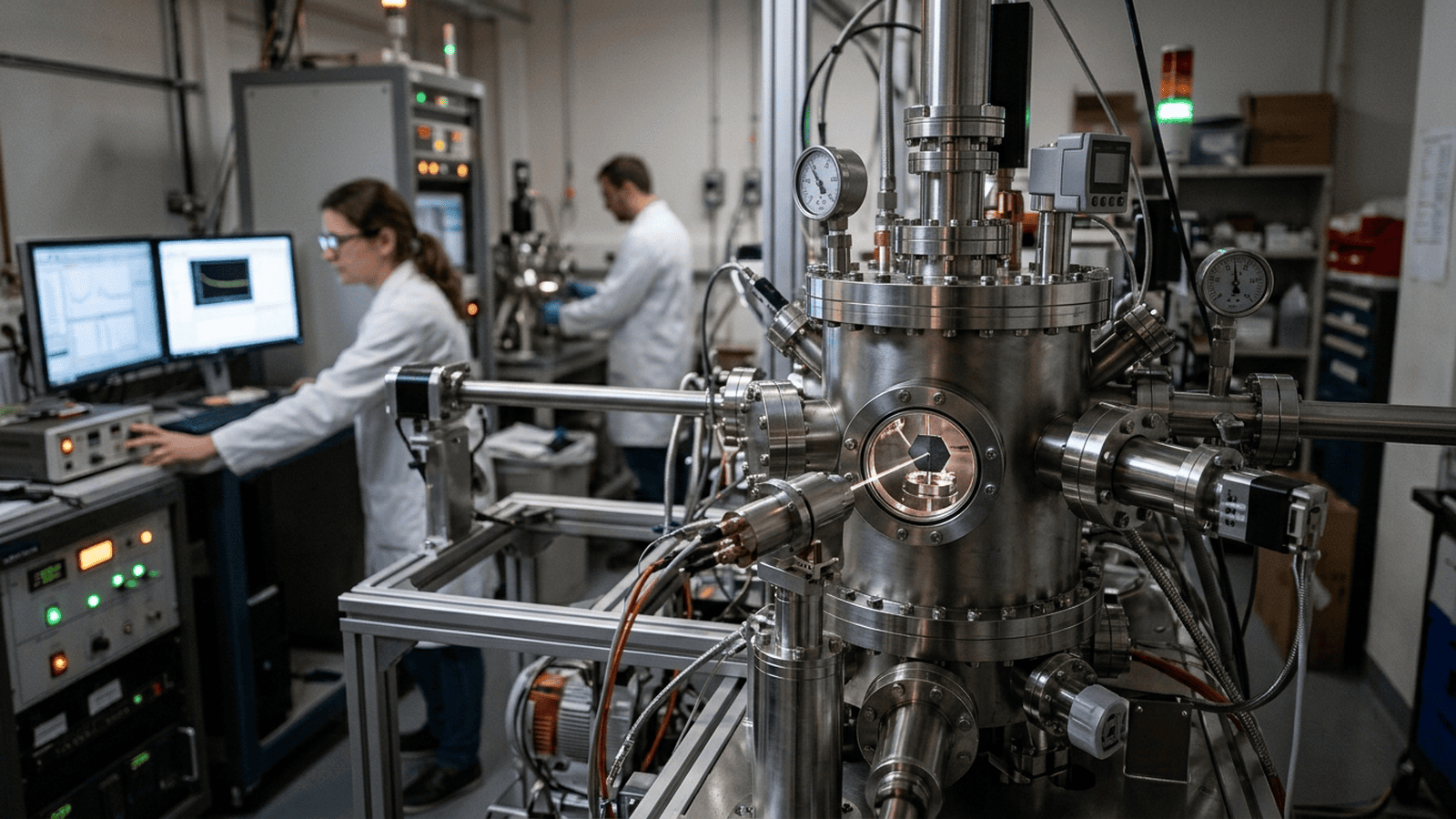
The researchers examined manganese telluride, often abbreviated MnTe, using spin- and angle-resolved photoemission spectroscopy. The technique directs light at a sample and measures the energy and momentum of electrons emitted from its surface, while also determining their spin. Those measurements let scientists map how electronic states vary across the material and test whether the predicted spin-dependent band splitting was present. By comparing spin channels at corresponding momenta, they could distinguish the proposed splitting from ordinary energy-band features.
The observed pattern matched the expected altermagnetic signature. The finding was significant because it connected the material’s magnetic structure to the behavior of its electrons, rather than relying only on indirect clues. MnTe had already been studied as an antiferromagnet; the newer interpretation and measurements highlighted how its symmetry permits a distinct form of spin splitting. This distinction matters for classification.
The work brought together researchers across institutions and countries, including groups in the Czech Republic and partner teams with expertise in magnetic materials, spectroscopy and theory. Such collaboration matters because identifying an altermagnet requires several kinds of evidence: a careful understanding of the crystal structure, measurements sensitive to electron spin, and calculations that link those observations to the underlying magnetic order.
The result does not mean that a practical altermagnetic memory device is ready. MnTe’s electronic properties, the conditions needed to manipulate its magnetic state, and the stability of that state in a working device all require further study. Spectroscopy also probes a material under controlled laboratory conditions, not as part of a complete information-processing system.
Still, the discovery broadens the options researchers can explore when designing spintronic devices, which use electron spin as well as electrical charge. The absence of a net magnetic field could reduce unwanted interactions between nearby components, while the direction-dependent electronic response may offer ways to read or control information. Those are potential advantages, not yet demonstrated performance claims.
The next steps include finding ways to switch altermagnetic order reliably, testing other candidate materials, and learning how interfaces and thin films affect their behavior. Researchers will also need to establish whether the predicted properties persist in devices that can be manufactured and operated efficiently. MnTe’s experimentally observed signature gives the field a concrete system for pursuing those questions—and a stronger foundation for investigating this emerging class of magnetic materials.

Mason Reed serves as a Staff Writer for Just Right News, where he spearheads the Future Frontiers & Special Projects desk. In an era defined by rapid technological shifts and evolving social landscapes, Mason provides a steady, principled voice, examining the innovations of tomorrow through the lens of traditional American values. His work is most prominently featured in his signature series, “The Next Horizon,” where he explores the intersection of emerging technology, national sovereignty, and the preservation of individual liberty.
A native of San Diego, California, Mason’s worldview was shaped by the unique culture of his hometown. Growing up in a region defined by its strong military presence and its history of maritime industry, he developed a deep-seated respect for the institutions that provide national stability and the entrepreneurial spirit that drives the American economy. This upbringing instilled in him a belief that true progress is not found in discarding the past, but in building upon a foundation of proven principles. His reporting often reflects this San Diego influence, emphasizing the importance of a robust national defense and the necessity of maintaining a competitive edge in the global marketplace.
Now based in San Francisco, Mason operates from the heart of the world’s technological engine. Living and working in the Bay Area provides him with a front-row seat to the advancements—and the ideological challenges—emanating from Silicon Valley. While many in the region embrace a “move fast and break things” mentality, Mason’s reporting serves as a vital counterweight. He offers Just Right News readers a “boots on the ground” perspective, documenting how radical local policies and the concentration of tech power impact the everyday lives of citizens. His proximity to the industry allows him to cut through the marketing jargon of big tech to uncover the real-world implications for privacy, free speech, and the nuclear family.
In his “Future Frontiers” beat, Mason tackles complex subjects ranging from the ethics of artificial intelligence to the burgeoning private space race. He approaches these topics with a healthy skepticism toward centralized bureaucracy, championing instead the decentralized innovations that empower individuals. Through “The Next Horizon,” he highlights the pioneers and thinkers who are working to ensure that the future remains a place where human dignity and constitutional rights are protected. He believes that the rapid pace of change requires more than just technical expertise; it requires a moral compass rooted in the Western tradition.
Throughout his tenure at Just Right News, Mason has remained committed to the idea that the future is something to be shaped, not merely accepted. His writing is characterized by a rigorous defense of American exceptionalism and a belief that the country’s best days lie ahead, provided it remains true to its founding ideals. Whether he is investigating the impact of automation on the American workforce or profiling the next generation of aerospace engineers, Mason Reed ensures that his readers are equipped with the insights they need to navigate a changing world with confidence and clarity.