

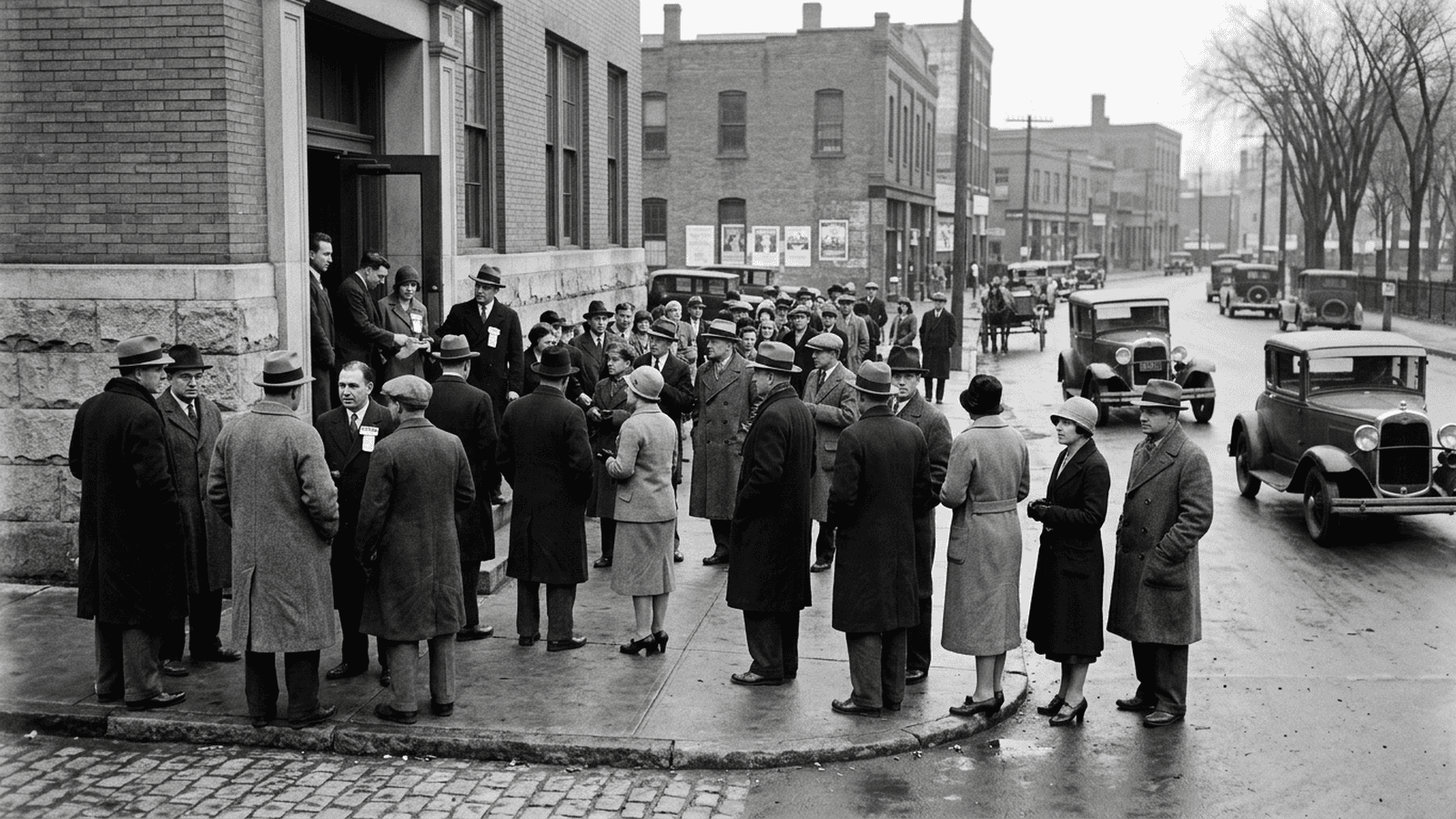
In 1933, Depression-era voters in Bridgeport, Connecticut, elected Socialist reformer Jasper McLevy mayor, ending decades of Democratic machine control. His victory reflected demands for economical, accountable city government in the United States, and began a long administration marked by both anti-patronage efforts and disputes over public spending.
TLDR: Bridgeport voters elected Jasper McLevy mayor in 1933, ending decades of Democratic control. The Socialist reformer campaigned against patronage and waste as the Great Depression strained city finances. His long tenure made Bridgeport a notable experiment in municipal reform, while debates over spending and services continued.
On November 7, 1933, Bridgeport voters elected Jasper McLevy mayor, ending decades of Democratic control and bringing a self-described municipal reformer to power during the Great Depression. McLevy, a Socialist and longtime political outsider, campaigned against patronage and waste. His victory made Bridgeport a prominent example of how economic distress and anger at machine politics could reshape local government in New England.
Bridgeport had grown rapidly as an industrial city, producing goods ranging from sewing machines to munitions. Its expansion brought crowded neighborhoods, labor disputes, and increasing demands for public services. The Democratic organization had dominated city politics, relying on networks of ward leaders and public jobs. Critics charged that patronage, favoritism, and lax oversight weakened public confidence, although the election was not a referendum on one single proven criminal scandal.
McLevy’s path to City Hall began long before 1933. Born in 1878, he worked as a house painter and entered politics through the Socialist Party. He ran for mayor repeatedly, building a reputation for frugality and persistence even when he lost. His campaigns emphasized honest administration, lower costs, and professional standards rather than the distribution of municipal jobs through party connections. The Depression made those arguments more potent as unemployment and shrinking revenues put pressure on city budgets.
In 1933, McLevy won with support that crossed the boundaries of his party. His election was part of a wider period of political experimentation: voters facing economic hardship were willing to consider candidates outside established party organizations. Bridgeport’s result also reflected McLevy’s local recognition and years of campaigning, not simply a sudden national swing toward socialism. He took office in January 1934 and began a mayoral tenure that would last until 1957.
McLevy’s administration became closely identified with economy in city government. He sought to restrain spending, scrutinize municipal departments, and limit the use of public employment as a political reward. Supporters viewed those efforts as a practical alternative to machine rule. Critics, including labor advocates, argued that extreme cost-cutting could leave city services and workers underfunded. His record therefore combined an anti-patronage reputation with contentious choices over what government should provide during a crisis.
The mayor’s methods were shaped by the limited powers of a city executive and by the broader economic emergency. New Deal programs created federal assistance and public works opportunities, but they did not erase Bridgeport’s fiscal pressures or settle local debates about priorities. McLevy’s administration had to navigate those pressures while maintaining its claim to careful management. The city’s politics remained competitive, and his long tenure did not mean every resident agreed with his policies or that political conflict disappeared.
The 1933 result mattered beyond the immediate change in office. It demonstrated that a disciplined local campaign could defeat a deeply established party organization when voters connected economic strain with demands for cleaner, more accountable administration. McLevy’s electoral success also gave Socialist politics a rare foothold in a major American industrial city, though it did not produce a wholesale transformation of the national party system.
Bridgeport’s reform episode was not a substitute for formal investigations or a sweeping new ethics code. Its significance lay in the electoral check voters imposed on a machine and in the administration’s continuing emphasis on spending oversight and patronage restraint. McLevy’s years in office kept the city’s experiment in reform visible through the New Deal and into the postwar era. The case illustrated both the promise and limits of municipal anti-corruption politics: elections could change who controlled City Hall, while debates over transparency, services, and public spending continued.

Dylan Brooks serves as the Senior Correspondent for Statehouses and Local Governance at Just Right News, where he brings a principled, constitutionalist lens to the often-overlooked machinery of state-level politics. As the lead voice behind the acclaimed feature series “Fifty Laboratories of Power,” Dylan has dedicated his career to the idea that the most impactful governance happens closest to home. His reporting consistently champions the Tenth Amendment, exploring how individual states can serve as testing grounds for innovative, conservative policy solutions that prioritize personal liberty and fiscal responsibility.
A native of Des Moines, Iowa, Dylan’s journalistic philosophy was forged in the heart of the American Midwest. Growing up in a community where local school board meetings and town halls were the bedrock of civic life, he developed a deep appreciation for the “retail politics” of the heartland. This upbringing instilled in him a fundamental belief that the American experiment is best preserved when power is decentralized. He carries the values of his Iowa roots into every assignment, maintaining a healthy skepticism of federal overreach and a steadfast commitment to the concerns of everyday citizens over the interests of the administrative state.
Now based in Madison, Wisconsin, Dylan operates from one of the nation’s most pivotal political battlegrounds. His location in a state capital known for its rigorous policy debates allows him to provide Just Right News readers with a front-row seat to the legislative process. From Madison, he tracks the ripple effects of statehouse decisions on local municipalities, ensuring that the connection between high-level policy and community impact is never lost. His work often highlights the success of conservative governors and legislatures in fostering economic growth, protecting parental rights, and securing the integrity of local institutions.
As an African American man in the conservative media landscape, Dylan offers a vital perspective on how limited government and free-market principles empower individuals and families. He frequently reports on how deregulation and school choice initiatives provide new avenues for success in underserved communities, challenging the monolithic narratives often presented by legacy media outlets. Dylan’s work is characterized by a commitment to the facts and a refusal to shy away from the complex realities of modern governance.
Throughout his tenure at Just Right News, Dylan has become a trusted authority for readers who value a rigorous, principled approach to the news. Whether he is dissecting a complex state budget or profiling a local grassroots movement, his goal remains the same: to provide the American public with the information they need to hold their local leaders accountable. By focusing on the “Fifty Laboratories of Power,” Dylan Brooks ensures that the vital work being done in statehouses across the country receives the national attention it deserves, always through a lens that respects the traditions and sovereignty of the American people.