

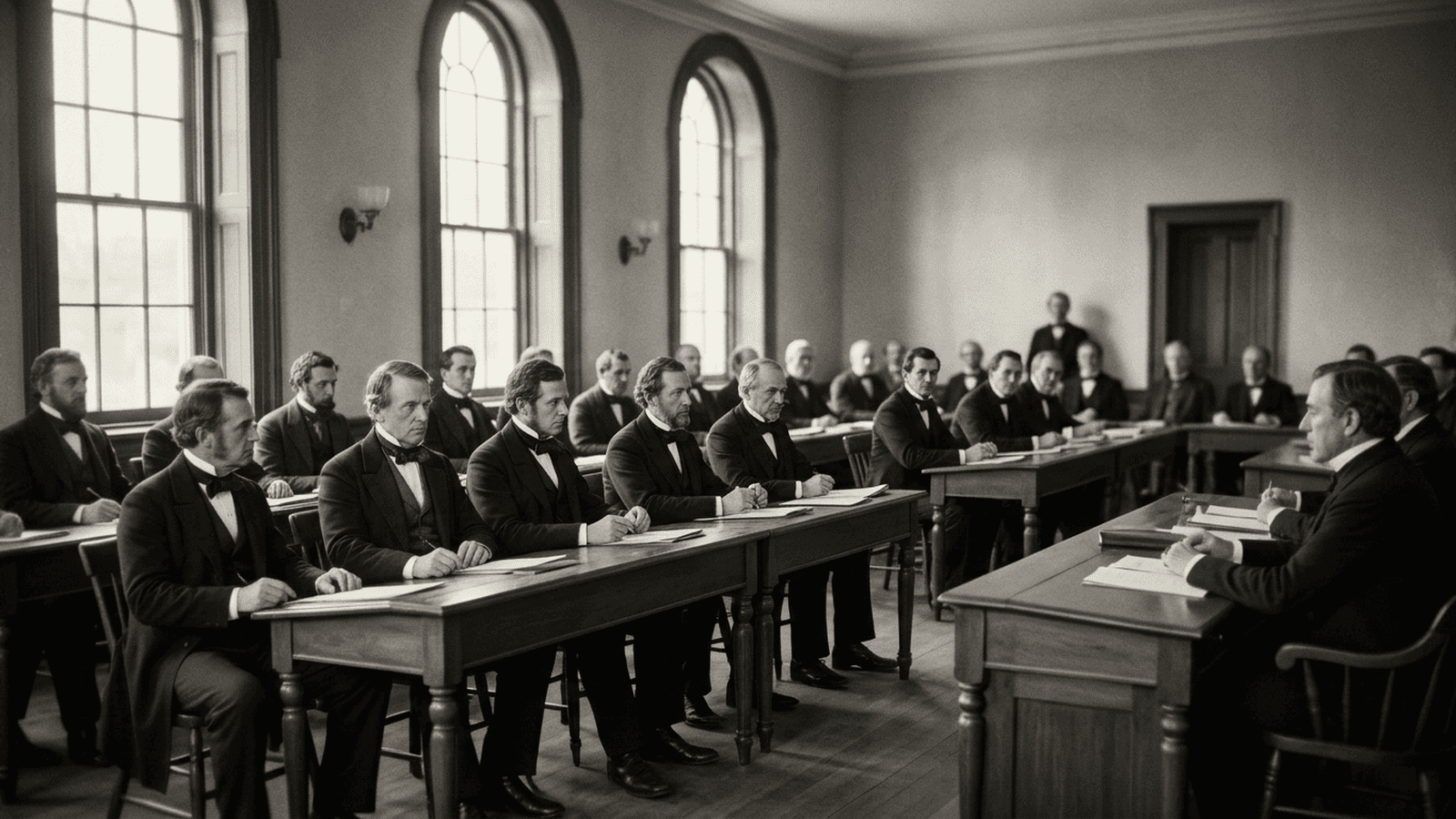
Ohio’s 1850–51 constitutional convention responded to concerns about public debt, legislative favoritism and limited accountability by rewriting the state’s governing rules. Ratified by voters in 1851, the new constitution expanded elections for key offices and imposed safeguards on borrowing and corporate privileges in the United States.
TLDR: Ohio’s 1850–51 constitutional convention rewrote state government amid concerns about legislative favoritism, public debt and accountability. Voters ratified a constitution that made major officials, including judges, elective and restricted certain borrowing, special corporate charters and the use of public credit. It took effect in September 1851.
By the middle of the nineteenth century, Ohio’s government was struggling to keep pace with a fast-growing state. Its 1802 constitution had established the basic institutions, but population, commerce and public works had expanded dramatically. The older charter dated from Ohio’s admission to the Union, before its later growth. Critics argued that lawmakers could grant corporations special privileges, accumulate public debt and shape the courts with too little direct accountability. In 1850, voters approved a convention to reconsider the state’s governing rules.
The convention assembled in Columbus in May 1850, bringing together 108 delegates elected from across Ohio. They worked amid arguments familiar throughout the Midwest: how to finance roads and canals, restrain powerful interests and give citizens a stronger check on officials. The debate was not simply about a single corruption scandal. It was a broad response to concerns that concentrated authority and private influence could distort public policy. Delegates weighed stronger popular control against risks of politicizing offices through frequent elections.
Ohio’s earlier system gave the legislature considerable influence over appointments, including the selection of judges. Convention delegates proposed transferring more choices to voters. Under the new framework, voters would elect the governor and other major executive officers, as well as judges. The change promised clearer public accountability, although critics worried that election campaigns could make the courts vulnerable to partisan pressure.
The draft constitution also sought to limit special legislative favors. It directed the General Assembly to create corporations under general laws rather than routinely granting individual charters by special act. This approach aimed to make rules more uniform and reduce opportunities for lawmakers to reward particular applicants. It did not eliminate corporate influence, but it narrowed one route through which private interests could seek exceptional treatment.
Fiscal restraint was another central concern. Ohio had experienced the dangers of borrowing for ambitious internal-improvement projects, including roads and canals, when expected returns failed to meet obligations. The constitution placed limits on state borrowing and required greater voter involvement before certain large debts could be incurred. It also restricted the state’s ability to invest public money in private corporations or lend them its credit. These rules reflected distrust of speculative projects as well as a demand for stronger safeguards over taxpayers’ funds.
Delegates also debated taxation, local government and the structure of the legislature. The resulting document preserved a bicameral General Assembly but set rules intended to regularize lawmaking and public finance. Its provisions reflected a broader antebellum reform impulse: government should have enough authority to serve a growing population, yet should not be able to make costly commitments or dispense privileges without checks.
The convention completed its work in March 1851. Ohio voters ratified the constitution on June 17, and it took effect on September 1. The change marked a substantial revision rather than a clean break. The state retained its existing political institutions, but altered how key officials reached office and placed new constitutional constraints on debt, corporate privileges and public credit. Popular election made officials more directly answerable to voters; it also tied judicial careers more closely to electoral politics.
The 1851 constitution endured for generations, though Ohioans amended it repeatedly as the state changed. Its restrictions on borrowing and special legislation did not end disputes over public spending or corporate power. They did, however, establish lasting rules for oversight and accountability. Ohio’s convention showed how anti-corruption politics in the antebellum Midwest could take the form of structural reform: limiting discretionary favors, making officials answer to voters and writing fiscal safeguards into the state’s governing charter.

Dylan Brooks serves as the Senior Correspondent for Statehouses and Local Governance at Just Right News, where he brings a principled, constitutionalist lens to the often-overlooked machinery of state-level politics. As the lead voice behind the acclaimed feature series “Fifty Laboratories of Power,” Dylan has dedicated his career to the idea that the most impactful governance happens closest to home. His reporting consistently champions the Tenth Amendment, exploring how individual states can serve as testing grounds for innovative, conservative policy solutions that prioritize personal liberty and fiscal responsibility.
A native of Des Moines, Iowa, Dylan’s journalistic philosophy was forged in the heart of the American Midwest. Growing up in a community where local school board meetings and town halls were the bedrock of civic life, he developed a deep appreciation for the “retail politics” of the heartland. This upbringing instilled in him a fundamental belief that the American experiment is best preserved when power is decentralized. He carries the values of his Iowa roots into every assignment, maintaining a healthy skepticism of federal overreach and a steadfast commitment to the concerns of everyday citizens over the interests of the administrative state.
Now based in Madison, Wisconsin, Dylan operates from one of the nation’s most pivotal political battlegrounds. His location in a state capital known for its rigorous policy debates allows him to provide Just Right News readers with a front-row seat to the legislative process. From Madison, he tracks the ripple effects of statehouse decisions on local municipalities, ensuring that the connection between high-level policy and community impact is never lost. His work often highlights the success of conservative governors and legislatures in fostering economic growth, protecting parental rights, and securing the integrity of local institutions.
As an African American man in the conservative media landscape, Dylan offers a vital perspective on how limited government and free-market principles empower individuals and families. He frequently reports on how deregulation and school choice initiatives provide new avenues for success in underserved communities, challenging the monolithic narratives often presented by legacy media outlets. Dylan’s work is characterized by a commitment to the facts and a refusal to shy away from the complex realities of modern governance.
Throughout his tenure at Just Right News, Dylan has become a trusted authority for readers who value a rigorous, principled approach to the news. Whether he is dissecting a complex state budget or profiling a local grassroots movement, his goal remains the same: to provide the American public with the information they need to hold their local leaders accountable. By focusing on the “Fifty Laboratories of Power,” Dylan Brooks ensures that the vital work being done in statehouses across the country receives the national attention it deserves, always through a lens that respects the traditions and sovereignty of the American people.