

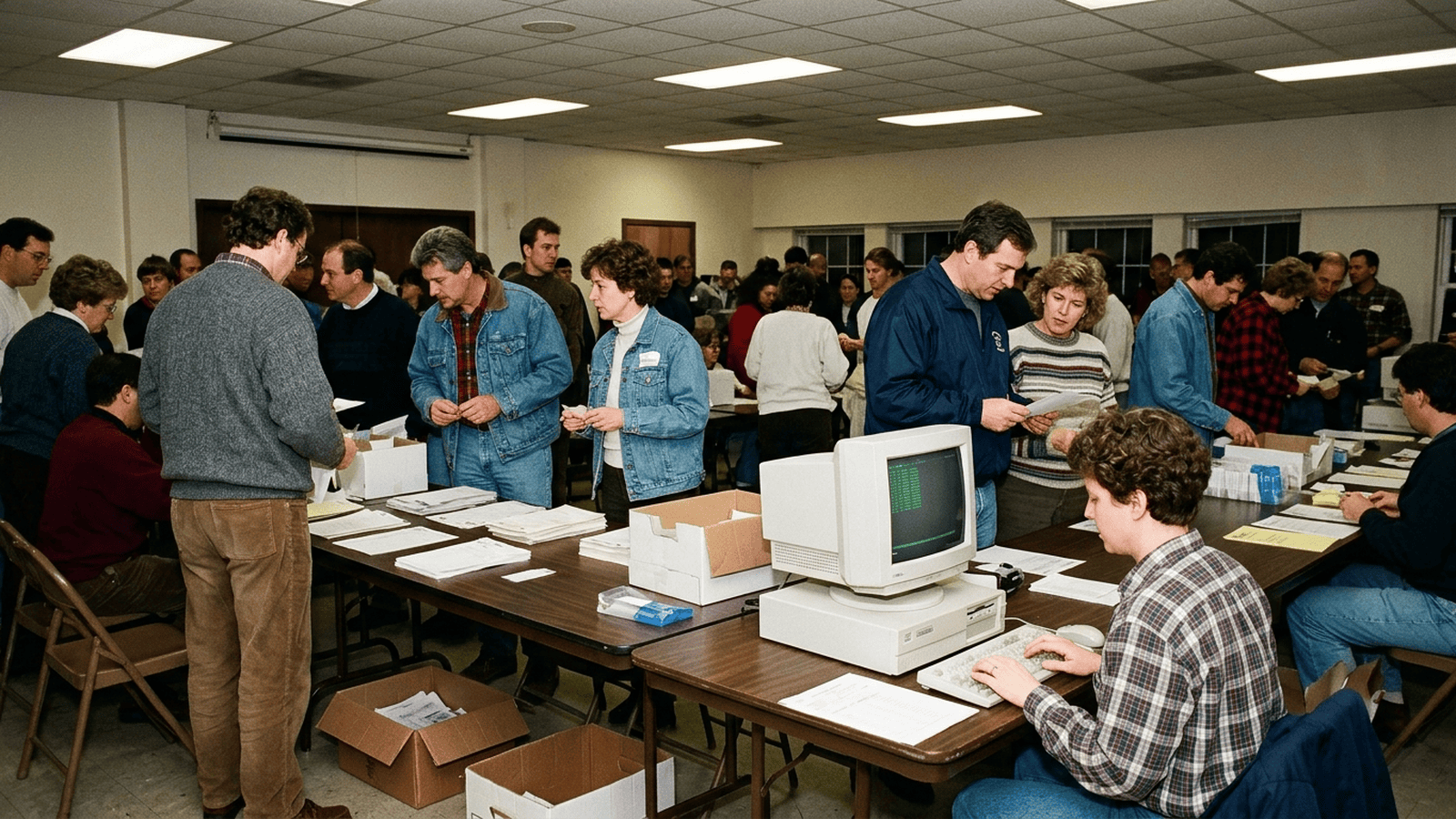
Massachusetts voters approved the Clean Elections Law in 1998, creating voluntary public financing for qualifying state candidates. The U.S. state’s experiment was blocked by funding disputes, upheld against a repeal vote in 2002, and then repealed by the legislature in 2003.
TLDR: Massachusetts voters approved voluntary public financing for state candidates in 1998. A dispute over legislative appropriations reached the state’s highest court, while voters rejected repeal in 2002. The legislature repealed the program in 2003, leaving a brief but influential case study in the limits of voter-approved election reform.
In November 1998, Massachusetts voters approved a new approach to campaign finance: qualifying candidates for state office could receive public money rather than rely entirely on private contributions. The Clean Elections Law passed as a ballot question with roughly two-thirds support. Its backers argued that candidates should be able to campaign without becoming dependent on large donors, while opponents questioned the cost and the state’s role in financing political campaigns. The vote made Massachusetts a prominent test of whether public financing could change the incentives of state-level elections. Because the initiative dealt with state offices, its effects concerned races for positions such as governor and the legislature, not federal elections.
The law created a voluntary system. Candidates who chose to participate had to meet qualification requirements, including gathering a prescribed number of small contributions, and agree to limits on campaign spending and private fundraising. In return, eligible candidates could receive public funds for their campaigns. The measure also established a dedicated fund, with revenue linked to a voluntary tax-return checkoff. It did not prohibit privately financed campaigns; instead, it offered candidates a different route to run for office. The contribution threshold was meant to demonstrate grassroots support, while spending caps were the trade-off for accepting taxpayer assistance.
Implementation required cooperation from the state government. The law’s supporters expected officials to establish the program and make money available to candidates in the next election cycle. But legislative appropriations became a central obstacle. Although voters had approved the measure, lawmakers disputed how much should be spent and whether public funds should be provided at the levels the program required. The conflict exposed a basic limitation of ballot initiatives: a voter-approved policy may still depend on legislators to carry out its practical details. The checkoff offered a way for taxpayers to designate a small amount without increasing their tax liability, but it did not remove the need for legislative action.
The funding dispute grew more consequential as the 2002 elections approached. Candidates who had qualified for assistance argued that the state could not leave them without the resources promised by the law. The Massachusetts Supreme Judicial Court ruled that the Commonwealth had a legal obligation to provide qualifying candidates with the funds required under the statute. The decision strengthened the law’s force, but it did not settle the political argument over whether the program should continue or how its costs should be met. That ruling made the dispute a question of statutory enforcement, not simply political preference.
The confrontation also unfolded amid a larger national debate about campaign finance after Watergate. Federal reforms had created public financing for presidential campaigns, while states experimented with their own systems. Massachusetts voters’ decision reflected concern that private contributions could distort access and public trust. Yet the state’s experience showed that formal eligibility rules alone could not guarantee a functioning program: the legislature controlled appropriations, and candidates needed funds on an election timetable, in practice.
In 2002, voters rejected a ballot question that would have repealed the Clean Elections Law, preserving it at the polls. The legislature nevertheless repealed the program in 2003, ending the experiment after only a few years of conflict over its implementation. The episode did not produce a lasting Massachusetts system of public campaign financing, but it established a clear precedent for scrutiny of the gap between voter-approved rules and legislative funding. Later debates over campaign finance continued to draw on the same questions: who should pay for elections, how public promises are enforced, and what oversight is needed when lawmakers control the purse.

Sophie Carter serves as a Staff Writer for Just Right News, where she anchors the outlet’s critical coverage of Elections, Influence, and Democracy Infrastructure. In an era where the mechanics of voting and the flow of political capital are under constant scrutiny, Sophie provides a steady, principled voice dedicated to the preservation of American institutional integrity and the rule of law.
Raised in Charlotte, North Carolina, Sophie’s perspective was forged in a community that balances rapid modern growth with a deep respect for tradition and civic duty. Growing up in the Queen City, she witnessed firsthand how a robust local culture depends on the trust between the citizen and the state. This upbringing instilled in her a foundational belief that the right to vote is a sacred trust—one that must be protected from both administrative overreach and the encroaching influence of special interest groups. Her reporting reflects these North Carolina roots, emphasizing the importance of community-led governance and the preservation of the individual’s voice in the face of nationalized political movements.
Now based in Atlanta, Georgia, Sophie operates from the heart of one of the nation’s most pivotal and contested political landscapes. Her location allows her to report from the front lines of the debate over election security, legislative reform, and the modernization of voting systems. For Sophie, the “infrastructure” of democracy is not merely a matter of machines and ballots; it is the collection of laws, people, and transparent processes required to maintain public confidence. Her work often highlights the necessity of clear, enforceable standards that ensure every legal vote is counted fairly and that the machinery of our republic remains accountable to the taxpayers who fund it.
Central to her work at Just Right News is her acclaimed feature series, “The Price of a Vote.” Through this ongoing project, Sophie explores the complex web of influence that shapes modern campaigns and policy decisions. She delves into how high-level lobbying, non-governmental organizations, and shifting bureaucratic regulations impact the weight of an individual citizen’s ballot. By examining the financial and structural pressures placed on the electoral process, she provides readers with a comprehensive look at the forces vying for control over the American political system.
Sophie’s approach to journalism is rooted in a commitment to the constitutional framework. She views her role as a watchdog for the voter, ensuring that the systems meant to serve the public remain transparent and free from corruption. Whether she is analyzing the implementation of new voting technologies or investigating the influence of outside money on state-level policy, her work is characterized by a rigorous adherence to facts and a refusal to succumb to the sensationalism that often plagues modern political reporting.
At Just Right News, Sophie Carter continues to be a vital resource for readers who value clarity, conviction, and a defense of traditional American values. Her deep ties to the Southeast and her specialized focus on the mechanics of our republic make her an essential voice in the ongoing conversation about the future of American self-governance. Through her reporting, she remains dedicated to the idea that a secure and honest electoral system is the bedrock of a free and prosperous society.