

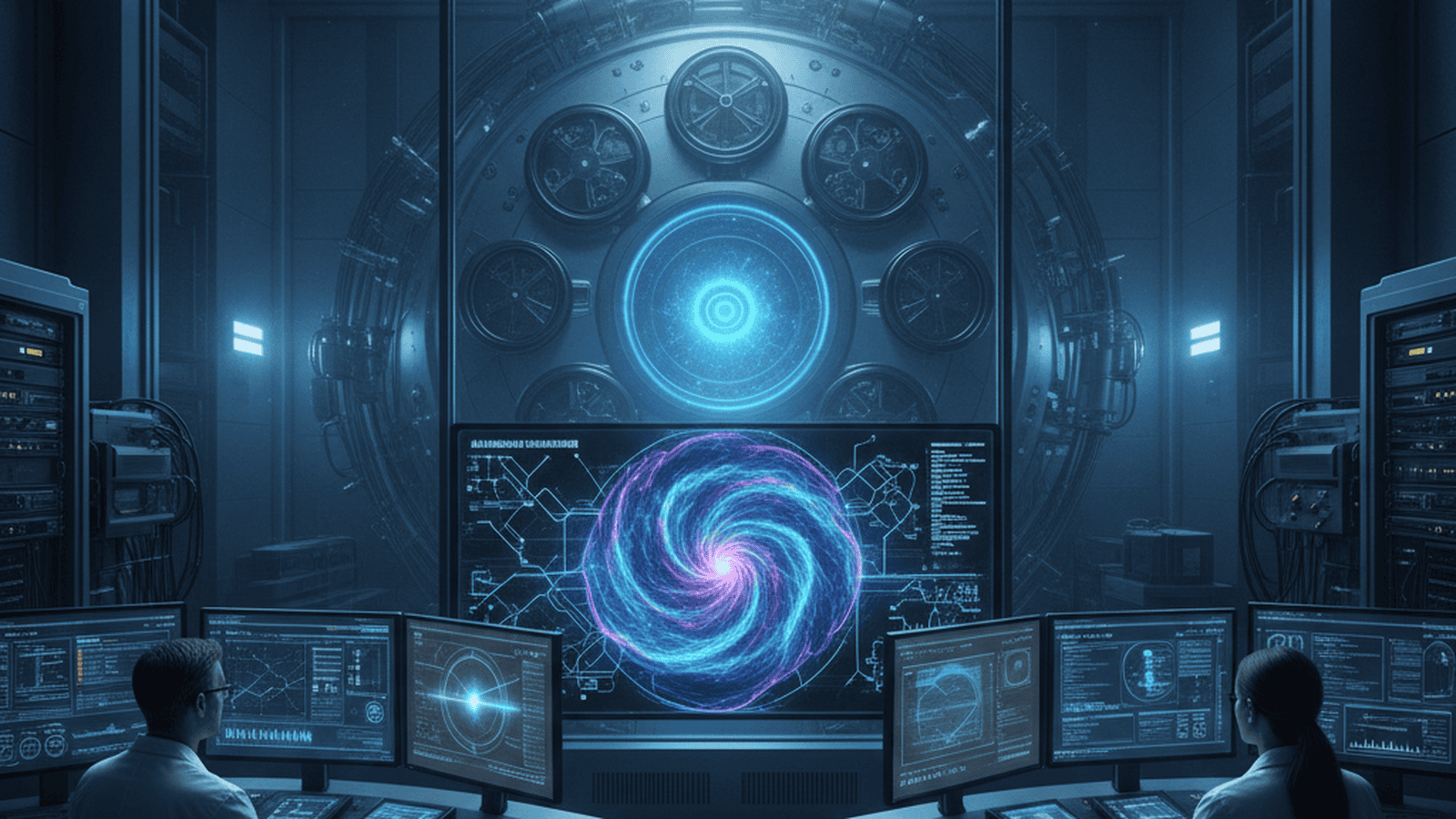
Researchers at Lawrence Livermore National Laboratory have integrated artificial intelligence with traditional physics simulations to improve the predictability of nuclear fusion experiments. This “Cognitive Simulation” approach allows scientists to navigate the complex variables of inertial confinement fusion more effectively than ever before.
TLDR: Scientists at the National Ignition Facility are using a new AI framework called Cognitive Simulation to bridge the gap between theoretical models and experimental fusion data. By training neural networks on massive datasets, the system predicts plasma behavior, bringing researchers closer to achieving consistent, high-yield fusion energy.
Scientists at Lawrence Livermore National Laboratory (LLNL) have unveiled a sophisticated artificial intelligence framework designed to solve one of the most persistent challenges in nuclear fusion: the discrepancy between theoretical models and experimental reality. Known as Cognitive Simulation (CogSim), this approach leverages deep learning to enhance the accuracy of simulations used at the National Ignition Facility (NIF). By bridging the gap between high-performance computing and empirical observation, CogSim is providing a clearer path toward the commercialization of fusion energy. This development represents a major milestone in the Department of Energy’s efforts to harness the power of the stars for clean energy on Earth.
For decades, researchers have relied on high-fidelity radiation-hydrodynamics codes to predict how fusion targets will behave when struck by the world’s most powerful lasers. These targets, often tiny capsules of deuterium and tritium, must be compressed with near-perfect symmetry to reach the temperatures and pressures found in the cores of stars. However, the extreme conditions of these experiments often lead to non-linear behaviors and hydrodynamic instabilities that traditional codes struggle to capture. These “model-to-data” gaps have historically hindered the path toward achieving a robust and repeatable fusion ignition, as even minor deviations in laser delivery or target fabrication can cause a shot to fail.
The CogSim framework addresses this by training neural networks on a combination of synthetic data from millions of simulations and empirical data from actual NIF experiments. This process, often referred to as transfer learning, allows the AI to learn the general laws of physics from the simulations and then refine its understanding based on the “ground truth” of physical shots. By anchoring the AI in real-world results, the researchers have created a hybrid model that retains the foundational physics of traditional codes while gaining the predictive flexibility of machine learning. This allows the system to account for subtle imperfections in target fabrication or laser delivery that were previously overlooked by human analysts.
Recent applications of CogSim have demonstrated a significant improvement in predicting the “stagnation” phase of fusion, where the fuel is at its peak compression. The AI was able to identify specific patterns of instability, such as “mix”—where the capsule material bleeds into the fuel—that lead to energy loss. By providing a more accurate map of these failure modes, CogSim provides a roadmap for engineers to adjust target geometry and laser pulse shapes. These insights are critical for maintaining the conditions necessary for a self-sustaining fusion reaction, a milestone LLNL first achieved in late 2022 but must now make reliable for future power plants.
Beyond merely predicting outcomes, the AI is now being used to explore a vast “design space” for future experiments. Traditional methods of searching for optimal target configurations are computationally expensive and time-consuming, often requiring weeks of supercomputer time for a single iteration. CogSim can evaluate thousands of potential designs in a fraction of the time, identifying high-performing candidates that human researchers might not have considered. This accelerated discovery process is essential for the Department of Energy’s goal of developing an Inertial Fusion Energy (IFE) pilot plant within the coming decades.
The integration of AI into the fusion workflow marks a significant shift toward “AI-augmented science” within government research centers. As the Department of Energy continues to deploy exascale computing resources like the El Capitan supercomputer, frameworks like CogSim will become essential for managing the complexity of next-generation energy systems. These machines provide the raw power necessary to run the millions of simulations required to train increasingly sophisticated neural networks. The synergy between massive computing power and intelligent algorithms is redefining the boundaries of experimental physics.
Future research will focus on expanding these models to include real-time feedback loops and multi-physics integration. Scientists hope to eventually implement “in-the-loop” AI that can suggest autonomous adjustments to laser settings in the moments leading up to a shot. By minimizing human error and maximizing the precision of every ignition attempt, this technology could shave years off the timeline for delivering fusion power to the electrical grid. The success of CogSim at LLNL serves as a blueprint for how other complex scientific fields might utilize AI to conquer their most difficult data-modeling hurdles.

Mason Reed serves as a Staff Writer for Just Right News, where he spearheads the Future Frontiers & Special Projects desk. In an era defined by rapid technological shifts and evolving social landscapes, Mason provides a steady, principled voice, examining the innovations of tomorrow through the lens of traditional American values. His work is most prominently featured in his signature series, “The Next Horizon,” where he explores the intersection of emerging technology, national sovereignty, and the preservation of individual liberty.
A native of San Diego, California, Mason’s worldview was shaped by the unique culture of his hometown. Growing up in a region defined by its strong military presence and its history of maritime industry, he developed a deep-seated respect for the institutions that provide national stability and the entrepreneurial spirit that drives the American economy. This upbringing instilled in him a belief that true progress is not found in discarding the past, but in building upon a foundation of proven principles. His reporting often reflects this San Diego influence, emphasizing the importance of a robust national defense and the necessity of maintaining a competitive edge in the global marketplace.
Now based in San Francisco, Mason operates from the heart of the world’s technological engine. Living and working in the Bay Area provides him with a front-row seat to the advancements—and the ideological challenges—emanating from Silicon Valley. While many in the region embrace a “move fast and break things” mentality, Mason’s reporting serves as a vital counterweight. He offers Just Right News readers a “boots on the ground” perspective, documenting how radical local policies and the concentration of tech power impact the everyday lives of citizens. His proximity to the industry allows him to cut through the marketing jargon of big tech to uncover the real-world implications for privacy, free speech, and the nuclear family.
In his “Future Frontiers” beat, Mason tackles complex subjects ranging from the ethics of artificial intelligence to the burgeoning private space race. He approaches these topics with a healthy skepticism toward centralized bureaucracy, championing instead the decentralized innovations that empower individuals. Through “The Next Horizon,” he highlights the pioneers and thinkers who are working to ensure that the future remains a place where human dignity and constitutional rights are protected. He believes that the rapid pace of change requires more than just technical expertise; it requires a moral compass rooted in the Western tradition.
Throughout his tenure at Just Right News, Mason has remained committed to the idea that the future is something to be shaped, not merely accepted. His writing is characterized by a rigorous defense of American exceptionalism and a belief that the country’s best days lie ahead, provided it remains true to its founding ideals. Whether he is investigating the impact of automation on the American workforce or profiling the next generation of aerospace engineers, Mason Reed ensures that his readers are equipped with the insights they need to navigate a changing world with confidence and clarity.