

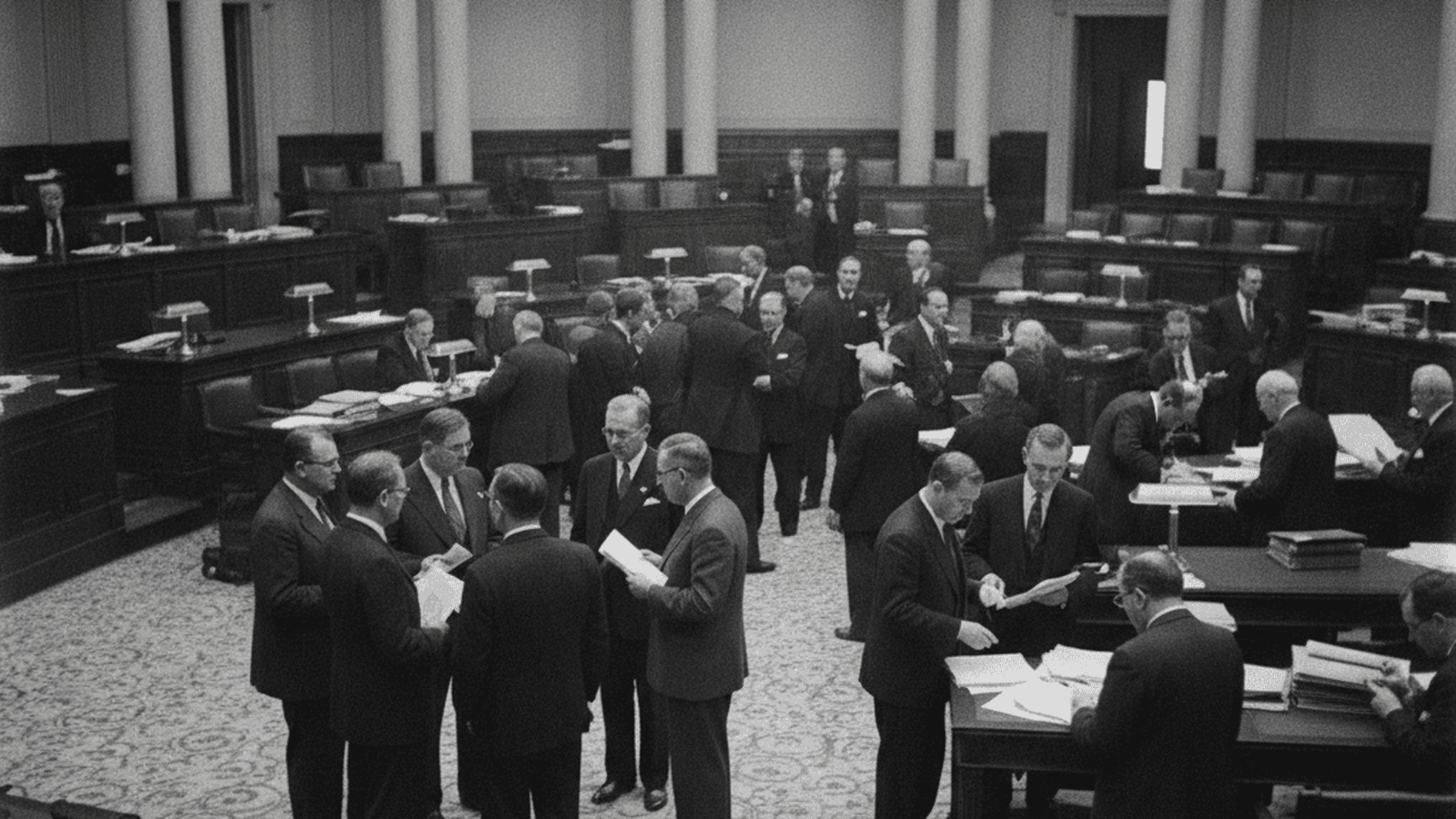
The Soldier Voting Act of 1942 and its 1944 revision addressed the challenge of enabling millions of overseas U.S. troops to participate in elections during World War II. The legislative battle in Washington, D.C., pitted federal oversight against state control, ultimately resulting in a compromise that expanded absentee voting rights while navigating intense partisan and constitutional disagreements.
TLDR: During World War II, the United States struggled to ensure millions of overseas troops could vote. The Soldier Voting Act of 1942 and the subsequent 1944 debate over federal ballots highlighted deep divisions between federal authority and states’ rights, eventually leading to modern protections for overseas and military voters.
In 1942, as the United States rapidly mobilized for World War II, the nation faced a profound logistical and constitutional dilemma: how to ensure that millions of citizens serving overseas could participate in the democratic process they were fighting to defend. With over ten million Americans eventually entering the armed forces, the potential for mass disenfranchisement was a looming crisis. The mobilization threatened to exclude a significant portion of the electorate, particularly young men who were often the most politically active. Recognizing the inherent injustice of asking soldiers to risk their lives for a democracy while being denied a voice in its leadership, Congress moved to address the complex hurdles of absentee voting. The resulting Soldier Voting Act of 1942, also known as Public Law 712, represented the first major attempt to federalize aspects of the American election process.
The initial 1942 legislation was an ambitious but flawed attempt to bypass restrictive state residency requirements and the poll taxes that were prevalent in many jurisdictions. It mandated that states allow service members to vote via absentee ballot in federal elections. However, the law was plagued by severe administrative weaknesses. It relied heavily on the voluntary cooperation of state officials, many of whom were ill-equipped or unwilling to handle the influx of overseas requests. Furthermore, the 1942 law did not provide a uniform federal ballot; instead, it left the distribution and collection of materials to a confusing patchwork of local jurisdictions. For a soldier stationed in the South Pacific or the deserts of North Africa, navigating the specific registration requirements of their home county proved nearly impossible.
By 1944, as the presidential election approached, the issue became a fierce partisan flashpoint in Washington, D.C. President Franklin D. Roosevelt and Northern Democrats advocated for a robust, uniform federal ballot. They argued that the federal government possessed the authority to protect the voting rights of its defenders under its broad constitutional war powers. Roosevelt famously characterized the opposition to a federal ballot as a “fraud” on the American soldier. However, this proposal met stiff resistance from a powerful coalition of Southern Democrats and Republicans. Southern legislators feared that a federal ballot would bypass the poll taxes and literacy tests used to maintain racial segregation and white supremacy at the polls. Meanwhile, many Republicans feared that the soldier vote would overwhelmingly favor Roosevelt, their commander-in-chief.
The debate over the “Green-Lucas Bill” in early 1944 saw some of the most intense legislative maneuvering of the war years. Opponents characterized the federal ballot as an unconstitutional power grab and a direct threat to state sovereignty. They argued that Article I, Section 4 of the Constitution reserved the power to regulate the “Times, Places and Manner” of elections strictly to the states. Proponents countered that the exigencies of global war made state-level administration a practical impossibility for millions of mobile troops. The tension highlighted a fundamental conflict between the necessity of national wartime administration and the traditional decentralized nature of American elections.
A compromise was eventually reached with the 1944 revision of the Soldier Voting Act. The new law allowed for a limited federal ballot, but only under extremely narrow conditions. A soldier could use the federal ballot only if they had applied for a state ballot by a specific date and had not received it. Crucially, the governor of the soldier’s home state had to certify that the federal ballot was acceptable under state law. While this compromise preserved the veneer of state authority, it significantly hampered the effectiveness of the federal intervention. Despite these hurdles, the struggle over the soldier vote during the New Deal era established a critical precedent for federal oversight in election administration. The debate laid the groundwork for future reforms, eventually evolving into the Federal Voting Assistance Act of 1955 and the Uniformed and Overseas Citizens Absentee Voting Act of 1986, which finally secured a permanent, streamlined process for military and overseas citizens to exercise their right to vote.

Sophie Carter serves as a Staff Writer for Just Right News, where she anchors the outlet’s critical coverage of Elections, Influence, and Democracy Infrastructure. In an era where the mechanics of voting and the flow of political capital are under constant scrutiny, Sophie provides a steady, principled voice dedicated to the preservation of American institutional integrity and the rule of law.
Raised in Charlotte, North Carolina, Sophie’s perspective was forged in a community that balances rapid modern growth with a deep respect for tradition and civic duty. Growing up in the Queen City, she witnessed firsthand how a robust local culture depends on the trust between the citizen and the state. This upbringing instilled in her a foundational belief that the right to vote is a sacred trust—one that must be protected from both administrative overreach and the encroaching influence of special interest groups. Her reporting reflects these North Carolina roots, emphasizing the importance of community-led governance and the preservation of the individual’s voice in the face of nationalized political movements.
Now based in Atlanta, Georgia, Sophie operates from the heart of one of the nation’s most pivotal and contested political landscapes. Her location allows her to report from the front lines of the debate over election security, legislative reform, and the modernization of voting systems. For Sophie, the “infrastructure” of democracy is not merely a matter of machines and ballots; it is the collection of laws, people, and transparent processes required to maintain public confidence. Her work often highlights the necessity of clear, enforceable standards that ensure every legal vote is counted fairly and that the machinery of our republic remains accountable to the taxpayers who fund it.
Central to her work at Just Right News is her acclaimed feature series, “The Price of a Vote.” Through this ongoing project, Sophie explores the complex web of influence that shapes modern campaigns and policy decisions. She delves into how high-level lobbying, non-governmental organizations, and shifting bureaucratic regulations impact the weight of an individual citizen’s ballot. By examining the financial and structural pressures placed on the electoral process, she provides readers with a comprehensive look at the forces vying for control over the American political system.
Sophie’s approach to journalism is rooted in a commitment to the constitutional framework. She views her role as a watchdog for the voter, ensuring that the systems meant to serve the public remain transparent and free from corruption. Whether she is analyzing the implementation of new voting technologies or investigating the influence of outside money on state-level policy, her work is characterized by a rigorous adherence to facts and a refusal to succumb to the sensationalism that often plagues modern political reporting.
At Just Right News, Sophie Carter continues to be a vital resource for readers who value clarity, conviction, and a defense of traditional American values. Her deep ties to the Southeast and her specialized focus on the mechanics of our republic make her an essential voice in the ongoing conversation about the future of American self-governance. Through her reporting, she remains dedicated to the idea that a secure and honest electoral system is the bedrock of a free and prosperous society.