

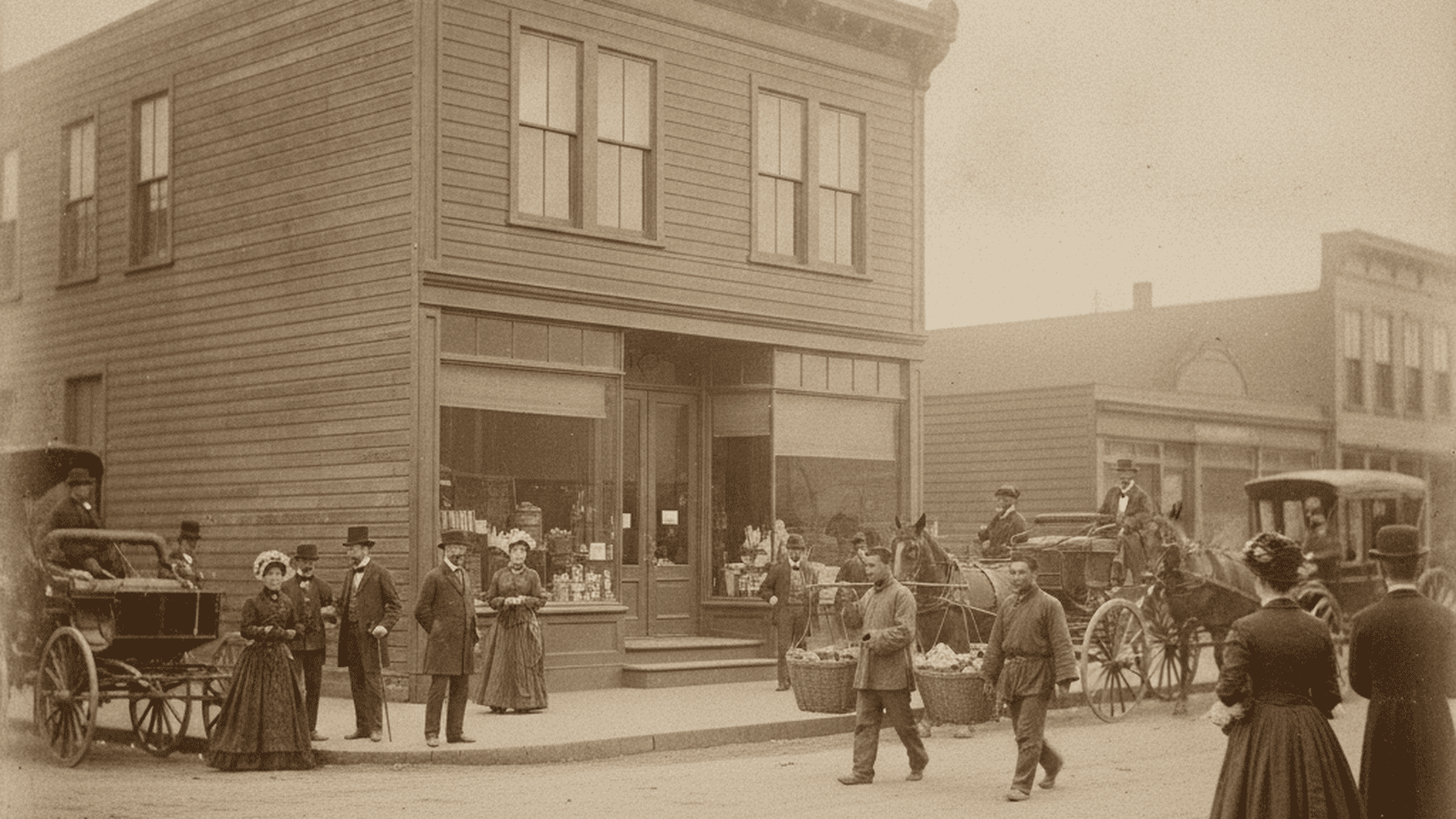
In 1886, the United States Supreme Court ruled in Yick Wo v. Hopkins that a San Francisco laundry ordinance was unconstitutionally applied. The decision established that the Fourteenth Amendment protects all persons, regardless of citizenship, from discriminatory enforcement of seemingly neutral laws.
TLDR: The 1886 Supreme Court case Yick Wo v. Hopkins struck down a San Francisco ordinance used to target Chinese laundry owners. The unanimous ruling established that the Fourteenth Amendment’s Equal Protection Clause applies to non-citizens and prohibits the discriminatory administration of laws that appear neutral on their face.
In the late 19th century, San Francisco was a city defined by rapid growth and simmering racial tensions. By 1880, the city’s laundry industry had become a focal point for anti-Chinese sentiment. To address perceived fire hazards, the San Francisco Board of Supervisors passed an ordinance requiring any laundry located in a wooden building to obtain a special permit. On its surface, the law seemed like a reasonable exercise of municipal police power designed to protect a densely packed urban environment from the constant threat of fire. However, the reality of its enforcement told a much different story.
At the time, approximately 320 laundries operated within the city limits. Of these, roughly 240 were owned and operated by Chinese immigrants, and nearly all of them were housed in wooden structures. When the permit process began, the Board of Supervisors denied the applications of every single Chinese laundry owner who applied—over 200 individuals. In stark contrast, the Board granted permits to 80 non-Chinese laundry owners, denying only one. This blatant disparity revealed that the ordinance was not being used for public safety, but as a tool of economic and racial exclusion.
Among those targeted was Lee Yick, who operated a business under the name Yick Wo. He had run his laundry in the same wooden building for 22 years and had consistently passed inspections by fire wardens and health officers. Despite his impeccable record, his permit application was summarily rejected. Refusing to accept the arbitrary destruction of his livelihood, Lee Yick continued to operate his business. He was subsequently arrested and fined ten dollars. When he refused to pay, he was imprisoned by Sheriff Hopkins.
With the support of the Chinese Laundry Guild, Lee Yick sued for a writ of habeas corpus, eventually bringing his case before the United States Supreme Court. The city argued that the ordinance was a valid safety measure and that the Board of Supervisors held absolute discretion over permit approvals. They contended that as a non-citizen, Lee Yick did not enjoy the same constitutional protections as Americans.
In 1886, the Supreme Court issued a unanimous and transformative ruling. Justice Stanley Matthews, writing for the Court, rejected the city’s arguments. The Court held that the Fourteenth Amendment’s Equal Protection Clause protects all “persons” within the jurisdiction of the United States, regardless of their race, nationality, or citizenship status. This was a landmark declaration that extended the shield of the Constitution to immigrants who were otherwise marginalized by law and society.
The Court’s most enduring contribution was its analysis of how the law was applied. Matthews famously wrote that even if a law is fair and impartial on its face, it is unconstitutional if it is “applied and administered by public authority with an evil eye and an unequal hand, so as practically to make unjust and illegal discriminations between persons in similar circumstances.” The Court found that the “grossly unequal” administration of the permit system was proof of a constitutional violation.
The decision in Yick Wo v. Hopkins invalidated the ordinance and secured Lee Yick’s release. More importantly, it established a vital legal precedent: the government cannot hide behind neutral language to practice systemic discrimination. By allowing statistical evidence of disparate impact to prove a violation of rights, the Court provided a powerful tool for future civil rights litigation. For over a century, Yick Wo has served as a cornerstone for challenging discriminatory policing, jury selection, and voting restrictions, ensuring that the promise of equal justice remains more than just words on a page.

Lila Hayes serves as a Staff Writer for Just Right News, where she anchors the “Courts, Law, and Constitutional Order” beat. Her work is defined by a steadfast commitment to the foundational principles of the American republic and a rigorous defense of the legal frameworks that ensure national stability. As a primary voice for the outlet, she provides readers with a clear-eyed analysis of the judiciary, focusing on the importance of originalism and the preservation of the separation of powers.
Lila’s perspective was forged in the American heartland. Raised in St. Louis, Missouri, she grew up in a Hispanic household where the values of hard work, faith, and respect for the law were paramount. Her upbringing instilled in her a deep appreciation for the American Dream and the legal protections that make it possible. This Missouri background remains a cornerstone of her reporting, providing a grounded, common-sense counter-narrative to the often-insular legal circles of the coastal elite. She understands that the decisions made in high-court chambers have real-world consequences for families and small business owners across the country.
At Just Right News, Lila has become widely recognized for her signature feature series, “The Rulebook of Power.” In this ongoing project, she delves into the mechanics of the federal government, examining how administrative overreach and judicial activism can threaten the delicate balance of the Constitution. She approaches her beat with the tenacity of a veteran journalist and the precision of a legal scholar, consistently advocating for a judiciary that interprets the law as written rather than legislating from the bench. For Lila, the Constitution is not a “living” document subject to the whims of modern social trends; it is a fixed standard that ensures the government remains the servant of the people, not their master.
Now based in Philadelphia, Pennsylvania, Lila finds herself at the very epicenter of American constitutional history. Living and working in the city where the Founders drafted the documents she defends daily provides a constant source of inspiration. The historic halls and landmarks of Philadelphia serve as a daily reminder of the high stakes involved in her reporting. Her presence in the city allows her to bridge the gap between the historical intent of the law and its contemporary application, ensuring that the legacy of the Founding Fathers remains central to the national conversation.
Throughout her career, Lila has remained dedicated to the idea that a free society requires an informed citizenry and a transparent legal system. Her reporting is more than just a collection of headlines; it is a defense of the constitutional order that has sustained the nation for over two centuries. By focusing on the “Rulebook of Power,” she ensures that her readers understand not just what is happening in the courtrooms, but why those decisions matter for the future of American liberty. Lila Hayes continues to be a vital voice for those who believe that the law should be a shield for the citizen and a constraint on the state.