

President Trump signed a voluntary ‘superintelligence’ accord with tech CEOs while the Supreme Court cleared the way for continued third-country deportations ahead of a December hearing.
The White House and the federal judiciary moved on two parallel tracks this week, reshaping the landscape of emerging technology and immigration enforcement. President Trump signed an executive order titled ‘Inaugurating the Era of Super Intelligence,’ which mandates that executive-branch agencies replace the term ‘artificial intelligence’ and the acronym ‘AI’ with ‘superintelligence’ and ‘SI’ in all official communications and documents. This semantic shift accompanied the announcement of the ‘Joint Commitment on Frontier Responsibilities,’ a voluntary agreement signed by executives from Google, Anthropic, Meta, OpenAI, xAI, and Nvidia.
The agreement, which Trump described as ‘morally binding’ during a White House luncheon, lacks formal enforcement mechanisms or legal penalties. It outlines four layers of internal controls, including internal audits, independent external reviews, and board-level oversight for technology firms. While the President characterized the deal as a form of ‘tremendous self-policing’ akin to a constitution, the administration has yet to propose binding legislation to codify these safeguards. Reports indicate the President is also considering a 10-person committee to oversee the industry, attempting to establish a national framework without the friction of congressional mandates.
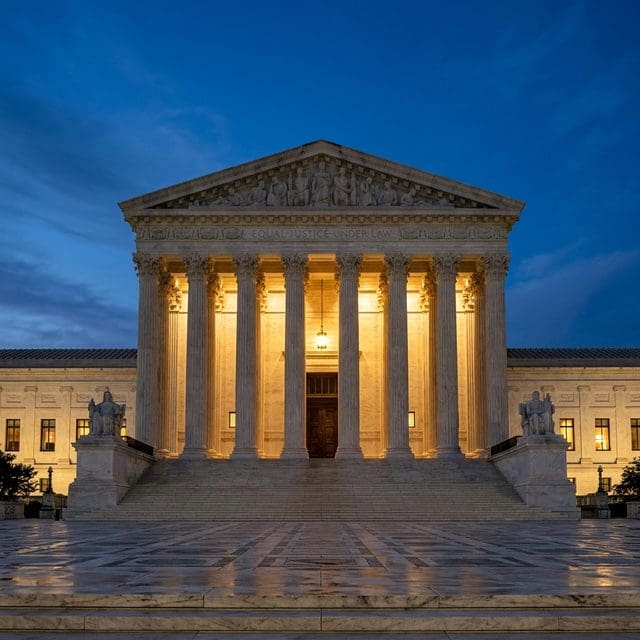
On the judicial front, the Supreme Court issued an unsigned emergency order staying a lower-court ruling that had blocked the administration’s third-country deportation policy. The decision allows the government to continue removing migrants to countries other than their home nations while the legal challenge proceeds. The Court has fast-tracked the case for oral arguments in December 2026, tasking parties to address whether the policy violates constitutional protections or anti-torture statutes. This ruling comes as the administration has already deported approximately 25,000 people to more than two dozen countries under often-secret agreements.
Congressional reaction to the deportation ruling was swift and divided. Representative Rob Menendez labeled the Supreme Court’s intervention ‘indefensible,’ arguing that the policy facilitates removals that sever individuals from their only known homes. Representative Lois Frankel and other Democratic lawmakers are now pressing for legislative intervention to ensure migrants have a meaningful opportunity to raise persecution or torture claims before being transported to third-party nations. The administration maintains these removals are necessary for border security, even as critics highlight the lack of due process.
In the Senate, a resolution led by Senator Chris Van Hollen to require a State Department report on human rights conditions in the West Bank failed in a 47–51 vote on September 29. The measure sought transparency regarding the deaths of nine Americans since 2022 and the detention of Palestinian children. The vote largely followed party lines, with Senator Rand Paul as the lone Republican supporter and Senator John Fetterman as the sole Democratic dissenter. While the resolution did not directly cut military aid, its defeat prevents the triggering of aid restrictions tied to human rights reporting, reflecting a continued Republican effort to protect the current Israeli government from congressional scrutiny.
Finally, the U.S. Court of International Trade began hearing arguments in a consolidated challenge against the administration’s latest tariff regime, which covers 99 percent of imported goods. Twenty-five Democratic-led states and several small businesses allege that the President is using forced-labor allegations as a pretext to bypass previous court rulings that limited his tariff authority. The plaintiffs argue the administration failed to provide the required country-specific findings for the 60 trading partners currently facing duties ranging from 10% to 12.5%. This legal battle follows a February Supreme Court ruling that struck down earlier broad tariff programs, forcing the administration to seek new legal justifications for its trade policy.

Ben Taylor serves as the Senior Correspondent and Investigations Lead for Just Right News, where he anchors the network’s commitment to government transparency and institutional accountability. With a career defined by a relentless pursuit of the facts, Taylor spearheads the acclaimed feature series “The Paper Trail,” a deep-dive investigative column that prioritizes primary source documentation over political rhetoric. Based in the heart of the nation’s capital, he has earned a reputation as one of the most formidable investigative journalists in Washington, D.C., known specifically for his mastery of public records and the Freedom of Information Act.
Taylor’s approach to journalism is deeply rooted in his upbringing in Kansas City, Missouri. Growing up in the “Show Me State,” he developed a healthy skepticism of centralized power and a profound respect for the common-sense values of the American heartland. This Midwestern foundation informs his reporting today, as he bridges the gap between the complex machinations of federal bureaucracy and the everyday concerns of citizens across the country. For Taylor, investigative reporting is not about chasing headlines; it is about ensuring that the government remains answerable to the people it serves.
As an African American man working within the conservative media landscape, Taylor brings a principled perspective to his beat. He views the Constitution and the right to information as the ultimate equalizers in a free society. His work often highlights how bureaucratic overreach and lack of transparency disproportionately affect individual liberties. By focusing on the “paper trail,” Taylor strips away the spin of partisan talking points, instead providing Just Right News readers with the raw data and internal communications that reveal how their tax dollars are spent and how policy decisions are actually made.
In his role as Investigations Lead, Taylor oversees a team dedicated to uncovering the stories that mainstream outlets often overlook. Whether he is auditing federal spending, investigating regulatory overreach, or exposing inefficiencies within the administrative state, his methodology remains consistent: follow the evidence wherever it leads. His presence in Washington, D.C., allows him to maintain a constant watch over the halls of power, yet he remains steadfastly connected to his roots, ensuring his reporting reflects the clarity and directness of his Missouri home.
Throughout his tenure at Just Right News, Taylor has become a vital voice for those who demand integrity in public office. He believes that a well-informed electorate is the strongest defense against government overreach, and he has dedicated his career to providing the public with the tools they need to hold their leaders accountable. Through “The Paper Trail” and his broader investigative work, Ben Taylor continues to set the standard for rigorous, document-driven journalism that champions the values of transparency, individual responsibility, and the rule of law.