

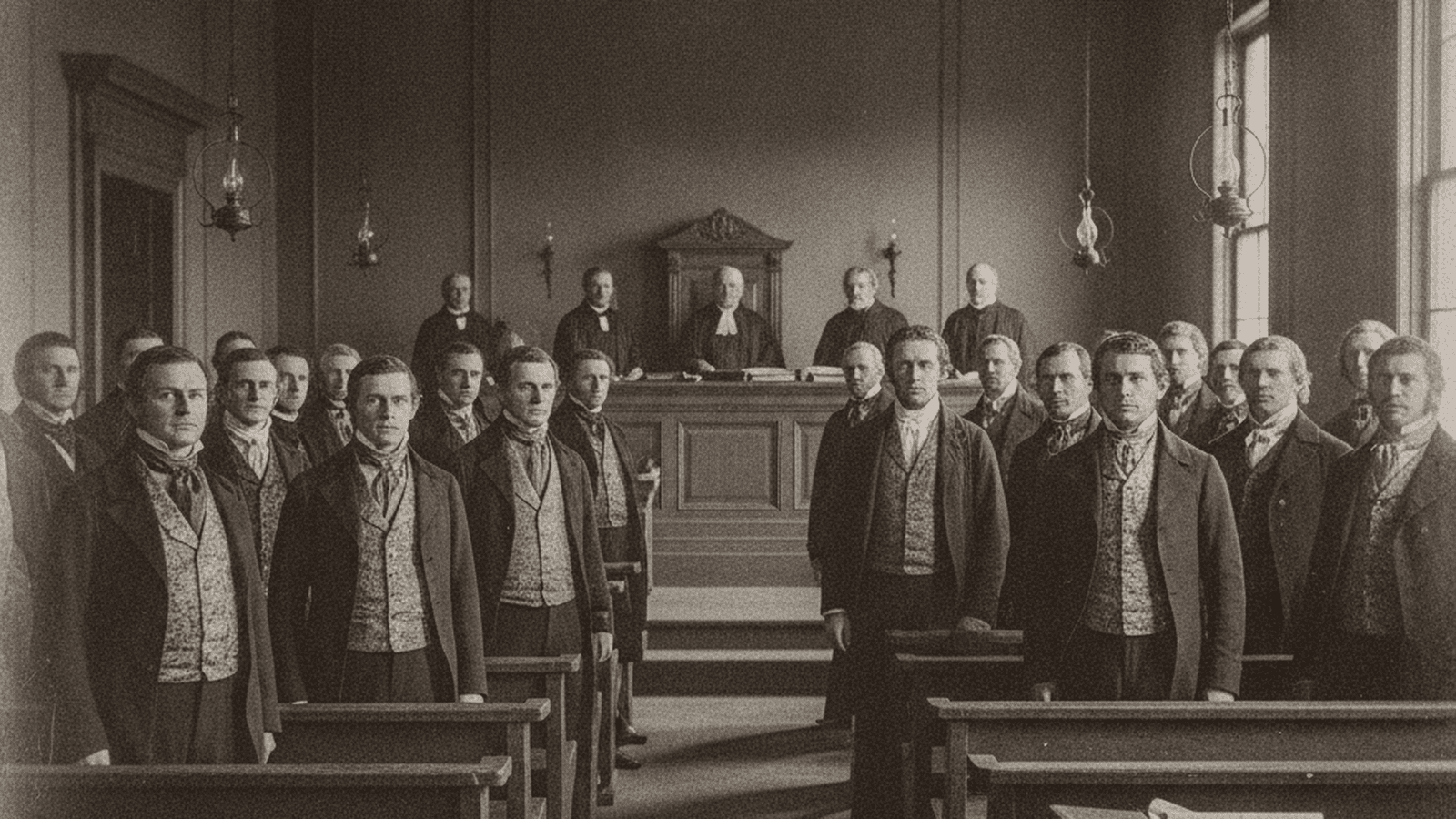
In 1832, the state of Georgia and President Andrew Jackson ignored a Supreme Court ruling that protected Cherokee sovereignty. This constitutional crisis in the United States demonstrated the limits of judicial power when the executive branch refuses to enforce the law.
TLDR: The 1832 constitutional crisis erupted when Georgia defied the Supreme Court’s ruling in Worcester v. Georgia. By refusing to protect Cherokee lands, President Andrew Jackson allowed state interests to override federal law. This standoff weakened the judiciary’s authority and directly contributed to the forced removal of indigenous populations.
In the early 1830s, the United States faced one of its most profound constitutional tests when the state of Georgia openly defied the Supreme Court. This crisis centered on the sovereignty of the Cherokee Nation and the limits of state authority over indigenous lands. The conflict reached a boiling point in 1832 with the landmark case of Worcester v. Georgia, a moment that threatened to dismantle the delicate balance of the federal system. The roots of the crisis lay in Georgia’s aggressive efforts to seize Cherokee territory following the discovery of gold in 1829 near Dahlonega. The state legislature, emboldened by the federal Indian Removal Act of 1830, passed a series of laws that effectively abolished the Cherokee government and extended Georgia’s legal jurisdiction over their lands. These laws were designed to make life so difficult for the Cherokee that they would have no choice but to migrate west.
Among these laws was a requirement that white residents in Cherokee territory obtain a state license and swear an oath of allegiance to Georgia. This was specifically aimed at missionaries who supported Cherokee resistance. Samuel Worcester and Elihu Butler, two prominent missionaries, refused to comply on principle. They were subsequently arrested, subjected to a grueling march, and sentenced to four years of hard labor in a Georgia penitentiary. Worcester, realizing the broader legal implications, appealed his conviction to the Supreme Court, arguing that Georgia had no right to legislate over a sovereign nation recognized by federal treaties.
Chief Justice John Marshall delivered the court’s opinion in March 1832. The ruling was unequivocal: the Cherokee Nation was a “distinct community” in which the laws of Georgia could have no force. Marshall declared that the federal government, not the states, held exclusive authority in dealings with Native American tribes. This decision created an immediate constitutional vacuum. Georgia Governor Wilson Lumpkin ignored the court’s mandate to release Worcester, asserting that the state’s internal affairs were beyond federal reach. More significantly, President Andrew Jackson famously declined to intervene. While the quote “John Marshall has made his decision; now let him enforce it” is likely apocryphal, it accurately reflected Jackson’s refusal to use federal power to uphold the court’s ruling against a state he supported.
This impasse highlighted a critical weakness in the American constitutional framework. Without executive enforcement, the Supreme Court’s decisions were effectively toothless. The crisis was further complicated by the simultaneous Nullification Crisis in South Carolina. Jackson found himself in a paradoxical position: he supported Georgia’s defiance of the Court regarding Indian removal, but he vehemently opposed South Carolina’s attempt to nullify federal tariffs. Fearing that Georgia might join South Carolina’s secessionist movement, Jackson eventually pressured Lumpkin to pardon Worcester in early 1833. This was a political compromise rather than a legal surrender; it allowed the state to release the prisoners without formally acknowledging the Supreme Court’s authority over its land laws.
The legacy of the 1832 crisis was devastating for the Cherokee people. The lack of federal protection paved the way for the fraudulent Treaty of New Echota in 1835 and the subsequent forced removal known as the Trail of Tears, during which thousands died. Politically, the event set a dangerous precedent for executive discretion in following judicial mandates. It remains a primary case study in the history of American federalism, illustrating the fragility of the rule of law when the branches of government are in direct opposition. The standoff proved that the judiciary’s power is ultimately dependent on the executive’s willingness to uphold the Constitution, a lesson that continues to resonate in American political discourse.

Lila Hayes serves as a Staff Writer for Just Right News, where she anchors the “Courts, Law, and Constitutional Order” beat. Her work is defined by a steadfast commitment to the foundational principles of the American republic and a rigorous defense of the legal frameworks that ensure national stability. As a primary voice for the outlet, she provides readers with a clear-eyed analysis of the judiciary, focusing on the importance of originalism and the preservation of the separation of powers.
Lila’s perspective was forged in the American heartland. Raised in St. Louis, Missouri, she grew up in a Hispanic household where the values of hard work, faith, and respect for the law were paramount. Her upbringing instilled in her a deep appreciation for the American Dream and the legal protections that make it possible. This Missouri background remains a cornerstone of her reporting, providing a grounded, common-sense counter-narrative to the often-insular legal circles of the coastal elite. She understands that the decisions made in high-court chambers have real-world consequences for families and small business owners across the country.
At Just Right News, Lila has become widely recognized for her signature feature series, “The Rulebook of Power.” In this ongoing project, she delves into the mechanics of the federal government, examining how administrative overreach and judicial activism can threaten the delicate balance of the Constitution. She approaches her beat with the tenacity of a veteran journalist and the precision of a legal scholar, consistently advocating for a judiciary that interprets the law as written rather than legislating from the bench. For Lila, the Constitution is not a “living” document subject to the whims of modern social trends; it is a fixed standard that ensures the government remains the servant of the people, not their master.
Now based in Philadelphia, Pennsylvania, Lila finds herself at the very epicenter of American constitutional history. Living and working in the city where the Founders drafted the documents she defends daily provides a constant source of inspiration. The historic halls and landmarks of Philadelphia serve as a daily reminder of the high stakes involved in her reporting. Her presence in the city allows her to bridge the gap between the historical intent of the law and its contemporary application, ensuring that the legacy of the Founding Fathers remains central to the national conversation.
Throughout her career, Lila has remained dedicated to the idea that a free society requires an informed citizenry and a transparent legal system. Her reporting is more than just a collection of headlines; it is a defense of the constitutional order that has sustained the nation for over two centuries. By focusing on the “Rulebook of Power,” she ensures that her readers understand not just what is happening in the courtrooms, but why those decisions matter for the future of American liberty. Lila Hayes continues to be a vital voice for those who believe that the law should be a shield for the citizen and a constraint on the state.