

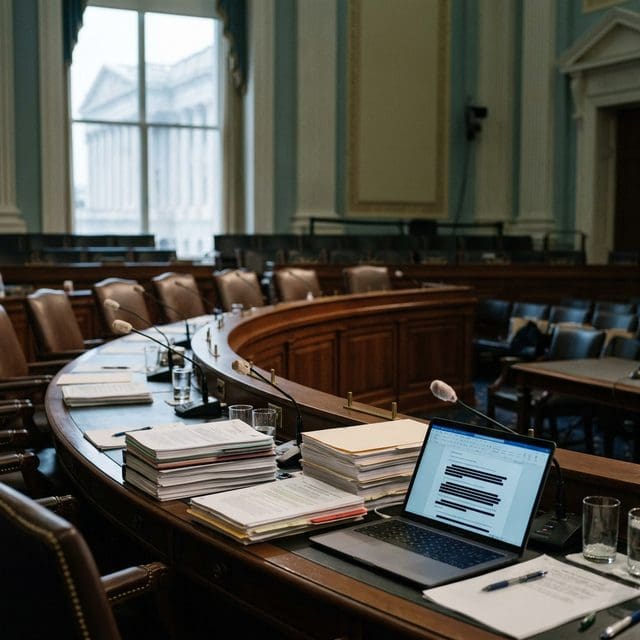
A White House warning to House Democrats, senators’ demands for Nvidia records and a limited UnitedHealth audit show why investigation scope and documentation matter.
The dispute over congressional investigations is turning on a practical question: what records exist, what they show and whether investigators can lawfully obtain them. Recent developments offer a reminder that the scope of an inquiry—and the limits of the evidence gathered—can matter as much as its headline allegations.
In a letter dated Nov. 9 and made public Wednesday, White House counsel Will Scharf told incoming House Oversight Committee Chairman Robert Garcia that the administration was “monitoring” alleged abusive threats by Democratic lawmakers. Scharf warned that unlawful subpoenas intended to deprive people of constitutional rights “may warrant further investigation,” the Washington Examiner reported. The Hill has also reported that the White House told House Democrats their planned investigations may cross into criminality.
The letter is a warning, not a finding that lawmakers committed a crime. The material made public so far does not identify specific subpoenas Scharf considers unlawful or disclose evidence supporting the warning. Those details matter: an assertion about congressional conduct is not a substitute for the documents and legal analysis behind it. The letter’s phrasing also leaves open what further investigation would involve and which officials or actions might be examined.
Garcia has said Democrats will proceed. “We’re not going to be deterred, and we’re certainly not going to be intimidated,” he told NPR. The legal boundaries are not settled by that political exchange. ABC News identifies Watkins v. United States, which requires congressional inquiries to serve a legitimate legislative purpose, and Trump v. Mazars USA, LLP, which calls for heightened scrutiny of subpoenas seeking presidential records, including their scope, necessity and burden.
Those standards make the particulars of a request consequential. A committee’s stated legislative purpose, the records it seeks and the demands placed on the recipient all bear on whether a subpoena can withstand challenge. The New York Times has reported that the Supreme Court’s 2024 presidential-immunity ruling could also limit congressional scrutiny of matters within the president’s “exclusive and preclusive” authority, including pardons and decisions about which crimes to investigate or prosecute. How those precedents apply will depend on the records sought and the stated purpose of the inquiry.
A separate records request involving Nvidia underscores the importance of preserving evidence before conclusions are drawn. Sens. Elizabeth Warren and Chris Coons asked Commerce Secretary Howard Lutnick, Secretary of State Marco Rubio and White House Chief of Staff Stephen Miller to preserve records concerning Nvidia’s advanced-chip exports to China and a reported intelligence operation involving chief executive Jensen Huang, Politico reported. They requested written confirmation by Nov. 17 and a congressional briefing. A preservation request seeks to keep potentially relevant materials available; by itself, it does not establish what those materials contain.
The senators’ request does not establish that the reported operation occurred or that export rules were violated. Nvidia’s independent directors have retained Wachtell, Lipton, Rosen & Katz to assist an inquiry into whether Huang was targeted by a foreign intelligence operation, according to Insurance Journal and the company. The board said it had no reason to believe national-security interests or Nvidia secrets were compromised. The available material does not include the inquiry’s findings, so the board’s statement should not be mistaken for a published account of the investigation’s evidence or methods.
A UnitedHealth audit illustrates a different limit: what a review’s design allows it to establish. The review examined how medical policies were developed, not how they were applied in coverage decisions. It sampled nine policies and found missing documentation on when new policies should be created and how outside subject-matter experts should be vetted. It also described the policies as complex and difficult for doctors and members to use, Healthcare Dive reported.
The audit therefore cannot establish whether the policies caused particular denials. It did not assess the specific content of the policies or their application to coverage decisions. A finding about policy-development procedures is not a finding about patient outcomes, and the review’s stated scope leaves that central question unanswered.
Across these cases, preservation requests, audit methods, subpoena justifications and court filings can show what officials knew and what investigators examined. They can also show what remains outside the record. Until the relevant materials are produced and tested, warnings and allegations remain claims, not conclusions.

Ben Taylor serves as the Senior Correspondent and Investigations Lead for Just Right News, where he anchors the network’s commitment to government transparency and institutional accountability. With a career defined by a relentless pursuit of the facts, Taylor spearheads the acclaimed feature series “The Paper Trail,” a deep-dive investigative column that prioritizes primary source documentation over political rhetoric. Based in the heart of the nation’s capital, he has earned a reputation as one of the most formidable investigative journalists in Washington, D.C., known specifically for his mastery of public records and the Freedom of Information Act.
Taylor’s approach to journalism is deeply rooted in his upbringing in Kansas City, Missouri. Growing up in the “Show Me State,” he developed a healthy skepticism of centralized power and a profound respect for the common-sense values of the American heartland. This Midwestern foundation informs his reporting today, as he bridges the gap between the complex machinations of federal bureaucracy and the everyday concerns of citizens across the country. For Taylor, investigative reporting is not about chasing headlines; it is about ensuring that the government remains answerable to the people it serves.
As an African American man working within the conservative media landscape, Taylor brings a principled perspective to his beat. He views the Constitution and the right to information as the ultimate equalizers in a free society. His work often highlights how bureaucratic overreach and lack of transparency disproportionately affect individual liberties. By focusing on the “paper trail,” Taylor strips away the spin of partisan talking points, instead providing Just Right News readers with the raw data and internal communications that reveal how their tax dollars are spent and how policy decisions are actually made.
In his role as Investigations Lead, Taylor oversees a team dedicated to uncovering the stories that mainstream outlets often overlook. Whether he is auditing federal spending, investigating regulatory overreach, or exposing inefficiencies within the administrative state, his methodology remains consistent: follow the evidence wherever it leads. His presence in Washington, D.C., allows him to maintain a constant watch over the halls of power, yet he remains steadfastly connected to his roots, ensuring his reporting reflects the clarity and directness of his Missouri home.
Throughout his tenure at Just Right News, Taylor has become a vital voice for those who demand integrity in public office. He believes that a well-informed electorate is the strongest defense against government overreach, and he has dedicated his career to providing the public with the tools they need to hold their leaders accountable. Through “The Paper Trail” and his broader investigative work, Ben Taylor continues to set the standard for rigorous, document-driven journalism that champions the values of transparency, individual responsibility, and the rule of law.