

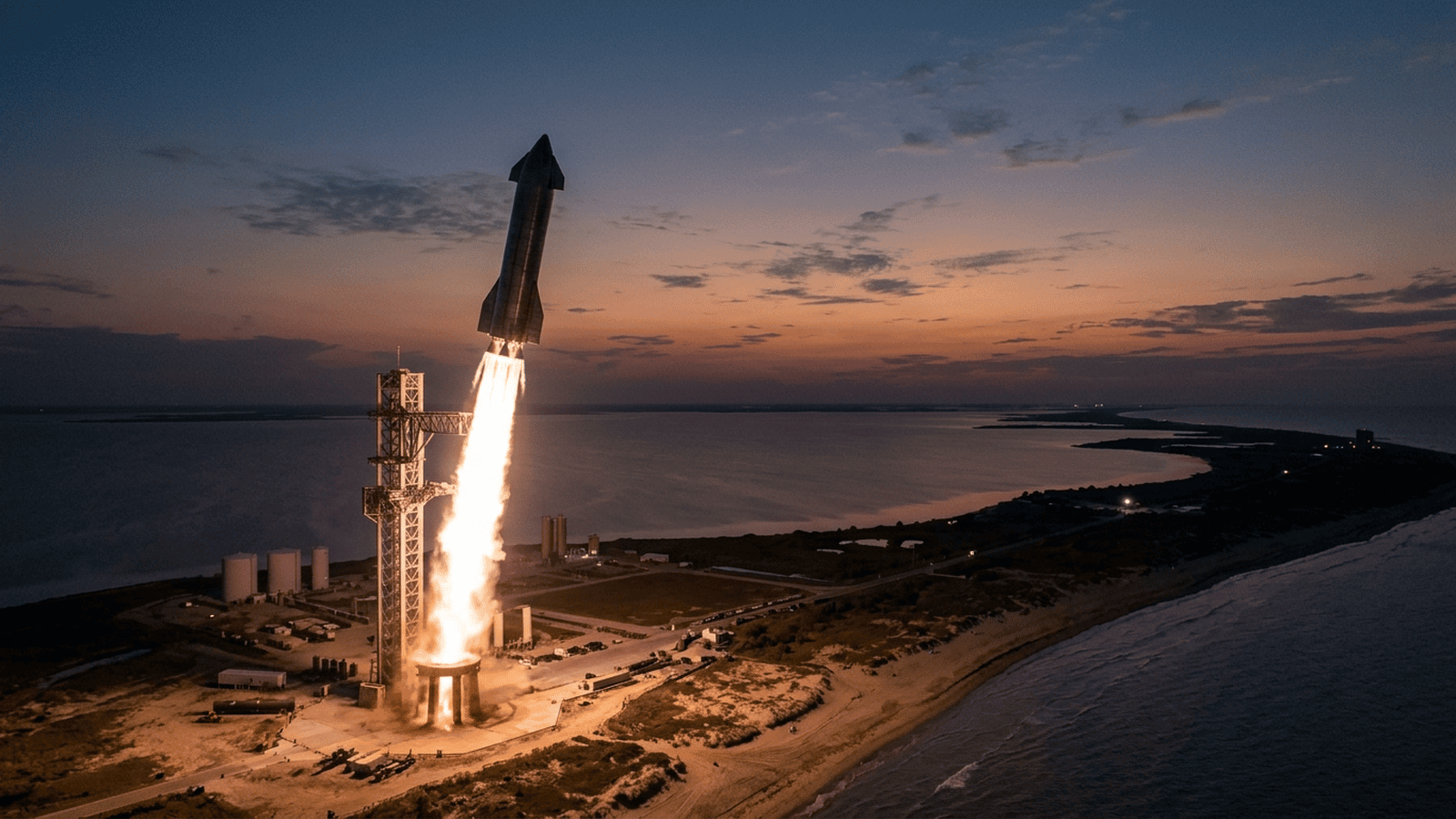
SpaceX launched Starship on its 15th test flight, a 22-hour mission aimed at advancing development of a fully reusable rocket. The Super Heavy booster splashed down offshore, while Starship continued through its planned flight. The plan includes deploying the first of 26 upgraded Starlink satellites and attempting a return to the launch pad, a first for the spacecraft. Controllers have pre-cleared ocean landing areas and options to end the mission if conditions threaten a safe return. The planned reentry and pad-catch sequence will test whether Starship can be recovered for possible refurbishment and relaunch, a capability NASA is counting on for a lunar mission in 2028.
TLDR: Starship’s latest test flight is advancing a high-stakes effort to recover and reuse an orbit-class rocket. The booster splashed down offshore, while the spacecraft’s planned return and first attempt at a pad catch remain the next major tests.
SpaceX launched Starship on its 15th test flight Friday, beginning a planned 22-hour mission from Starbase on the Texas Gulf Coast. The flight is a major test of the company’s effort to develop the first fully reusable rocket capable of reaching orbit. The Super Heavy booster splashed down offshore instead of returning to its launch pad, leaving the planned Starship return and catch as the mission’s central test.
The stated rationale is straightforward: SpaceX is testing whether a rocket built for orbit can be recovered, refurbished and launched again. The company describes full reusability as a way to support a rapid, airplane-like flight schedule. That goal depends on getting both the spacecraft and its recovery procedures to work reliably.
The rocket lifted off at 5:45 p.m. Eastern time, carrying eight million pounds of supercold liquid oxygen and methane fuel. Its 236-foot first stage used 33 Raptor engines to propel the booster and the 407-foot combined vehicle upward. The 171-foot Starship continued climbing on six engines as the booster turned back toward Starbase.
The booster did not complete that return. It splashed down in the ocean instead, while Starship continued on a planned suborbital path. That flight path gave controllers time to assess the spacecraft before any planned push toward orbit. It also meant an ocean splashdown was available if the vehicle developed a problem.
After an 18-minute coast, the plan called for one engine to fire for 10 seconds and move Starship into its intended orbit, assuming no problems arose. Eight and a half minutes later, the first of 26 upgraded version 3 Starlink satellites was expected to be released. Controllers planned to keep checking the vehicle’s condition throughout the rest of the flight.
The return attempt would be a first for SpaceX: bringing a Starship back to its launch pad for possible refurbishment and another flight. The planned reentry route included turns over sparsely populated areas of northern Mexico and southern Texas, followed by a path around major cities in the Rio Grande Valley. The spacecraft was also planned to pass north of South Padre Island and over the Gulf before turning toward Starbase.
A return to the pad would require a demanding sequence. Starship was expected to use its control flaps to guide its path, then use three engines to turn upright near the pad. One engine would shut down as the vehicle descended between the launch tower’s mechanical arms. A remaining engine would slow it nearly to a stop while the arms moved in to catch it. The attempt depends on a problem-free descent, and the booster’s offshore splashdown shows that the planned recovery is not assured.
The flight plan also includes alternatives. SpaceX said controllers could end the mission early and direct Starship to pre-cleared Pacific Ocean areas near Hawaii or several hundred kilometers off Chile. During reentry, controllers could end the flight by tumbling the spacecraft so it breaks apart in the atmosphere before reaching land. A later option would direct it into the Gulf if a spacecraft system or the tower prevented a safe catch.
The practical impacts described in the plan are operational rather than financial. The mission involves close monitoring, a 22-hour schedule, pre-cleared splashdown areas and a planned 56-minute belly-first reentry; the excerpt gives no fees, forms or public compliance deadlines. The flight directly involves SpaceX’s controllers and launch operations, while the route is designed to avoid major population centers. That design limits the freedom to pursue a direct return path, but it gives the team defined alternatives if conditions change.
The next steps are the planned return check and, if conditions permit, a single-engine burn scheduled for 3:21 p.m. Saturday to lower Starship into the atmosphere. Controllers are to continue assessing the vehicle and use the available abort options if needed. NASA is counting on a Starship variant for an Artemis lunar landing in 2028, although it has said it is open to Blue Origin’s Blue Moon Mark 2 depending on which craft is ready. The schedule and recovery attempt remain important tests, and the flight teams have specified procedures for monitoring the vehicle and ending the mission safely.

Lila Hayes serves as a Staff Writer for Just Right News, where she anchors the “Courts, Law, and Constitutional Order” beat. Her work is defined by a steadfast commitment to the foundational principles of the American republic and a rigorous defense of the legal frameworks that ensure national stability. As a primary voice for the outlet, she provides readers with a clear-eyed analysis of the judiciary, focusing on the importance of originalism and the preservation of the separation of powers.
Lila’s perspective was forged in the American heartland. Raised in St. Louis, Missouri, she grew up in a Hispanic household where the values of hard work, faith, and respect for the law were paramount. Her upbringing instilled in her a deep appreciation for the American Dream and the legal protections that make it possible. This Missouri background remains a cornerstone of her reporting, providing a grounded, common-sense counter-narrative to the often-insular legal circles of the coastal elite. She understands that the decisions made in high-court chambers have real-world consequences for families and small business owners across the country.
At Just Right News, Lila has become widely recognized for her signature feature series, “The Rulebook of Power.” In this ongoing project, she delves into the mechanics of the federal government, examining how administrative overreach and judicial activism can threaten the delicate balance of the Constitution. She approaches her beat with the tenacity of a veteran journalist and the precision of a legal scholar, consistently advocating for a judiciary that interprets the law as written rather than legislating from the bench. For Lila, the Constitution is not a “living” document subject to the whims of modern social trends; it is a fixed standard that ensures the government remains the servant of the people, not their master.
Now based in Philadelphia, Pennsylvania, Lila finds herself at the very epicenter of American constitutional history. Living and working in the city where the Founders drafted the documents she defends daily provides a constant source of inspiration. The historic halls and landmarks of Philadelphia serve as a daily reminder of the high stakes involved in her reporting. Her presence in the city allows her to bridge the gap between the historical intent of the law and its contemporary application, ensuring that the legacy of the Founding Fathers remains central to the national conversation.
Throughout her career, Lila has remained dedicated to the idea that a free society requires an informed citizenry and a transparent legal system. Her reporting is more than just a collection of headlines; it is a defense of the constitutional order that has sustained the nation for over two centuries. By focusing on the “Rulebook of Power,” she ensures that her readers understand not just what is happening in the courtrooms, but why those decisions matter for the future of American liberty. Lila Hayes continues to be a vital voice for those who believe that the law should be a shield for the citizen and a constraint on the state.