

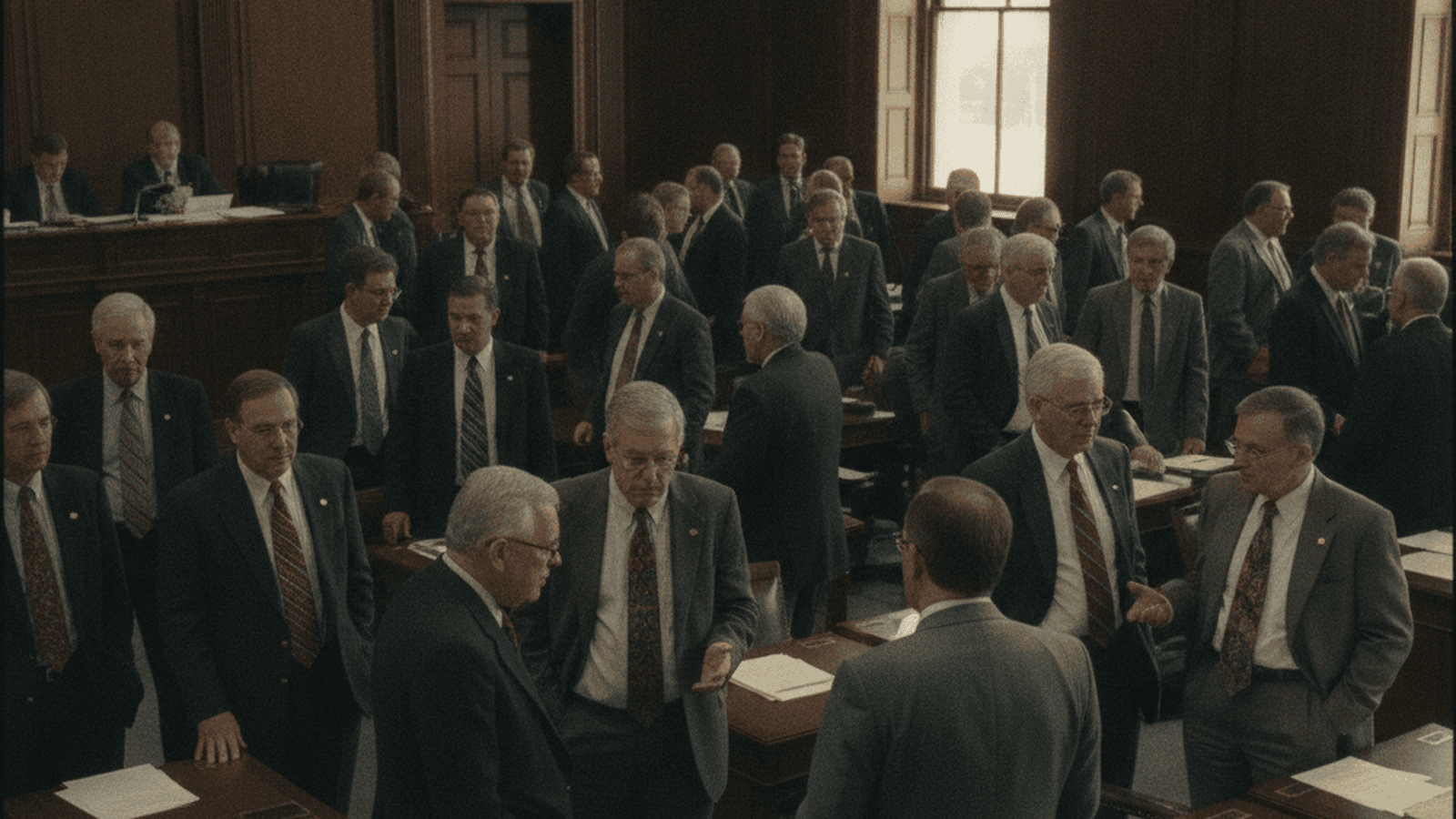
In 1994, the South Carolina House of Representatives experienced a historic parliamentary realignment as Republicans gained control for the first time since Reconstruction. This shift ended over a century of Democratic dominance in the United States statehouse and signaled a broader political transformation across the American South.
TLDR: The 1994 South Carolina House realignment saw Republicans seize control of the chamber for the first time in 118 years. Led by Speaker David Wilkins, the new majority implemented a conservative legislative agenda, marking a permanent shift in the state’s political landscape and the broader regional realignment of the United States.
The 1994 midterm elections are often defined by the national “Republican Revolution” led by Newt Gingrich, but the most enduring structural transformations occurred within the halls of state legislatures. In South Carolina, the 1994 election triggered a parliamentary realignment that dismantled a century-old political order. For 118 years, the Democratic Party had maintained an iron grip on the South Carolina House of Representatives, a streak that began in 1876 following the end of Reconstruction. This dominance had survived the Great Depression, the Civil Rights Movement, and the initial rise of the modern conservative movement under figures like Barry Goldwater and Ronald Reagan.
The shift began to materialize as the 1994 campaign season intensified. Republican candidates across the Palmetto State aligned themselves with the “Contract with America,” a national platform emphasizing fiscal responsibility, term limits, and smaller government. However, the local momentum was also fueled by a profound demographic and ideological migration. Conservative voters who had historically identified as “Dixiecrats” or “Boll Weevil” Democrats were increasingly moving toward the Republican banner. They felt that the national Democratic Party had drifted too far to the left on social and economic issues, leaving a vacuum that the state GOP was eager to fill. This grassroots energy provided the Republicans with a slate of competitive candidates in districts that had long been considered safe for the opposition, particularly in the growing suburban areas of the Upstate and the Lowcountry.
When the ballots were tallied in November 1994, the results were seismic. Republicans flipped 16 seats, transforming a 74-50 Democratic majority into a 66-58 Republican advantage. This was the first time since the 1870s that the GOP held the reins of power in the state’s lower chamber. The transition was not merely symbolic; it necessitated a total restructuring of the House’s internal governance. Committee chairmanships, which had been held by senior Democrats for decades—often through a system of rigid seniority—were transferred to Republican members. Many of these new leaders had spent their entire careers in the minority and suddenly found themselves responsible for the state’s legislative agenda.
David Wilkins, a representative from Greenville, emerged as the central figure of this new era. Upon the convening of the 121st General Assembly in January 1995, Wilkins was elected Speaker of the House. His ascension marked the definitive end of the traditional Democratic leadership that had characterized South Carolina politics for generations. Wilkins worked to professionalize the Republican caucus, implementing a more disciplined and partisan approach to legislative strategy that mirrored the shifts occurring in the United States Congress. The new majority moved quickly to advance a conservative policy agenda, focusing on welfare reform, significant property tax relief, and stricter criminal sentencing guidelines, including “Two Strikes” laws.
This parliamentary shift in South Carolina was a precursor to a broader regional trend. Over the next two decades, Republican parties across the Deep South would follow a similar trajectory, gaining control of chambers that had been Democratic strongholds since the 19th century. The 1994 realignment established a new baseline for partisan competition in the state, leading to further GOP gains in the State Senate by 2000 and a consistent hold on the Governor’s mansion. Today, the legacy of the 1994 flip remains visible in the state’s deeply entrenched Republican supermajorities. It represented the moment South Carolina transitioned from a one-party Democratic state to a cornerstone of the modern Republican South, fundamentally altering the state’s political identity for the 21st century.

Dylan Brooks serves as the Senior Correspondent for Statehouses and Local Governance at Just Right News, where he brings a principled, constitutionalist lens to the often-overlooked machinery of state-level politics. As the lead voice behind the acclaimed feature series “Fifty Laboratories of Power,” Dylan has dedicated his career to the idea that the most impactful governance happens closest to home. His reporting consistently champions the Tenth Amendment, exploring how individual states can serve as testing grounds for innovative, conservative policy solutions that prioritize personal liberty and fiscal responsibility.
A native of Des Moines, Iowa, Dylan’s journalistic philosophy was forged in the heart of the American Midwest. Growing up in a community where local school board meetings and town halls were the bedrock of civic life, he developed a deep appreciation for the “retail politics” of the heartland. This upbringing instilled in him a fundamental belief that the American experiment is best preserved when power is decentralized. He carries the values of his Iowa roots into every assignment, maintaining a healthy skepticism of federal overreach and a steadfast commitment to the concerns of everyday citizens over the interests of the administrative state.
Now based in Madison, Wisconsin, Dylan operates from one of the nation’s most pivotal political battlegrounds. His location in a state capital known for its rigorous policy debates allows him to provide Just Right News readers with a front-row seat to the legislative process. From Madison, he tracks the ripple effects of statehouse decisions on local municipalities, ensuring that the connection between high-level policy and community impact is never lost. His work often highlights the success of conservative governors and legislatures in fostering economic growth, protecting parental rights, and securing the integrity of local institutions.
As an African American man in the conservative media landscape, Dylan offers a vital perspective on how limited government and free-market principles empower individuals and families. He frequently reports on how deregulation and school choice initiatives provide new avenues for success in underserved communities, challenging the monolithic narratives often presented by legacy media outlets. Dylan’s work is characterized by a commitment to the facts and a refusal to shy away from the complex realities of modern governance.
Throughout his tenure at Just Right News, Dylan has become a trusted authority for readers who value a rigorous, principled approach to the news. Whether he is dissecting a complex state budget or profiling a local grassroots movement, his goal remains the same: to provide the American public with the information they need to hold their local leaders accountable. By focusing on the “Fifty Laboratories of Power,” Dylan Brooks ensures that the vital work being done in statehouses across the country receives the national attention it deserves, always through a lens that respects the traditions and sovereignty of the American people.