

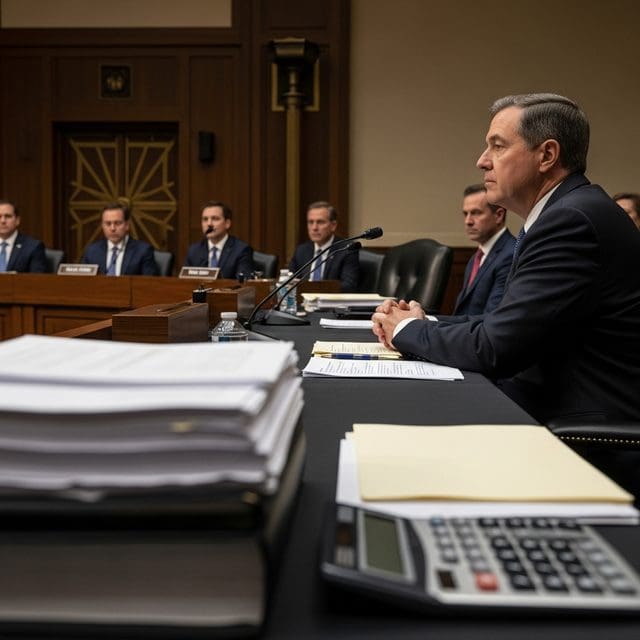
The U.S. defense chief informed Congress that military operations against Iran have reached $37.5 billion as regional instability drives domestic fuel prices above four dollars per gallon.
The fiscal reality of the escalating Middle East conflict reached Congress on Wednesday as the U.S. defense chief disclosed that the war with Iran has cost taxpayers $37.5 billion to date. This figure, presented during a high-stakes budget hearing, provides the first comprehensive look at the financial burn rate of a conflict characterized by naval blockades and missile strikes in the Strait of Hormuz. For fiscal watchdogs, the $37.5 billion represents a significant unbudgeted surge that threatens to widen the federal deficit.
This expenditure comes at a volatile moment for the American economy. On July 20, 2026, the national average gasoline price climbed above $4 per gallon, driven by the reinstatement of a naval blockade on Iran. This followed extreme energy market volatility where oil prices surged 9 percent to $83 per barrel on July 13, peaked above $90 on July 19, and then retreated below $87 on July 20 following reports of a potential ceasefire. The collapse of the OPEC+ agreement, which was contingent on a U.S.-Iran peace deal, has further destabilized crude costs, forcing the treasury to manage high defense outlays alongside domestic energy inflation.
Forensic analysis suggests these military expenditures are occurring as domestic growth slows. The Conference Board Leading Economic Index for the U.S. declined 0.2 percent in June 2026, settling at 99.1. This represents a 0.3 percent drop over the first half of the year, signaling a cooling economy even as defense spending accelerates to maintain the July 14 blockade. While U.S. manufacturing output reached a record $2.91 trillion as of July 21, the divergence between industrial productivity and leading economic indicators suggests a precarious balance for the national ledger.
Accountability concerns regarding large-scale federal spending are not limited to the United States. In Nigeria, transparency advocate Timi Frank has called for increased oversight of the 2026 federal budget, alleging inflated provisions. Similarly, the United Kingdom is grappling with its own fiscal commitments; Chancellor Healey recently reaffirmed that the UK would meet its NATO defense obligations despite his resignation, underscoring a global trend of rising military costs that strain national treasuries.
In Pakistan, Finance Minister Muhammad Aurangzeb unveiled a massive Rs 18.8 trillion budget for the 2026-27 fiscal year. While the plan includes tax relief, it highlights the immense scale of government spending required to navigate regional crises. Meanwhile, the U.S. domestic market faces hurdles like the Paramount Skydance-Warner Bros. Discovery merger pause, which was halted by a federal judge on July 20 following an antitrust lawsuit from twelve state attorneys general. This legal intervention adds complexity to a market already reacting to the $37.5 billion war cost.
As Congress reviews the defense chief’s testimony, the focus remains on whether the administration will seek a formal budget supplemental. The Trump administration is currently considering two options: a 10-day ceasefire to reopen the Strait of Hormuz or a massive joint military campaign with Israel. Each path carries distinct and heavy fiscal consequences. With the Leading Economic Index down and fuel prices up, the $37.5 billion figure is a signal that the cost of global stability is increasingly difficult to reconcile with domestic fiscal responsibility.

Max Grant serves as the Senior Correspondent for Data and Financial Forensics at Just Right News, where he brings a meticulous, investigative eye to the complex world of numbers. In an era where media narratives often overshadow objective reality, Max operates on a simple but firm principle: while rhetoric can be manipulated, the ledger never lies. As the architect behind the acclaimed feature series “Numbers That Talk,” he has carved out a vital niche in conservative journalism, translating dense financial data into clear, actionable insights for the American public.
Max’s journey to the forefront of financial reporting began in Buffalo, New York. Growing up in the Queen City, he was raised with the grit and grounded perspective typical of the Rust Belt. Buffalo is a place that understands the value of a dollar and the consequences of economic shifts on the working class. This upbringing instilled in Max a deep-seated respect for fiscal responsibility and a healthy skepticism toward bureaucratic overreach. He carries the spirit of his hometown into every investigation, viewing his work not just as reporting, but as a form of public service dedicated to protecting the interests of taxpayers and everyday citizens.
Now based in Brooklyn, New York, Max operates from the heart of one of the world’s most influential financial and cultural hubs. This vantage point allows him to keep a close watch on the institutions that drive the global economy. Living and working in a city often defined by progressive policy experiments, Max provides a necessary counter-perspective, using his forensic skills to analyze the real-world costs of local and national governance. His proximity to the financial district ensures he is never far from the source of the data he deconstructs, yet he remains firmly rooted in the conservative values that prioritize transparency and individual liberty.
His beat, Data and Financial Forensics, is more than just a job title; it is a commitment to uncovering the truth hidden within spreadsheets and annual reports. In “Numbers That Talk,” Max dives deep into federal spending, corporate accountability, and the intricate web of international finance. He has a unique ability to spot the anomalies that others miss, identifying where public funds are being mismanaged or where economic policies are failing to deliver on their promises. His reporting is characterized by a relentless pursuit of clarity, stripping away the jargon to show readers exactly how their money is being used and how the economy is truly performing.
At Just Right News, Max Grant is recognized as a steady hand and a sharp mind. He understands that for a free society to function, its citizens must have access to the facts regarding their financial future. By combining his British heritage’s tradition of rigorous inquiry with an American drive for accountability, Max ensures that the numbers don’t just sit on a page—they tell the story of where the country has been and where it is headed. His work stands as a testament to the power of forensic journalism in holding the powerful to account and championing the principles of a transparent, fiscally sound nation.