

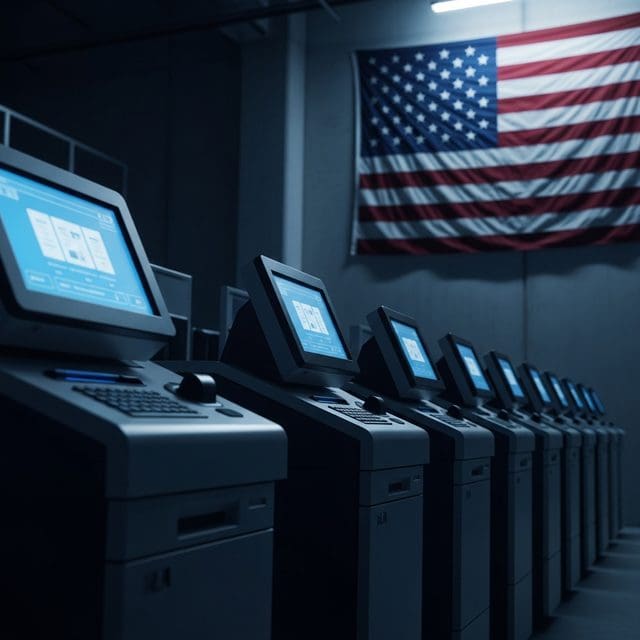
Declassified intelligence and a new CISA report reveal critical security gaps in election technology as nation-state adversaries target centralized voter databases and registration systems.
The digital frontlines of American sovereignty are under renewed scrutiny following the declassification of high-level intelligence assessments and a scathing report from the Cybersecurity and Infrastructure Security Agency (CISA). These documents reveal a troubling reality: bureaucratic processes intended to secure U.S. elections are currently serving as a bottleneck for critical security updates, leaving the nation vulnerable to sophisticated nation-state actors. As the United States navigates a complex geopolitical landscape, the intersection of technology and national security has become the primary theater of operations for global adversaries.
A CISA report dated July 16, 2026, details systemic failures within the fragmented certification regimes governing election technology. Under current rules, many jurisdictions are effectively prohibited from applying security patches for months leading up to an election, as doing so would void the equipment’s certification. This creates a dangerous window for adversaries to exploit known vulnerabilities that remain unaddressed by design. CISA is now urging a radical shift in policy, calling for harmonized patch rules that allow for real-time updates without the loss of certification. The report emphasizes that the delay in vulnerability disclosure represents a significant risk to the integrity of the democratic process.
Complementing these findings, the White House recently published previously classified Intelligence Community assessments covering the period from January 2020 through June 2026. The intelligence confirms that Russia, China, Iran, and North Korea maintain the capability to compromise U.S. election infrastructure. Analysts identified centralized repositories, such as voter registration databases, electronic pollbooks, and official reporting websites, as the primary targets. The objective of such incursions is rarely to change individual votes, but rather to disrupt the process, compromise personal data, and erode public confidence. The IC assessments highlight that access to these systems could be used to delete voter records or alter registration data, creating chaos on election day.
To counter these threats, CISA is advocating for an enterprise-wide patch management program. Recommendations include the mandatory use of Software Bill of Materials (SBOMs), the assignment of Common Vulnerabilities and Exposures (CVE) identifiers to election software, and the enforcement of multi-factor authentication for all registration systems. Furthermore, the agency is pushing for the adoption of paper ballots as a physical fail-safe against digital interference. CISA’s “Best Practices” document further specifies technical mandates, such as disabling SMBv1 and implementing dedicated, fully-patched workstations for all election-related tasks to prevent lateral movement by hackers.
Private sector leaders are also weighing in on the defense strategy. Google and Mandiant have issued guidance urging election officials to adopt indicator-less behavior monitoring and cloud-asset evaluation. This private-sector involvement highlights the necessity of a unified front between government and industry. As of 2024, CISA’s operational posture included continuous “Cyber Hygiene” scanning of over 21,000 election-related endpoints across 40 states. However, the report suggests that without harmonized patching rules, these technical defenses remain incomplete against persistent threats.
Beyond domestic borders, the intersection of cyber and kinetic geopolitics continues to evolve. Recent consultations between Germany and Ukraine established working groups to harden Ukraine’s digital administration and cybersecurity infrastructure. This international cooperation underscores the global nature of the ‘New Cold War,’ where digital sovereignty is increasingly tied to national survival. While U.S. manufacturing output has reached a record $2.91 trillion, the security of the digital systems managing this power remains a critical vulnerability. Protecting the vote is no longer just a matter of logistics; it is a matter of national defense in an era where bits and bytes are as lethal as traditional munitions.

Ryan Mitchell serves as a Staff Writer for Just Right News, where he anchors the desk for Cyber, Technology Policy, and Digital Sovereignty. In an era where the digital landscape has become as much a battlefield as any physical territory, Ryan provides a critical conservative lens on the forces shaping the future of American innovation and national security. His work is defined by a commitment to the idea that American leadership in the digital age is not just a matter of economic success, but a necessity for the preservation of global liberty.
Born and raised in Austin, Texas, Ryan’s perspective is deeply rooted in the Lone Star State’s tradition of independence and skepticism of centralized authority. Growing up in a city that transformed from a quiet state capital into a global technology hub, he witnessed firsthand the disruptive power of the tech industry. This upbringing instilled in him a firm belief in free-market principles and the necessity of protecting individual liberties from both government overreach and corporate overstep. His Texan background serves as a foundational compass, guiding his reporting toward stories that emphasize national resilience and the preservation of constitutional values in an increasingly virtual world.
Now based in San Francisco, California, Ryan operates from the epicenter of the very industry he scrutinizes. Living and working in the heart of Silicon Valley allows him to provide “boots on the ground” reporting that few conservative journalists can match. He navigates the cultural and political complexities of the Bay Area to bring Just Right News readers an inside look at the boardrooms and coding labs where the next generation of digital policy is forged. For Ryan, being stationed in San Francisco is a strategic choice; it allows him to challenge the prevailing ideological monoculture of the tech elite from within their own backyard, ensuring that the concerns of middle America are represented in the conversation about our digital future.
His beat—Cyber, Technology Policy, and Digital Sovereignty—covers the high-stakes world of data privacy, artificial intelligence, and the infrastructure of the modern web. Ryan is particularly focused on the concept of digital sovereignty, arguing that for a nation to remain truly free, it must maintain control over its own technological destiny and critical infrastructure. He frequently explores how international regulations and domestic policies impact the ability of American firms to compete without sacrificing the privacy or security of their citizens.
Central to his current body of work is his featured series, “The New Cold War.” Through this project, Ryan examines the escalating technological rivalry between the United States and its global adversaries. He delves into the complexities of state-sponsored hacking, the global race for semiconductor dominance, and the ideological struggle to define the rules of the internet. Ryan views this competition not merely as a commercial race, but as a fundamental defense of Western values against authoritarian digital models. Through his rigorous reporting and principled analysis, Ryan Mitchell ensures that the readers of Just Right News stay informed about the invisible forces defining the 21st century, always advocating for a future where technology serves the cause of freedom.