

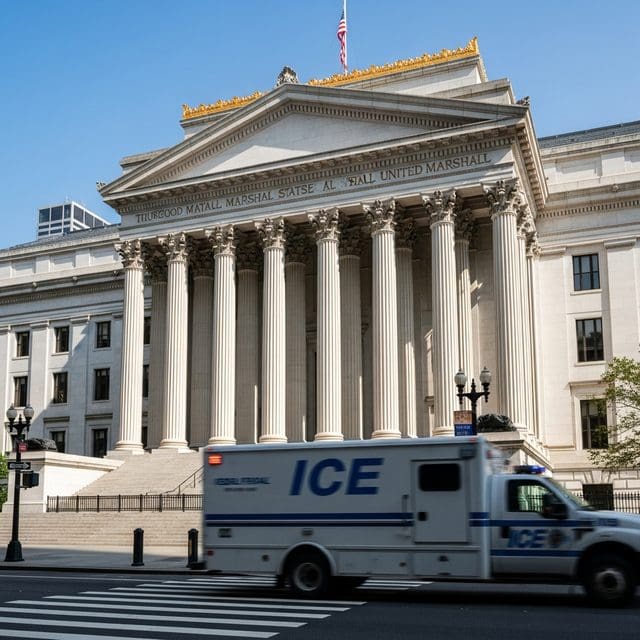
The 2nd Circuit ruled that district courts lack jurisdiction to release non-citizens from ICE custody before administrative remedies are exhausted, clearing the way for Mohsen Mahdawi’s potential re-arrest.
A three-judge panel of the 2nd U.S. Circuit Court of Appeals on July 21 formally vacated a 2025 order that had released Mohsen Mahdawi from the custody of U.S. Immigration and Customs Enforcement (ICE). The decision, which orders the dismissal of Mahdawi’s habeas corpus case, represents a significant victory for the Trump administration’s efforts to streamline the deportation of non-citizens involved in campus protests. The court held that the district court lacked the necessary jurisdiction to intervene in the detention, as such matters must first be litigated through the specialized immigration court system.
Mahdawi, a 35-year-old Palestinian-born lawful permanent resident who has lived in the United States for over a decade, was arrested by ICE in April 2025. The arrest occurred in Vermont during what Mahdawi believed was a routine citizenship interview. His detention became a flashpoint for legal debates regarding the targeting of non-citizen student activists. The administration has maintained that such enforcement actions are necessary to uphold the rule of law and maintain public order, particularly following the widespread unrest at Columbia University and other institutions.
The 2nd Circuit’s reasoning in this case closely mirrors a previous 2026 appellate decision involving Mahmoud Khalil, a former classmate of Mahdawi at Columbia. In that instance, the court similarly dismissed a habeas challenge to ICE detention for lack of jurisdiction. This emerging doctrinal pattern signals a broader judicial trend that limits the ability of federal district courts to provide immediate relief to non-citizens facing deportation. By requiring defendants to exhaust all immigration remedies before seeking federal court review, the judiciary is effectively centralizing enforcement power within the executive branch’s administrative framework.
The path to today’s ruling was paved by a series of administrative reversals. In May 2026, the Board of Immigration Appeals (BIA) overturned a decision by Immigration Judge Nina Froes, who had previously terminated Mahdawi’s removal proceedings. The BIA’s intervention reinstated the case, leading directly to a June 3, 2026, removal order for Mahdawi to be deported to Jordan. While Mahdawi is currently appealing that deportation order within the immigration system, the 2nd Circuit’s decision today removes his legal shield against physical detention. He remains out of custody for the moment, but he is now legally vulnerable to immediate re-arrest by ICE agents.
Central to Mahdawi’s defense was the claim that he was unconstitutionally targeted for his First Amendment activities, specifically his vocal criticism of Israel and his participation in protests regarding the war in Gaza. However, the appellate panel explicitly declined to rule on these free-speech claims. The judges stated that these constitutional questions are not yet “ripe” for review. According to the panel’s instructions, Mahdawi can only seek federal court review of his First Amendment arguments after he has fully exhausted the immigration court process, a cycle that can take months or years to complete.
This ruling arrives during a period of heightened federal activity across multiple sectors. While the administration focuses on border and interior enforcement, other branches of government are managing significant shifts, such as the recent surge in oil prices to over $90 per barrel following naval blockades, and record-breaking U.S. manufacturing output reaching $2.91 trillion. For Mahdawi and others in similar legal positions, the focus remains on the integrity of the social contract and the specific legal requirements of their residency status. The decision today clarifies that for non-citizens, the path to constitutional relief is strictly gated by the administrative requirements of the immigration system.

Julie Harris serves as a Staff Writer for Just Right News, where she tackles some of the most pressing and complex issues facing the nation today. As the lead reporter for the Migration, Demographics & Cultural Shifts beat, Julie provides a grounded, principled perspective on how the movement of people and the changing makeup of communities are reshaping the American landscape. Her work is defined by a commitment to exploring the long-term consequences of social change, prioritizing the stability of local institutions and the preservation of national identity.
Her deep understanding of these issues is rooted in her upbringing in Tucson, Arizona. Growing up in a prominent border state, Julie witnessed firsthand the intricate realities of migration and the profound impact it has on local infrastructure, law enforcement, and the social fabric. This early exposure instilled in her a respect for the rule of law and a keen awareness of the challenges that arise when federal policies fail to align with the needs of border communities. Her reporting often reflects this lived experience, bringing a necessary level of nuance to topics that are often treated with abstraction in coastal newsrooms.
Now based in Santa Fe, New Mexico, Julie continues to report from the heart of the American Southwest. Her location provides a unique vantage point to observe the intersection of traditional regional cultures and the modern shifts brought about by both internal and external migration. In Santa Fe, a city defined by its rich history and distinct cultural heritage, she finds a perfect environment to explore how communities strive to maintain their character while navigating the pressures of a rapidly changing world. This perspective allows her to bridge the gap between policy debates in Washington and the reality of life in the high desert.
At Just Right News, Julie’s work is characterized by a dedication to examining the data and the human stories that define the “New Mosaic” of America. Her signature feature series, “The New Mosaic,” has become a cornerstone of her reporting. Through this series, Julie explores the evolving social architecture of the United States, documenting how shifts in population affect everything from local economies to the political landscape. She brings a critical eye to the narrative of demographic inevitability, instead asking how these shifts impact the average citizen’s sense of belonging and the integrity of the American social contract.
Julie’s background and her dedication to conservative principles make her a vital voice in contemporary journalism. She understands that demographics are more than just numbers on a spreadsheet; they represent the future of the American family and the nation’s enduring legacy. Through her diligent reporting and insightful analysis, Julie Harris ensures that her readers are informed about the forces shaping their world, providing a perspective that is as thoughtful as it is necessary for the modern era.