

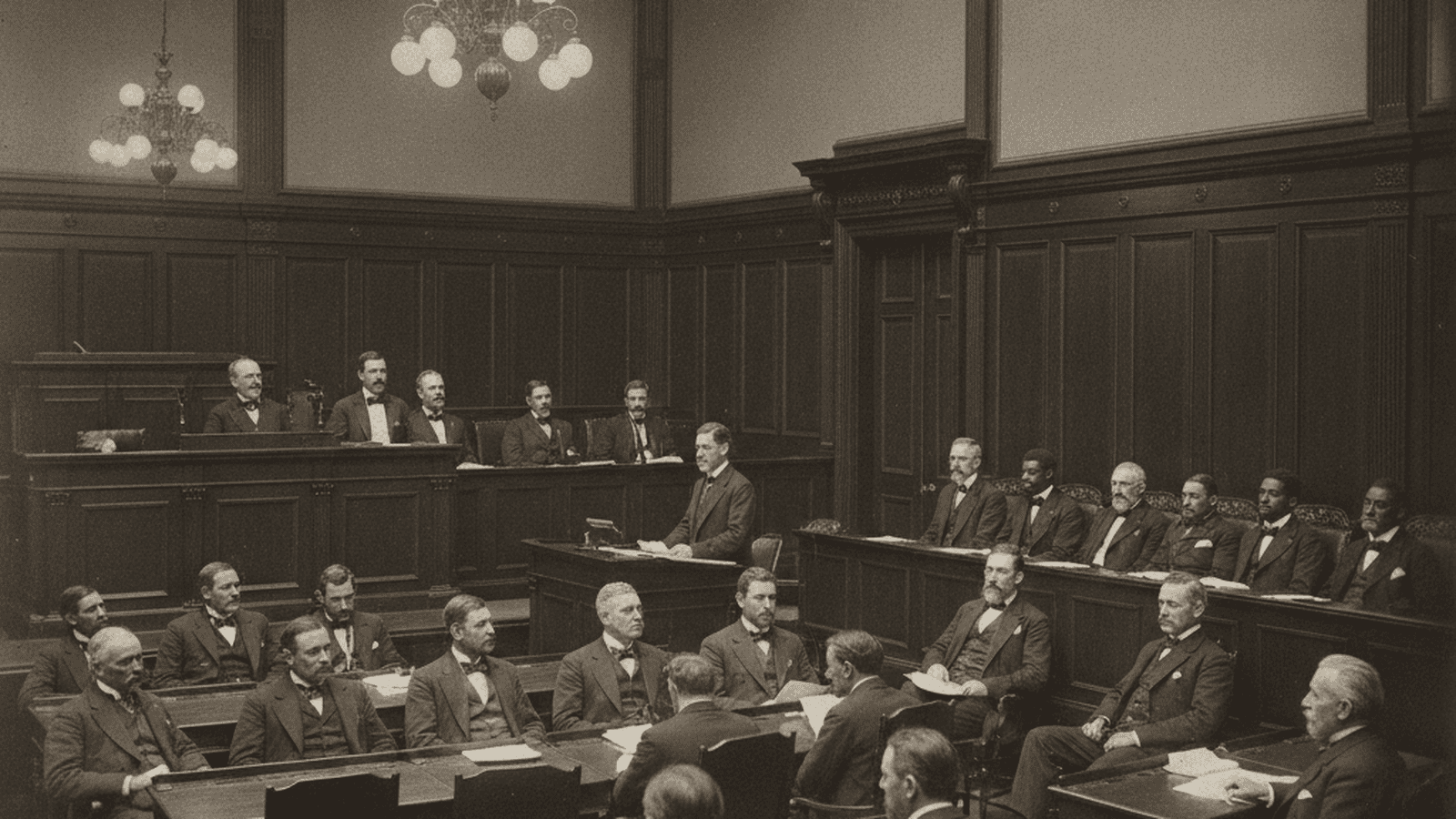
Following the U.S. Supreme Court’s invalidation of federal civil rights protections in 1883, New Jersey became one of the first states to pass its own comprehensive civil rights law. The 1884 act prohibited discrimination in public accommodations, marking a significant shift toward state-level responsibility for protecting the rights of Black citizens in the United States.
TLDR: In 1884, New Jersey legislators passed a landmark civil rights act to counter a Supreme Court ruling that gutted federal protections. The law banned racial discrimination in public spaces like theaters and hotels, establishing a crucial legal framework for state-enforced equality during the Gilded Age.
The 1883 United States Supreme Court decision in the Civil Rights Cases dealt a devastating blow to the aspirations of Black Americans across the nation. By declaring the federal Civil Rights Act of 1875 unconstitutional in an 8-1 ruling, the Court asserted that the Fourteenth Amendment only prohibited state-sponsored discrimination, not the actions of private individuals or businesses. This legal retreat effectively ended federal efforts to ensure equal access to public life, leaving the protection of such rights entirely to the discretion of individual states. In the wake of this federal abandonment, Black activists and sympathetic legislators in the Mid-Atlantic region, particularly in New Jersey, launched a concerted effort to codify civil rights protections at the state level.
New Jersey emerged as a primary battleground for this legislative shift. The state’s Black population, though smaller than those in the South, was politically organized, urbanized, and increasingly vocal. Leaders such as William R. Reeve and organizations like the New Jersey State Convention of Colored Men recognized a dangerous precedent: without state intervention, the doctrine of racial exclusion would rapidly solidify into an impenetrable barrier. They lobbied the New Jersey Legislature intensely throughout the winter of 1883 and early 1884, demanding that the state uphold the spirit of the Reconstruction amendments that the federal judiciary had so severely narrowed.
The political environment in Trenton was fraught with tension. The Democratic Party, which held significant power, often resisted civil rights measures to appease conservative constituents, while the Republican Party sought to maintain its identity as the “Party of Lincoln.” However, the strategic placement of Black voters in several key swing districts forced a bipartisan consideration of the issue. Assemblyman William H. Carter, a Republican from Burlington County, introduced the bill that would eventually become the New Jersey Civil Rights Act of 1884. During the debates, opponents argued that the law would infringe upon private property rights and disrupt established social customs. Proponents, however, countered that the state had a moral and legal obligation to ensure that all citizens, regardless of race, could participate fully in the public economy and social fabric.
The Black press, including influential newspapers like the New York Globe, closely monitored the proceedings in Trenton. Editors and journalists provided a platform for activists to pressure wavering legislators, framing the bill as a litmus test for the state’s commitment to post-war equality. The resulting legislation was remarkably comprehensive for the Gilded Age. It mandated that all persons within the jurisdiction of New Jersey were entitled to the “full and equal enjoyment” of the accommodations, advantages, facilities, and privileges of inns, public conveyances on land or water, theaters, and other places of public amusement. Crucially, the law specified that these rights applied regardless of race, color, or previous condition of servitude.
To ensure the law had teeth, it included both criminal and civil penalties. Violators could be found guilty of a misdemeanor, facing fines between $500 and $1,000 or imprisonment. Furthermore, aggrieved parties were empowered to sue for damages in civil court. On May 10, 1884, Governor Leon Abbett signed the bill into law. Its passage was celebrated as a monumental victory for the state’s Black community and a direct rebuke to the Supreme Court’s restrictive interpretation of federal power.
While enforcement remained a persistent challenge due to local prejudice and the high cost of litigation, the 1884 Act established a vital legal framework. It signaled that state governments could serve as essential guardians of liberty when federal oversight failed. This victory in New Jersey helped spark similar legislative actions across the North, creating a patchwork of protections that kept the ideal of equality alive during the height of the Jim Crow era. Ultimately, the 1884 Act served as the foundational precursor to New Jersey’s landmark 1945 Law Against Discrimination, illustrating the enduring power of state-level activism.

Lila Hayes serves as a Staff Writer for Just Right News, where she anchors the “Courts, Law, and Constitutional Order” beat. Her work is defined by a steadfast commitment to the foundational principles of the American republic and a rigorous defense of the legal frameworks that ensure national stability. As a primary voice for the outlet, she provides readers with a clear-eyed analysis of the judiciary, focusing on the importance of originalism and the preservation of the separation of powers.
Lila’s perspective was forged in the American heartland. Raised in St. Louis, Missouri, she grew up in a Hispanic household where the values of hard work, faith, and respect for the law were paramount. Her upbringing instilled in her a deep appreciation for the American Dream and the legal protections that make it possible. This Missouri background remains a cornerstone of her reporting, providing a grounded, common-sense counter-narrative to the often-insular legal circles of the coastal elite. She understands that the decisions made in high-court chambers have real-world consequences for families and small business owners across the country.
At Just Right News, Lila has become widely recognized for her signature feature series, “The Rulebook of Power.” In this ongoing project, she delves into the mechanics of the federal government, examining how administrative overreach and judicial activism can threaten the delicate balance of the Constitution. She approaches her beat with the tenacity of a veteran journalist and the precision of a legal scholar, consistently advocating for a judiciary that interprets the law as written rather than legislating from the bench. For Lila, the Constitution is not a “living” document subject to the whims of modern social trends; it is a fixed standard that ensures the government remains the servant of the people, not their master.
Now based in Philadelphia, Pennsylvania, Lila finds herself at the very epicenter of American constitutional history. Living and working in the city where the Founders drafted the documents she defends daily provides a constant source of inspiration. The historic halls and landmarks of Philadelphia serve as a daily reminder of the high stakes involved in her reporting. Her presence in the city allows her to bridge the gap between the historical intent of the law and its contemporary application, ensuring that the legacy of the Founding Fathers remains central to the national conversation.
Throughout her career, Lila has remained dedicated to the idea that a free society requires an informed citizenry and a transparent legal system. Her reporting is more than just a collection of headlines; it is a defense of the constitutional order that has sustained the nation for over two centuries. By focusing on the “Rulebook of Power,” she ensures that her readers understand not just what is happening in the courtrooms, but why those decisions matter for the future of American liberty. Lila Hayes continues to be a vital voice for those who believe that the law should be a shield for the citizen and a constraint on the state.