

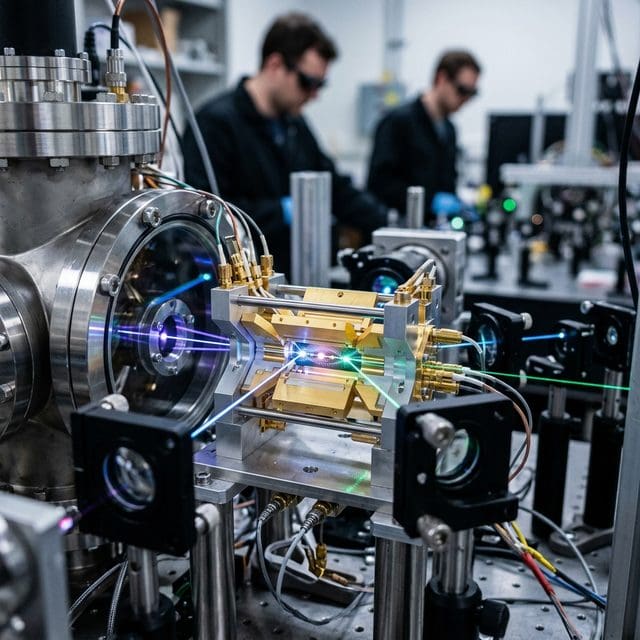
An Oxford hybrid quantum computer reproduced the Aharonov–Bohm effect, showing how magnetic flux can halt particle tunneling through destructive interference.
A particle need not pass through a magnetic field to be affected by it. In a celebrated quantum phenomenon, the Aharonov–Bohm effect, a magnetic field can alter the phase of a particle’s wave even when the particle travels only through a region where the field itself is absent. That phase can change how possible paths combine—and, in a new Oxford experiment, it stopped simulated matter from moving at all.
Researchers at the University of Oxford used a hybrid quantum computer to reproduce the effect in a deliberately compact model. The experiment joined two kinds of quantum elements: the trapped ions’ internal electronic states served as qubits representing a gauge field, while their vibrational motion acted as quantum oscillators representing matter. Together, two matter oscillators and two field qubits formed a loop.
Without simulated magnetic flux, matter tunneled between locations in the loop. With flux applied, the possible paths interfered destructively, completely canceling the tunneling. The system remained in its starting state. The result, reported by Phys.org in an article published October 10 and updated October 12, turns an abstract feature of quantum mechanics into a measurable change in a controlled experiment.
The finding matters because quantum computers are often discussed as future calculators, but they may also serve as specialized laboratories. Some interactions in particle physics are hard to model on conventional computers. A quantum system built to follow the same underlying rules could let researchers investigate how matter and fields behave together. Oxford’s demonstration is a small proof of principle, not a new machine ready to solve open problems in particle physics. Its value is showing that a hybrid device can reproduce a fundamental field–matter effect and reveal its dynamics.
The experiment’s architecture is part of the point. Rather than encoding every ingredient as a qubit, the researchers used the ions’ natural vibrational modes as oscillators for matter. That division gives the simulator different tools for representing different parts of the physics. Oxford researchers Sebastian Saner and Oana Băzăvan worked with Alejandro Bermúdez of Madrid’s Instituto de Física Teórica; development of the experiment began in 2022, according to Phys.org.
The Oxford result sits alongside a related effort at the University of Maryland, which illustrates how quickly researchers are exploring this hybrid approach. A team led by Anton Than, under the joint supervision of Zohreh Davoudi, Alaina Green and Norbert Linke, used ytterbium ions in a blade-style radiofrequency trap to simulate real-time dynamics in a one-spatial-dimension Yukawa model. The Yukawa potential describes an interaction relevant to nuclear and particle physics. In that system, qubits represented fermionic degrees of freedom, while native phonon modes—the ions’ collective vibrations—represented bosonic fields, avoiding the need to encode that bosonic register in qubits. The work appeared in Nature Physics on September 25.
Neither experiment reproduces the full complexity of a particle collision or a working nuclear theory. Both instead tackle simplified models, a necessary step toward determining which questions quantum hardware can answer reliably. The Oxford team’s next challenge is to build on the demonstrated control of matter and gauge fields; the Maryland work offers another model for testing real-time field dynamics.
For now, the striking result is precise and modest: in a quantum simulation, adding flux changed the phase of the available paths enough to shut off tunneling. That is not a breakthrough in everyday computing. It is a clear demonstration of quantum computing’s more immediate scientific promise—using carefully controlled quantum systems to test the rules of nature on their own terms.

Mason Reed serves as a Staff Writer for Just Right News, where he spearheads the Future Frontiers & Special Projects desk. In an era defined by rapid technological shifts and evolving social landscapes, Mason provides a steady, principled voice, examining the innovations of tomorrow through the lens of traditional American values. His work is most prominently featured in his signature series, “The Next Horizon,” where he explores the intersection of emerging technology, national sovereignty, and the preservation of individual liberty.
A native of San Diego, California, Mason’s worldview was shaped by the unique culture of his hometown. Growing up in a region defined by its strong military presence and its history of maritime industry, he developed a deep-seated respect for the institutions that provide national stability and the entrepreneurial spirit that drives the American economy. This upbringing instilled in him a belief that true progress is not found in discarding the past, but in building upon a foundation of proven principles. His reporting often reflects this San Diego influence, emphasizing the importance of a robust national defense and the necessity of maintaining a competitive edge in the global marketplace.
Now based in San Francisco, Mason operates from the heart of the world’s technological engine. Living and working in the Bay Area provides him with a front-row seat to the advancements—and the ideological challenges—emanating from Silicon Valley. While many in the region embrace a “move fast and break things” mentality, Mason’s reporting serves as a vital counterweight. He offers Just Right News readers a “boots on the ground” perspective, documenting how radical local policies and the concentration of tech power impact the everyday lives of citizens. His proximity to the industry allows him to cut through the marketing jargon of big tech to uncover the real-world implications for privacy, free speech, and the nuclear family.
In his “Future Frontiers” beat, Mason tackles complex subjects ranging from the ethics of artificial intelligence to the burgeoning private space race. He approaches these topics with a healthy skepticism toward centralized bureaucracy, championing instead the decentralized innovations that empower individuals. Through “The Next Horizon,” he highlights the pioneers and thinkers who are working to ensure that the future remains a place where human dignity and constitutional rights are protected. He believes that the rapid pace of change requires more than just technical expertise; it requires a moral compass rooted in the Western tradition.
Throughout his tenure at Just Right News, Mason has remained committed to the idea that the future is something to be shaped, not merely accepted. His writing is characterized by a rigorous defense of American exceptionalism and a belief that the country’s best days lie ahead, provided it remains true to its founding ideals. Whether he is investigating the impact of automation on the American workforce or profiling the next generation of aerospace engineers, Mason Reed ensures that his readers are equipped with the insights they need to navigate a changing world with confidence and clarity.