

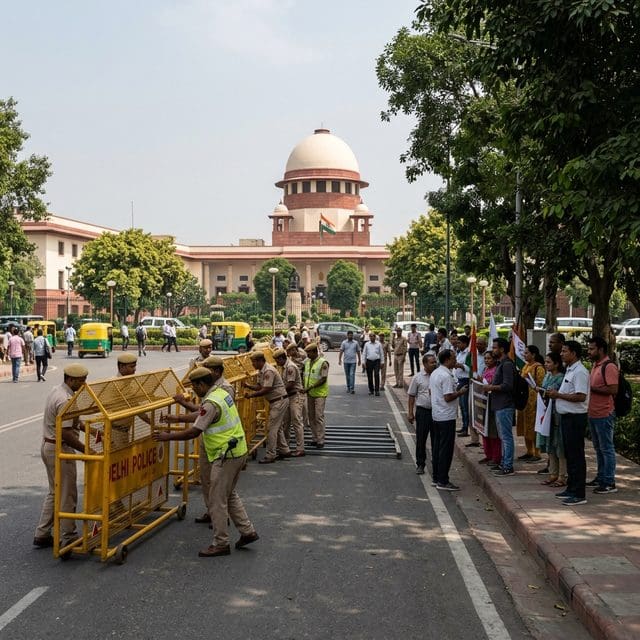
India’s Supreme Court directed restoration of transit and internet services and barred illegal detention of peaceful protesters, while seeking details from authorities on alleged restrictions and compliance.
India’s Supreme Court intervened in Delhi on October 11 amid protests over Chief Election Commissioner Gyanesh Kumar, directing authorities to restore ordinary metro and railway operations, maintain internet access and protect free movement, according to Hindustan Times, The Hindu and LiveLaw. The bench also said peaceful, unarmed people may not be detained except under procedure established by law.
The directions address restrictions affecting public movement and access to court complexes. The court called for a review of barricades and ordered removal of a notice restricting access around the Supreme Court and other court premises, the reports said. The immediate issue is whether people can travel, communicate and reach courts while demonstrations are under way.
The order places limits on how officials manage protests, but the available reporting does not show that the court issued a final judgment defining government authority to restrict public services or impose public-order measures in other circumstances. The reports describe directions issued at a special hearing, with further proceedings set for October 13. They do not reproduce the full legal provisions or the complete text of the order.
The court issued notice to alleged contemnors, including Union Home Secretary Govind Mohan, Delhi Police Commissioner Anurag Kumar, Delhi Metro Rail Corporation chairperson D. Thara, railway authorities and Delhi Police, according to Hindustan Times and the Indian Express. It sought responses, affidavits and compliance reports. A notice is not a finding of contempt: those named have an opportunity to respond before the court decides whether an earlier direction was violated.
That distinction is central to what the order says. The reported protection against detention is not categorical immunity from arrest; it requires detention to follow lawful procedure. Nor does an order requiring compliance establish that every protest-related restriction is unconstitutional. The court is examining officials’ conduct against its directions and the law, with the merits still unresolved.
The government’s account, reported by Hindustan Times, was that all metro stations had been open since 10 p.m. and internet connectivity had been restored. Solicitor General Tushar Mehta also described metro and train operations. The figures in the available account could not be independently verified, and the court sought station-by-station information. That request indicates that general assurances did not answer the court’s questions about which services were operating.
The contempt petition concerns alleged violations of an earlier direction on transit restrictions. Separate, though related, questions include what authority officials may invoke, what safeguards apply to detention and whether any restriction complies with the court’s orders. The source material does not provide the full earlier order or the government’s complete legal justification, so those questions remain contested.
Rahul Gandhi appears in wider coverage of protest-related detentions, but the cited reports contain no new verified development involving him. The petitions reportedly concern opposition leaders and other protesters. India Today said INDIA bloc leaders planned to meet Chief Justice Surya Kant; that report does not establish a separate ruling about Gandhi.
For now, the practical directions are to ensure access to services and courts and to avoid detaining peaceful people outside lawful process. The order’s lasting reach will depend on its written terms, the Central government’s response and any subsequent findings on compliance. It is best understood at this stage as judicial supervision during a public-order dispute, not a final constitutional ruling settling the limits of protest regulation.

Lila Hayes serves as a Staff Writer for Just Right News, where she anchors the “Courts, Law, and Constitutional Order” beat. Her work is defined by a steadfast commitment to the foundational principles of the American republic and a rigorous defense of the legal frameworks that ensure national stability. As a primary voice for the outlet, she provides readers with a clear-eyed analysis of the judiciary, focusing on the importance of originalism and the preservation of the separation of powers.
Lila’s perspective was forged in the American heartland. Raised in St. Louis, Missouri, she grew up in a Hispanic household where the values of hard work, faith, and respect for the law were paramount. Her upbringing instilled in her a deep appreciation for the American Dream and the legal protections that make it possible. This Missouri background remains a cornerstone of her reporting, providing a grounded, common-sense counter-narrative to the often-insular legal circles of the coastal elite. She understands that the decisions made in high-court chambers have real-world consequences for families and small business owners across the country.
At Just Right News, Lila has become widely recognized for her signature feature series, “The Rulebook of Power.” In this ongoing project, she delves into the mechanics of the federal government, examining how administrative overreach and judicial activism can threaten the delicate balance of the Constitution. She approaches her beat with the tenacity of a veteran journalist and the precision of a legal scholar, consistently advocating for a judiciary that interprets the law as written rather than legislating from the bench. For Lila, the Constitution is not a “living” document subject to the whims of modern social trends; it is a fixed standard that ensures the government remains the servant of the people, not their master.
Now based in Philadelphia, Pennsylvania, Lila finds herself at the very epicenter of American constitutional history. Living and working in the city where the Founders drafted the documents she defends daily provides a constant source of inspiration. The historic halls and landmarks of Philadelphia serve as a daily reminder of the high stakes involved in her reporting. Her presence in the city allows her to bridge the gap between the historical intent of the law and its contemporary application, ensuring that the legacy of the Founding Fathers remains central to the national conversation.
Throughout her career, Lila has remained dedicated to the idea that a free society requires an informed citizenry and a transparent legal system. Her reporting is more than just a collection of headlines; it is a defense of the constitutional order that has sustained the nation for over two centuries. By focusing on the “Rulebook of Power,” she ensures that her readers understand not just what is happening in the courtrooms, but why those decisions matter for the future of American liberty. Lila Hayes continues to be a vital voice for those who believe that the law should be a shield for the citizen and a constraint on the state.