

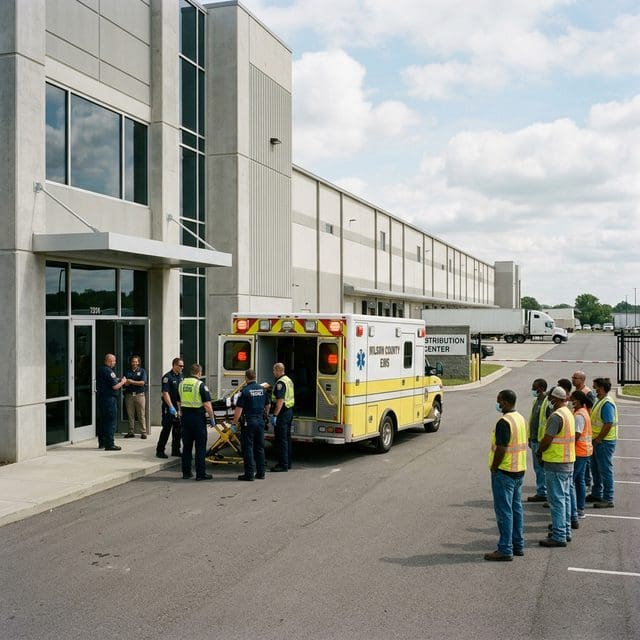
A possible illness at a Tennessee distribution center and a warning strike at a Nigerian hospital put workplace safety and accountability in focus.
Workplace safety—not wages or job creation—was at the center of two labor developments on October 12. Workers at a Walmart distribution center in Tennessee were treated after a possible food-related illness, while health workers at a Nigerian hospital began a warning strike over an alleged assault on a colleague.
At Walmart’s distribution center on Hixson Road in Lebanon, Tennessee, approximately 25 to 30 people were treated on site and 19 were transported to a medical facility. The cause remained under investigation as of Monday. Walmart said the incident did not involve products or food being delivered to its stores or customers.
That distinction addresses concern about the company’s supply chain, but the immediate question for employees remains unanswered: what caused people at the facility to become ill? Reporting did not establish a cause or detail the condition of those treated. It would be premature to call the episode food poisoning or assign responsibility while the investigation is ongoing.
A sudden illness at a distribution center can disrupt a shift and raise questions about response procedures, workplace conditions and communication with employees. But available reports did not say how the incident affected operations, whether workers missed additional time, or whether Walmart changed procedures. They also offered no details about wages, staffing or employment totals at the site.
The episode should not be conflated with a broader claim about Walmart products. The company said goods destined for stores or customers were not involved. That narrows the scope of the reported event, while leaving the source of the illness and circumstances inside the facility unresolved.
In Abeokuta, Ogun State, health workers at the Federal Medical Centre began a 72-hour warning strike at 11 a.m. Monday. The action followed the alleged stabbing of medical laboratory scientist Lawal Toheeb Olasunkanmi by a patient’s relative. Workers were due to resume at 8 a.m. on October 15.
The five-union Joint Action Committee is seeking an urgent management-union meeting, an investigation and accountability, improved security, and enforceable protections against threats, harassment and physical assault, Punch reported. The demands concern basic conditions for doing the work: staff need to be able to care for patients and perform laboratory duties without facing violence or intimidation.
The hospital said management had already met with unions, Punch reported. That account leaves a gap between the parties’ positions: management described prior engagement, while workers were still seeking an urgent meeting and concrete protections. Reporting did not detail what was discussed, whether security measures were agreed, or whether the unions considered the earlier meeting sufficient.
A warning strike is meant to press for action without becoming an indefinite stoppage, but it can still interrupt hospital services. The source material did not specify which services were affected or how patient care was arranged during the walkout. Those consequences matter alongside workers’ concerns, but the available information is insufficient to measure either. The unions’ call for enforceable protections also raises a practical test: whether commitments will be specific and monitorable, rather than assurances that leave staff uncertain about what happens after another threat or assault.
Neither case provides a broader measure of real wages, unemployment or workforce participation. Both show why labor coverage cannot be reduced to paychecks and hiring totals. Safety shapes whether people can remain at work, while management’s response can affect whether employees believe their concerns are being addressed. In Tennessee, the next key fact is what investigators determine. In Abeokuta, it is whether the hospital and unions agree on protections workers can rely on.

Tom Blake serves as the Senior Correspondent for Labor, Wages, and Automation at Just Right News, where he brings a grounded, principled perspective to the most pressing economic issues facing the American heartland. As the lead voice behind the acclaimed feature series “The Price of Work,” Tom focuses his reporting on the intersection of traditional industry and the rapidly evolving technological landscape, always prioritizing the dignity of the individual worker and the health of the American family.
Tom’s deep understanding of the labor market is not merely academic; it is rooted in his upbringing in Detroit, Michigan. Growing up in the shadow of the automotive industry, he witnessed firsthand the triumphs and tribulations of the American blue-collar workforce. He saw how the stability of a manufacturing job could build a community and, conversely, how the erosion of those industries could tear the social fabric apart. This background instilled in him a lifelong respect for the trades and a healthy skepticism toward economic policies that prioritize globalist interests over the well-being of local communities.
Now based in Pittsburgh, Pennsylvania, Tom continues to report from the front lines of the shifting economy. Pittsburgh, a city that has reinvented itself while maintaining its gritty, industrious spirit, provides the perfect vantage point for his beat. From the steel mills that remain to the high-tech robotics labs reshaping the city’s future, Tom explores how automation is changing the nature of employment. His reporting often highlights the tension between innovation and tradition, arguing that while progress is inevitable, it must not come at the expense of the American worker’s ability to provide for their family through honest, meaningful labor.
In his role at Just Right News, Tom has become a vital voice for those who feel overlooked by mainstream economic coverage. He rejects the notion that the decline of American manufacturing is an unavoidable casualty of the modern era. Instead, his work often examines how regulatory overreach, rising energy costs, and the unchecked rise of automation impact the take-home pay of everyday citizens. Through “The Price of Work,” Tom delves into the true cost of economic shifts, looking beyond the raw data to tell the stories of the people behind the statistics.
Tom’s reporting is characterized by a commitment to the conservative values of self-reliance, fiscal responsibility, and the preservation of the American dream. He believes that a strong nation is built on a foundation of stable jobs and fair wages, and his work seeks to hold both government and corporate entities accountable to that standard. Whether he is interviewing a shop floor manager about the implementation of new AI technology or analyzing the impact of wage inflation on small businesses, Tom provides a clear-eyed analysis that resonates with readers who value hard work and common sense.
Through his dedicated coverage, Tom Blake remains a steadfast advocate for the American workforce, ensuring that the voices of those in the industrial heartland are heard loud and clear in the national conversation. His perspective is essential for anyone seeking to understand the complex realities of labor and automation in the twenty-first century.