

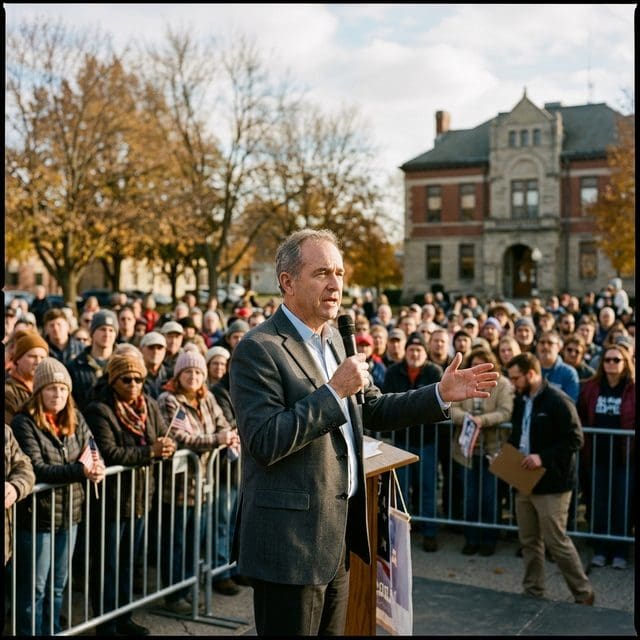
With control of Congress at stake, party leaders are campaigning across contested districts and states, where ratings and redrawn boundaries shape the battlefield.
With Election Day approaching, leaders from both parties are taking their midterm arguments to contested districts and states. The travel highlights the stakes of a possible change in House control, but it is not evidence that the electoral map has shifted.
House Speaker Mike Johnson has argued that polling weakness may not reflect Republican turnout. In an interview aired Sunday on Fox News, the Louisiana Republican said he was visiting swing districts where polls and pundits predicted losses. He suggested Republicans were difficult to reach through polling because many distrust pollsters, adding on a podcast hosted by Family Research Council president Tony Perkins that some voters could not tell who was behind survey calls.
That is a campaign argument, not independent evidence that polls are undercounting Republicans. Johnson’s comments offer supporters a reason for confidence while acknowledging a practical challenge: if campaigns cannot reliably reach voters, it becomes harder to measure support and plan turnout efforts. His explanation should be distinguished from the forecasts themselves.
House Minority Leader Hakeem Jeffries campaigned in Toledo, Ohio, for Rep. Marcy Kaptur, who faces Republican Derek Merrin. Ohio lawmakers redrew Kaptur’s district to make it more favorable to Republicans, and Inside Elections rates the race a Toss-up. That makes it one of the contests that could help determine House control, though the rating is not a prediction of the result.
Jeffries told The Associated Press that Democrats were making the case for “dramatic change” rather than the status quo, linking the party’s appeal to affordability. The message reflects Democrats’ effort to turn concerns about costs into a congressional choice. Its effect will depend on whether voters see the party as offering a credible response and whether the argument reaches them in the district.
Democratic Whip Katherine M. Clark is expected in Florida this week to campaign for Bale Dalton, a candidate in the open 7th District. Clark is in line to become majority leader if Democrats win the House, giving her trip both a campaign purpose and a leadership dimension. But Inside Elections rates the district Likely Republican. A senior party visit does not, by itself, mean a race is close. The contest also illustrates the uncertainty of open seats, where there is no incumbent campaign organization to carry forward.
President Donald Trump is scheduled to campaign in Kansas, North Carolina, South Carolina, Iowa, Florida, Georgia and Michigan. His Senate itinerary includes races where Republicans face challenges. In Kansas, Republican Sen. Roger Marshall is confronting Democrat Adam Hamilton. In Georgia, Democrat Jon Ossoff faces Republican Mike Collins; in North Carolina, Democrat Roy Cooper faces Republican Michael Whatley. Inside Elections rates the Georgia and North Carolina races Leans Democratic. Michigan’s contest between Republican Mike Rogers and Democrat Abdul El-Sayed is rated Tilt Democratic.
Those ratings suggest Trump’s Senate travel is more defensive than offensive: several stops are in states where Republicans are working to overcome Democratic advantages or protect seats. Vice President JD Vance is also scheduled to campaign in North Carolina, Ohio and Nebraska. Ohio Republicans have announced an Oct. 21 rally at the Sharonville Convention Center supporting Jon Husted and other Republicans.
Texas adds an immediate test of campaign organization. Early voting begins Oct. 19, after James Talarico and Ken Paxton held competing rallies the previous day. Across these races, campaign travel shows where party leaders are spending time and political capital. It cannot substitute for election results, and race ratings remain assessments, not guarantees. Voters will ultimately weigh candidates’ records and proposals; party leaders must turn attention into turnout.

Sophie Carter serves as a Staff Writer for Just Right News, where she anchors the outlet’s critical coverage of Elections, Influence, and Democracy Infrastructure. In an era where the mechanics of voting and the flow of political capital are under constant scrutiny, Sophie provides a steady, principled voice dedicated to the preservation of American institutional integrity and the rule of law.
Raised in Charlotte, North Carolina, Sophie’s perspective was forged in a community that balances rapid modern growth with a deep respect for tradition and civic duty. Growing up in the Queen City, she witnessed firsthand how a robust local culture depends on the trust between the citizen and the state. This upbringing instilled in her a foundational belief that the right to vote is a sacred trust—one that must be protected from both administrative overreach and the encroaching influence of special interest groups. Her reporting reflects these North Carolina roots, emphasizing the importance of community-led governance and the preservation of the individual’s voice in the face of nationalized political movements.
Now based in Atlanta, Georgia, Sophie operates from the heart of one of the nation’s most pivotal and contested political landscapes. Her location allows her to report from the front lines of the debate over election security, legislative reform, and the modernization of voting systems. For Sophie, the “infrastructure” of democracy is not merely a matter of machines and ballots; it is the collection of laws, people, and transparent processes required to maintain public confidence. Her work often highlights the necessity of clear, enforceable standards that ensure every legal vote is counted fairly and that the machinery of our republic remains accountable to the taxpayers who fund it.
Central to her work at Just Right News is her acclaimed feature series, “The Price of a Vote.” Through this ongoing project, Sophie explores the complex web of influence that shapes modern campaigns and policy decisions. She delves into how high-level lobbying, non-governmental organizations, and shifting bureaucratic regulations impact the weight of an individual citizen’s ballot. By examining the financial and structural pressures placed on the electoral process, she provides readers with a comprehensive look at the forces vying for control over the American political system.
Sophie’s approach to journalism is rooted in a commitment to the constitutional framework. She views her role as a watchdog for the voter, ensuring that the systems meant to serve the public remain transparent and free from corruption. Whether she is analyzing the implementation of new voting technologies or investigating the influence of outside money on state-level policy, her work is characterized by a rigorous adherence to facts and a refusal to succumb to the sensationalism that often plagues modern political reporting.
At Just Right News, Sophie Carter continues to be a vital resource for readers who value clarity, conviction, and a defense of traditional American values. Her deep ties to the Southeast and her specialized focus on the mechanics of our republic make her an essential voice in the ongoing conversation about the future of American self-governance. Through her reporting, she remains dedicated to the idea that a secure and honest electoral system is the bedrock of a free and prosperous society.