

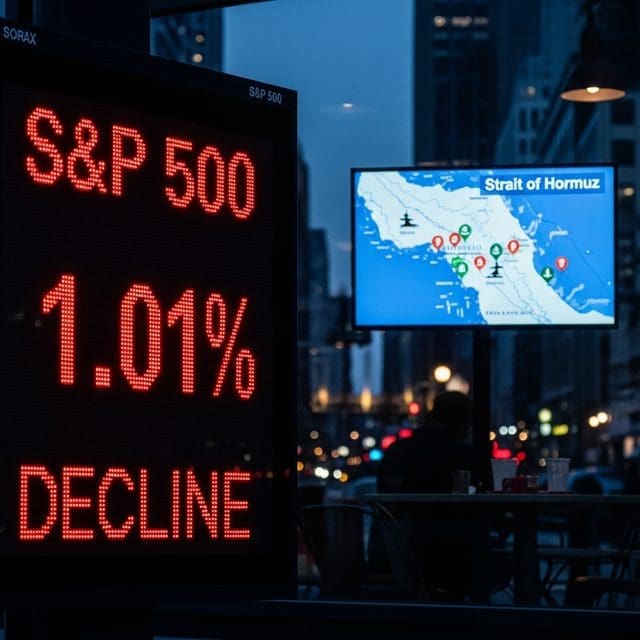
The S&P 500 fell 1.01% as escalating U.S.-Iran hostilities drove crude prices toward $83, heightening inflation concerns and the likelihood of further interest rate hikes from a hawkish Federal Reserve.
Global financial markets are navigating a period of significant volatility, with the S&P 500 (SPY) retreating 1.01% in the current session. This downturn is a continuation of a multi-day drawdown that saw the Nasdaq Composite fall 2.90% and the Dow Jones slide nearly 1% over the previous week. For American households, this shift reflects a confluence of geopolitical instability and a persistent inflationary environment that refuses to yield to current monetary policy. The market is currently testing support levels between 7,085 and 7,190, with technical indicators suggesting a corrective phase that could deepen if the broader macro outlook does not stabilize.
The primary catalyst for the risk-off sentiment is the escalating conflict between the United States and Iran. Following a naval blockade effective July 14 and subsequent ballistic missile attacks on a U.S. airbase in Jordan on July 19—which resulted in the deaths of two service members—markets are pricing in prolonged regional instability. This has directly impacted energy markets, with WTI crude surging toward $83 per barrel following the collapse of OPEC+ agreements contingent on a peace deal. For the average consumer, these maneuvers in the Strait of Hormuz translate to higher costs at the pump and increased transportation expenses for essential goods.
This spike in energy prices has reignited fears of sticky inflation. Federal Reserve officials, including Chair Kevin Warsh, recently reiterated that inflation remains “too high,” with core PCE at 3.4% and headline inflation at 4.1%. The market is reacting to the reality that the central bank may maintain a hawkish bias, with the 2-year Treasury yield remaining elevated at 4.2%. The prospect of further interest rate hikes is weighing heavily on rate-sensitive sectors, particularly technology and semiconductors, which had previously led the 2026 market rally. Gulf bourses in Saudi Arabia and Qatar have also fallen as regional investors brace for the inflationary impact of intensified hostilities.
On the corporate front, the landscape remains mixed. While Bank of America continues to authorize regular dividends on preferred stock, signaling some stability in the financial sector, other major players face headwinds. Netflix shares fell following mixed earnings and a decision to reduce transparency in viewing data reports. Meanwhile, the real estate sector provides a rare bright spot; Miami-Dade reported its strongest June in three years, with total home sales rising year-over-year for the tenth consecutive month, suggesting that while the national economy faces macro pressures, certain local markets show resilience.
Institutional movements also highlight a shift in capital. e& recently completed the sale of its Vodafone stake for $5.95 billion in cash, while FTX announced a fifth distribution of $900 million to creditors, injecting liquidity back into specific market corners. However, these gains are overshadowed by the broader trend of capital fleeing toward safe havens like gold, which remains firmly above the $4,000 handle. The corporate world is also seeing consolidation efforts, such as Paramount Skydance Corporation extending its exchange offers as the market adjusts to the new interest rate reality.
As the S&P 500 tests critical support, the broader trend suggests a transition from growth-oriented optimism to a defensive posture. Working households should note that the underlying mechanics of interest rates and global trade routes are currently being dictated by the cost of energy and the price of national sovereignty. Until a clear path toward de-escalation in the Middle East or a definitive cooling of inflation emerges, the volatility in retirement accounts and daily expenses is likely to persist as the market searches for a new equilibrium.

Jordan Lee serves as the Senior Correspondent for Wall Street, Finance, and Monetary Systems at Just Right News. Based in the heart of the world’s financial capital, New York City, Lee brings a sharp, principled eye to the complex mechanisms that drive the global economy. His reporting is defined by a commitment to fiscal responsibility, the defense of the free market, and a deep-seated belief that a transparent monetary system is the bedrock of a free society.
Raised in Portland, Oregon, Lee’s perspective was forged in a city that has undergone significant cultural and economic shifts. His upbringing in the Pacific Northwest instilled in him a profound appreciation for the industriousness of small business owners and the importance of local economic stability. Watching the evolution of his hometown’s landscape sparked an early interest in how federal fiscal policy and large-scale financial trends eventually trickle down to the average citizen. This background provides him with a unique vantage point; he understands the growing disconnect between the policy-making elite and the reality of Main Street, a theme that frequently resonates throughout his work.
Now operating from his base in New York City, Lee bridges the gap between the high-stakes trading floors of Manhattan and the households of everyday Americans. He views the financial sector not merely as a collection of numbers and tickers, but as a vital engine of American prosperity that requires constant vigilance and accountability. His reporting often highlights the dangers of centralized financial control and the necessity of maintaining a system that rewards merit, risk-taking, and innovation.
As the creator and lead of the featured series, “The Invisible Economy,” Lee pulls back the curtain on the often-opaque world of monetary systems. He specializes in translating the dense jargon of central banking and international finance into actionable insights for the Just Right News audience. His work explores the “invisible” forces—such as inflationary pressures, regulatory creep, and the expansion of the administrative state—that erode the purchasing power of American families. By focusing on these systemic issues, Lee empowers readers to understand the hidden forces shaping their financial independence.
Lee’s journalistic philosophy is rooted in a steadfast commitment to traditional American values. As an Asian American professional who has navigated the competitive corridors of the financial world, he is a vocal advocate for meritocracy and the preservation of the American Dream. He believes that a stable currency and a predictable regulatory environment are essential for national sovereignty and individual liberty. His reporting frequently warns against the risks of government overreach in the private sector, arguing that the most effective solutions to economic challenges arise from competition and individual enterprise rather than bureaucratic mandates.
At Just Right News, Jordan Lee remains dedicated to providing a clear-eyed defense of the taxpayer. Whether he is analyzing market volatility or investigating the long-term implications of national debt, his mission is to provide the truth about where the money is going and what it means for the future of the country. Through his rigorous analysis and principled stance, Lee has become a trusted voice for those who value a strong, sovereign, and fiscally sound America.