

Researchers have successfully demonstrated the first universal topological gate set using exotic braided particles, a milestone that could secure the future of decentralized, error-free computing.
For years, the promise of quantum computing has been haunted by the specter of fragility. The very qubits that offer exponential processing power are notoriously sensitive to their environment, collapsing at the slightest interference from heat, radiation, or magnetic fields. This week, however, a landmark discovery published in Nature and reported by Phys.org suggests that American-led innovation has found a way to weave stability into the very fabric of quantum logic, moving the field from theoretical speculation into the realm of practical engineering.
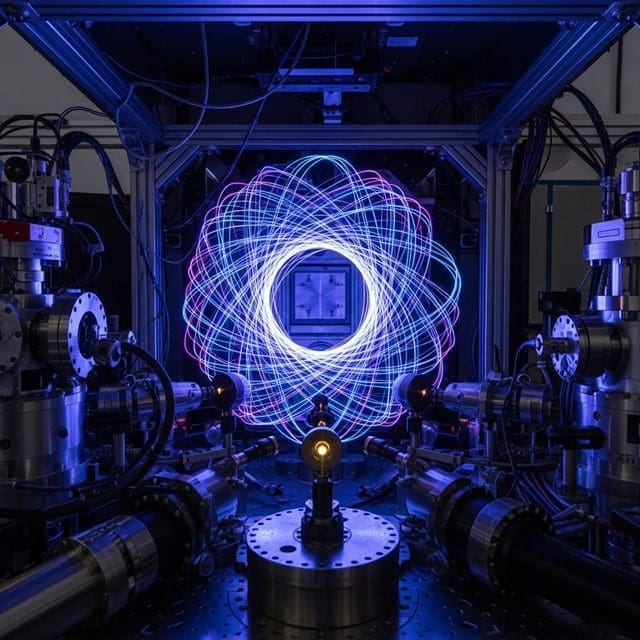
Researchers from Quantinuum, in collaboration with academic heavyweights including Harvard, the University of Chicago, Caltech, and Stony Brook, have demonstrated the first universal topological gate set. Using the H2 trapped-ion processor to entangle 54 physical qubits into topologically protected states, the team successfully manipulated exotic quasiparticles known as non-Abelian anyons. By “braiding” these particles—moving them around one another in specific, calculated patterns—the researchers performed logic operations that are intrinsically protected from the local errors that plague traditional quantum systems.
This is not merely a marginal improvement in hardware; it represents a fundamental shift in how we approach the sovereignty of information. In a standard quantum computer, a stray heat pulse can flip a bit and ruin a calculation. In a topological system, the information is stored in the global configuration of the particles. Much like a knot in a rope remains a knot even if the rope is shaken or moved, these braided states are resilient by design. This “topological protection” has long been the holy grail of the field, previously dismissed by many skeptics as experimentally intractable due to the extreme precision required to manage anyons.
The implications for national security and economic independence are profound. As centralized bureaucracies and foreign adversaries race to break current encryption standards, the development of a fault-tolerant quantum computer is a matter of strategic necessity. A universal gate set means these machines can now, in theory, run any quantum program with built-in error correction. This development is characterized as a “genuine landmark” because it proves that we can reduce the massive overhead typically required for error-correcting codes, which often demand thousands of physical qubits just to protect a single logical one.
Parallel to the trapped-ion breakthrough, new research into neutral-atom quantum circuits is also making waves this week. These systems, which use laser fields to trap individual atoms in optical potentials, are now demonstrating the ability to find and fix errors in real-time. While neutral-atom platforms have historically struggled with crosstalk and motional decoherence, these new schemes allow for the detection and correction of errors at scales involving hundreds to thousands of atoms. This moves neutral-atom systems from being research prototypes toward becoming viable fault-tolerant architectures, closing the gap with superconducting and ion-trap platforms.
The timing of these discoveries is critical, arriving as global markets grapple with the volatility of the tech sector and shifting timelines for scalable quantum machines. By demonstrating that topological error protection is no longer purely hypothetical, Quantinuum and its partners have provided a concrete industrial roadmap. Future quantum architectures can now realistically incorporate anyon-based topological layers, ensuring that the next generation of computing is not just faster, but fundamentally more reliable.
While these results remain in the experimental proof-of-concept stage and are not yet ready for immediate commercial deployment, they provide a clear path forward. By moving away from fragile, centralized architectures and toward systems protected by the immutable laws of physics, American researchers are ensuring that the next frontier of technology remains grounded in stability, precision, and the protection of individual data integrity.

Mason Reed serves as a Staff Writer for Just Right News, where he spearheads the Future Frontiers & Special Projects desk. In an era defined by rapid technological shifts and evolving social landscapes, Mason provides a steady, principled voice, examining the innovations of tomorrow through the lens of traditional American values. His work is most prominently featured in his signature series, “The Next Horizon,” where he explores the intersection of emerging technology, national sovereignty, and the preservation of individual liberty.
A native of San Diego, California, Mason’s worldview was shaped by the unique culture of his hometown. Growing up in a region defined by its strong military presence and its history of maritime industry, he developed a deep-seated respect for the institutions that provide national stability and the entrepreneurial spirit that drives the American economy. This upbringing instilled in him a belief that true progress is not found in discarding the past, but in building upon a foundation of proven principles. His reporting often reflects this San Diego influence, emphasizing the importance of a robust national defense and the necessity of maintaining a competitive edge in the global marketplace.
Now based in San Francisco, Mason operates from the heart of the world’s technological engine. Living and working in the Bay Area provides him with a front-row seat to the advancements—and the ideological challenges—emanating from Silicon Valley. While many in the region embrace a “move fast and break things” mentality, Mason’s reporting serves as a vital counterweight. He offers Just Right News readers a “boots on the ground” perspective, documenting how radical local policies and the concentration of tech power impact the everyday lives of citizens. His proximity to the industry allows him to cut through the marketing jargon of big tech to uncover the real-world implications for privacy, free speech, and the nuclear family.
In his “Future Frontiers” beat, Mason tackles complex subjects ranging from the ethics of artificial intelligence to the burgeoning private space race. He approaches these topics with a healthy skepticism toward centralized bureaucracy, championing instead the decentralized innovations that empower individuals. Through “The Next Horizon,” he highlights the pioneers and thinkers who are working to ensure that the future remains a place where human dignity and constitutional rights are protected. He believes that the rapid pace of change requires more than just technical expertise; it requires a moral compass rooted in the Western tradition.
Throughout his tenure at Just Right News, Mason has remained committed to the idea that the future is something to be shaped, not merely accepted. His writing is characterized by a rigorous defense of American exceptionalism and a belief that the country’s best days lie ahead, provided it remains true to its founding ideals. Whether he is investigating the impact of automation on the American workforce or profiling the next generation of aerospace engineers, Mason Reed ensures that his readers are equipped with the insights they need to navigate a changing world with confidence and clarity.