

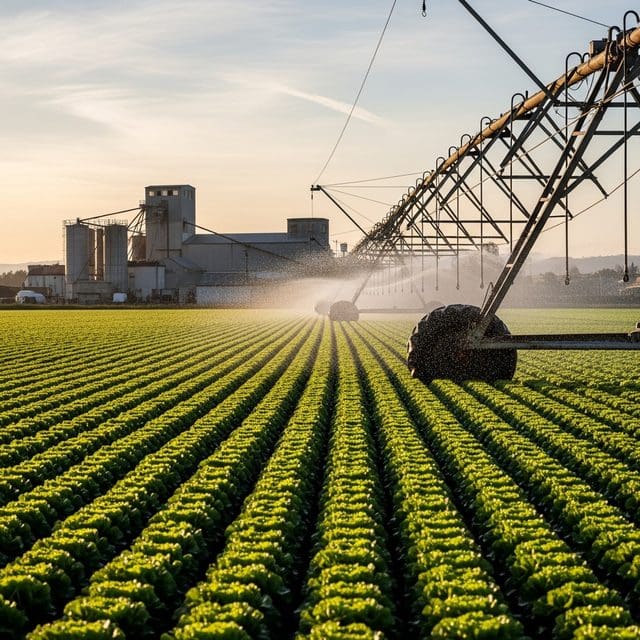
A widespread Cyclospora outbreak linked to Mexican iceberg lettuce has exposed critical vulnerabilities in agricultural water infrastructure and federal pathogen surveillance gaps.
The American dinner table is facing a renewed threat from crumbling infrastructure and regulatory blind spots as a massive Cyclospora outbreak, linked to contaminated irrigation water, continues to spread across at least 34 states. What began as a localized concern has ballooned into a multi-state recall of shredded iceberg lettuce sourced from Taylor Farms in Guanajuato, Mexico, affecting major restaurant chains and retailers in 27 states. The situation has become so dire that Mexico’s Ministry of Health has issued a diarrhea risk advisory for travel to the United States, explicitly linking the warning to the very produce they export, citing contamination likely occurring via irrigation water or handling processes involving human waste.
Investigators at the Food and Drug Administration (FDA) are now focusing on the “underestimated” role of agricultural water in the supply chain. While federal oversight has historically focused on handling practices and facility cleanliness, experts point to contaminated canal and surface water as the primary driver of this parasite’s spread. In Guanajuato, the contamination is believed to have originated from water sources tainted by human waste, a recurring issue in regions where modern sewage treatment has not kept pace with the scale of agricultural exports. Taylor Fresh Foods has responded by removing all iceberg lettuce sourced from Central Mexico from the U.S. market, though they maintain the implicated independent farm represents less than one percent of the total U.S. iceberg supply.
The scope of the crisis is likely significantly larger than official tallies suggest, hampered by a recent shift in federal policy. Since July 2025, federal reporting requirements for foodborne pathogens were loosened, making the reporting of organisms like Cyclospora optional for state and local authorities. This policy shift has left public health officials flying blind, as mandatory reporting is now strictly reserved for Salmonella and STEC. This fragmented surveillance network is struggling to explain why states like New York and Colorado are reporting high infection rates despite being excluded from the initial Taylor Farms recall, raising the alarming possibility of additional contaminated products or secondary water sources yet to be identified.
Domestic producers are using the crisis to highlight the benefits of controlled environments and local sovereignty over the food supply. Gotham Greens and other greenhouse operators are emphasizing their use of monitored, indoor irrigation systems to distinguish themselves from open-field farms that rely on surface water. Currently, nearly 45% of U.S. irrigation water comes from surface sources that are increasingly vulnerable to leaking septic systems and drought-concentrated pollutants. Under current Food Safety Modernization Act standards, farmers are permitted to harvest crops up to four days after water application. Critics argue this window provides ample time for pathogens to multiply on the leaf, especially when surface water is used during periods of high heat or low flow.
As Taco Bell removes impacted lettuce from its nationwide supply chain and halts produce service in several states, the situation underscores a hard truth for the American consumer: food safety is only as strong as the water infrastructure supporting it. The reliance on distant, surface-water-dependent farms creates a chain of vulnerability that federal regulators, currently hamstrung by optional reporting rules and political transitions, are failing to adequately monitor. For the American family, the current outbreak is a reminder that common-sense stewardship of local water resources and private-sector innovation in indoor farming may be the only reliable defense against a failing federal surveillance apparatus.

Eric Nolan serves as the Senior Correspondent for Food, Water, and Environmental Health at Just Right News, where he brings a principled, common-sense perspective to the most fundamental issues facing the American public. With a career dedicated to uncovering the truth behind the policies that govern our natural resources, Eric has become a trusted voice for readers who value traditional stewardship over bureaucratic overreach. His reporting is defined by a commitment to the idea that true environmentalism is rooted in the protection of the American family and the preservation of the nation’s agricultural heritage.
Raised in Fresno, California, Eric’s worldview was shaped in the heart of the San Joaquin Valley. Growing up in one of the world’s most productive agricultural hubs, he witnessed firsthand the vital connection between the land, the water, and the dinner table. In Fresno, he saw the resilience of farmers and the devastating impact that distant, top-down regulations can have on local communities. This upbringing instilled in him a deep respect for the producers who feed the country and a lifelong skepticism toward the alarmist narratives often pushed by mainstream media. For Eric, environmental health is not an abstract political talking point; it is a matter of ensuring that the people who work the land have the freedom and the resources to do so effectively.
Now based in Eugene, Oregon, Eric operates from a unique vantage point in the Pacific Northwest. Living in a region often defined by intense environmental debate, he provides a necessary counter-narrative to the prevailing trends of the area. From his base in Eugene, he monitors the shifting tides of federal and state policies, ensuring that the voices of rural citizens and property owners are not drowned out by urban activism. His reporting often bridges the gap between the rugged realities of the outdoors and the legislative halls where decisions are made, offering a grounded perspective that prioritizes local sovereignty and practical solutions.
As the lead for the acclaimed feature series “Earth on the Table,” Eric explores the intricate journey of the American food supply. He tackles critical issues such as water rights, soil health, and food security through a lens of national stability and individual liberty. He believes that a healthy environment and a thriving economy are not mutually exclusive, but rather two sides of the same coin of national prosperity. His work consistently highlights how innovation and private-sector ingenuity are the most effective tools for ensuring clean water and a safe food supply, rather than the expansion of the administrative state.
At Just Right News, Eric’s reporting serves as a vital resource for those who seek accountability and transparency. Whether he is investigating the impact of federal land management on local economies or examining the safety of the national food infrastructure, his work remains anchored in the values of heritage and hard work. Eric Nolan continues to be a leading voice in environmental journalism, championing the belief that the best way to protect our natural resources is to empower the people who live and work closest to them.