

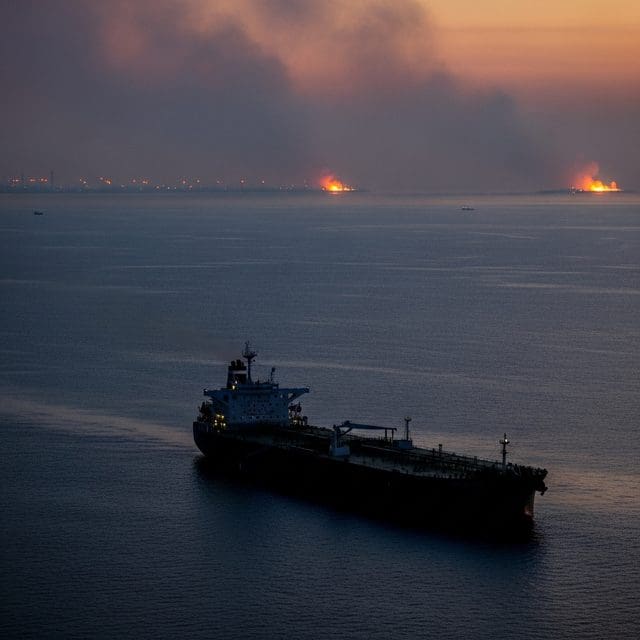
Iranian military forces have declared the Strait of Hormuz closed, sparking U.S. airstrikes and stranding thousands of seafarers as global crude exports face a critical bottleneck.
The delicate architecture of global trade is facing its most severe stress test in decades as the Strait of Hormuz, the world’s most vital energy artery, has become a contested combat zone. Following a declaration by the Islamic Revolutionary Guard Corps (IRGC) on July 12 that the waterway is closed, the Trump administration responded on July 19, 2026, with a wave of CENTCOM airstrikes. These strikes targeted Iranian capabilities intended to threaten commercial shipping and punished units linked to attacks on U.S. personnel in Jordan, marking a sharp escalation in the battle for maritime sovereignty.
For the American worker and consumer, the stakes extend far beyond the Middle East. The Strait of Hormuz facilitates the transit of roughly 20 percent of the world’s oil and liquefied natural gas. While U.S. retail spending showed resilience through June despite gasoline price increases, the tightening chokehold on this transit point threatens the long-term stability of domestic energy prices and the manufacturing supply chains that rely on them. The IRGC has begun deploying special forces and intelligence systems along the Gulf coast to enforce “Iran-designated routes,” demanding that international vessels seek permits to pass—a claim the European Union and Gulf Cooperation Council have denounced as unlawful and a violation of international transit rights.
The human and economic cost of this geopolitical friction is mounting at sea. The International Maritime Organization reports that approximately 6,000 seafarers are currently stranded on hundreds of vessels caught in the crossfire, while only 136 ships have been successfully evacuated. On Thursday, only three commodity tankers successfully transited the strait, a staggering collapse from the 12 to 13 million barrels per day that were moving through the region earlier this month. This paralysis highlights the fragility of a globalist trade model that relies on narrow, vulnerable corridors controlled by hostile actors who view commercial shipping as a tool for political leverage.
In Washington, the administration is moving to decouple the American economy from this instability while reinforcing regional allies. On July 7, the U.S. Treasury revoked temporary licenses that had permitted the export of Iranian-origin crude, setting a hard wind-down deadline of July 17, 2026. This move effectively re-tightens the sanctions regime, barring new purchases and signaling a return to a policy of maximum pressure. Simultaneously, the administration notified Israel on July 17 of plans to provide dozens of additional refueling aircraft, preparing for a potential wider offensive to ensure the freedom of navigation against an IRGC that vows to keep the strait shut “until the end of America’s evils.”
Domestically, the political landscape remains in flux as these trade disruptions unfold. The recent death of Senator Lindsey Graham at age 71 has led to the appointment of his sister, Darline Graham Nordone, to his seat, while the Senate Judiciary Committee continues confirmation hearings for Todd Blanche as Attorney General. These leadership transitions occur as the administration also moves to halt offshore wind development on national security grounds, further signaling a shift toward protecting domestic infrastructure from foreign influence and ensuring that American energy remains under American control.
This crisis serves as a stark reminder of why domestic energy independence and localized manufacturing are not merely economic preferences, but national security imperatives. When a single foreign entity can hold the world’s shipping lanes hostage, the dignity of the local workforce is sacrificed to the volatility of global markets. The current gridlock in the Gulf, where navies are now firing on merchant ships, underscores the necessity of a trade policy that prioritizes secure, sovereign supply chains over the cheap efficiency of distant, contested waters.

Sean Bradley serves as the Senior Correspondent for Trade, Supply Chains, and Global Labor at Just Right News, where he brings a principled, clear-eyed perspective to the complex systems that power the modern world. With a focus on the economic forces that impact the American household, Bradley has distinguished himself as a leading voice in explaining how global shifts in manufacturing and logistics translate to the kitchen table.
Growing up in Long Beach, California, Bradley’s interest in the movement of goods was forged against the backdrop of one of the nation’s most vital maritime gateways. Raised in a community where the towering cranes of the port were a constant fixture on the horizon, he developed an early appreciation for the blue-collar industries that form the backbone of the American economy. This upbringing instilled in him a profound respect for the dockworkers, truckers, and laborers who keep the country moving, a sentiment that remains a cornerstone of his reporting today. For Bradley, trade is not merely a series of abstract figures on a spreadsheet; it is a human endeavor that sustains families and defines the strength of a nation.
Now based in Seattle, Washington, Bradley occupies a strategic vantage point in another of the country’s most significant trade hubs. His location allows him to witness firsthand the intersection of traditional industry and the evolving technological landscape of global logistics. From the Pacific Northwest, he monitors the flow of goods across the ocean, providing Just Right News readers with timely insights into how international tensions, regulatory hurdles, and labor disputes affect the availability and cost of essential goods.
His signature feature series, “The Journey of Things,” has become a staple for readers seeking to understand the intricate path products take from raw materials to the retail shelf. Through this series, Bradley pulls back the curtain on the global marketplace, often highlighting the risks of over-reliance on foreign adversaries and the importance of domestic manufacturing resilience. His reporting consistently emphasizes the conservative values of national sovereignty, free-market competition, and the protection of the American worker from unfair global practices.
As a journalist of Irish heritage, Bradley maintains a deep-seated respect for the dignity of the individual worker and the importance of community stability. He approaches his beat with a commitment to transparency, often questioning the status quo of globalist policies that prioritize corporate efficiency over local prosperity. Whether he is reporting from a warehouse floor or analyzing a new international trade agreement, his goal remains the same: to provide the American public with the truth about where their products come from and what it costs to get them there.
Throughout his tenure at Just Right News, Bradley has remained a steadfast advocate for economic common sense. His work serves as a vital resource for those who believe that a strong nation is built on secure borders, robust trade, and a respected workforce. By combining his local roots in Long Beach with his professional experience in Seattle, Bradley continues to offer a unique and necessary perspective on the forces that shape the American way of life.