

Recent breakthroughs in quantum memory and satellite-based computing signal a shift from theoretical physics to the construction of a secure, sovereign quantum internet.
The long-promised era of quantum technology is rapidly transitioning from the chalkboard to the bedrock of national infrastructure. This week, a series of developments across the private sector and international agencies suggests that the race to build a ‘quantum internet’ is no longer a matter of theoretical physics, but a practical race to deploy the physical hardware required to secure sovereign data. As Silicon Valley continues its pursuit of raw processing power, a parallel movement is rising to build the decentralized, unhackable networks that will define the next century of communication.
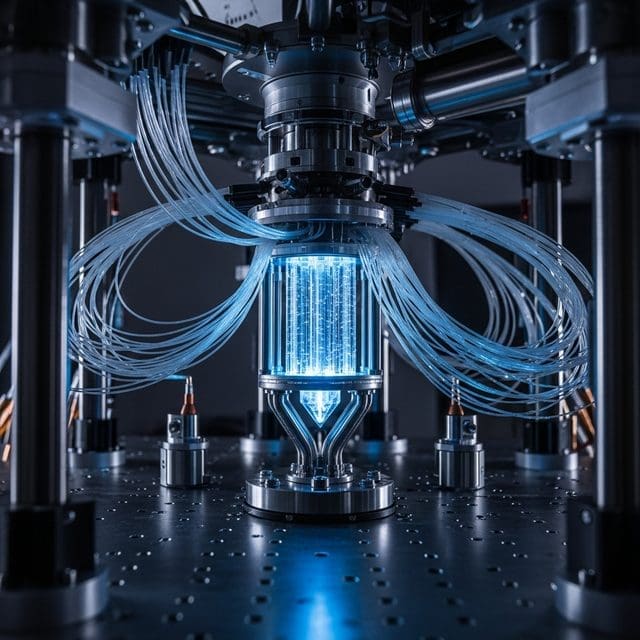
At the forefront of this shift is Arq Quantum Technologies. The startup recently closed a $1.4 million pre-seed funding round led by Ground State Ventures to develop multiplexed quantum repeaters. These devices, which utilize rare-earth-doped crystals for quantum memory, serve as the essential ‘signal boosters’ for a quantum network. Because quantum information is notoriously fragile and cannot be copied or amplified in the traditional sense, these repeaters are the only way to transmit secure data across long distances without the signal collapsing. By focusing on the memory and networking hardware rather than just the processors, Arq is positioning itself to build the literal plumbing of a future, secure internet that respects the boundaries of private and national data.
While Arq builds the ground-based links, the European Space Agency (ESA) is taking quantum power toward the stars. The ESA recently installed its first quantum computer, the Equal1 Bell-1, at its Frascati Earth-observation center in Italy. The agency is already utilizing hybrid quantum-classical algorithms to process massive streams of satellite data for climate, disaster, and science applications. This move represents a practical application of quantum advantage, using specialized hardware to spot patterns in environmental data that traditional computers might overlook. Although experts suggest that full quantum advantage for satellite operations remains decades away, the ESA is establishing the mission data pipelines today to ensure that space-based intelligence remains a sovereign capability.
Security remains the primary driver for these innovations, particularly as the threat of ‘harvest now, decrypt later’ looms over traditional encryption. Microsoft took a significant step this week by integrating post-quantum cryptography (PQC) into the production version of Windows TLS 1.3. By shipping three hybrid ML-KEM key-exchange groups to Windows 11 and Windows Server 2025, the software giant is providing a defensive shield against future quantum-enabled adversaries. While these features are currently disabled by default, requiring explicit activation by administrators, their presence in the mainstream OS protocol layer signals that the transition to a post-quantum world has officially moved from the laboratory to the enterprise desktop.
The geopolitical stakes of these technological milestones are increasingly visible. As China’s Pan Jianwei receives international accolades for his work on the Micius satellite and long-distance quantum key distribution, Western nations are accelerating their own sovereign networks. Initiatives like Europe’s PETRUS2 and HarmoniQCI are designed to ensure that the next generation of communication remains interoperable yet under domestic control. Furthermore, the standardization of the Classic McEliece encryption scheme by ISO/IEC 18033-2 provides a globally recognized framework for this transition.
From the Jane Goodall Institute using IonQ hardware to study ecological conflict to the State of Tennessee launching K-12 quantum education initiatives, the ecosystem is expanding beyond elite research circles. For the American observer, these developments underscore a vital truth: the defense of digital sovereignty and the protection of the nuclear family’s privacy in the 21st century will be won at the level of the atom. The construction of this new frontier is no longer a distant dream; it is being built one crystal, one satellite, and one line of code at a time.

Mason Reed serves as a Staff Writer for Just Right News, where he spearheads the Future Frontiers & Special Projects desk. In an era defined by rapid technological shifts and evolving social landscapes, Mason provides a steady, principled voice, examining the innovations of tomorrow through the lens of traditional American values. His work is most prominently featured in his signature series, “The Next Horizon,” where he explores the intersection of emerging technology, national sovereignty, and the preservation of individual liberty.
A native of San Diego, California, Mason’s worldview was shaped by the unique culture of his hometown. Growing up in a region defined by its strong military presence and its history of maritime industry, he developed a deep-seated respect for the institutions that provide national stability and the entrepreneurial spirit that drives the American economy. This upbringing instilled in him a belief that true progress is not found in discarding the past, but in building upon a foundation of proven principles. His reporting often reflects this San Diego influence, emphasizing the importance of a robust national defense and the necessity of maintaining a competitive edge in the global marketplace.
Now based in San Francisco, Mason operates from the heart of the world’s technological engine. Living and working in the Bay Area provides him with a front-row seat to the advancements—and the ideological challenges—emanating from Silicon Valley. While many in the region embrace a “move fast and break things” mentality, Mason’s reporting serves as a vital counterweight. He offers Just Right News readers a “boots on the ground” perspective, documenting how radical local policies and the concentration of tech power impact the everyday lives of citizens. His proximity to the industry allows him to cut through the marketing jargon of big tech to uncover the real-world implications for privacy, free speech, and the nuclear family.
In his “Future Frontiers” beat, Mason tackles complex subjects ranging from the ethics of artificial intelligence to the burgeoning private space race. He approaches these topics with a healthy skepticism toward centralized bureaucracy, championing instead the decentralized innovations that empower individuals. Through “The Next Horizon,” he highlights the pioneers and thinkers who are working to ensure that the future remains a place where human dignity and constitutional rights are protected. He believes that the rapid pace of change requires more than just technical expertise; it requires a moral compass rooted in the Western tradition.
Throughout his tenure at Just Right News, Mason has remained committed to the idea that the future is something to be shaped, not merely accepted. His writing is characterized by a rigorous defense of American exceptionalism and a belief that the country’s best days lie ahead, provided it remains true to its founding ideals. Whether he is investigating the impact of automation on the American workforce or profiling the next generation of aerospace engineers, Mason Reed ensures that his readers are equipped with the insights they need to navigate a changing world with confidence and clarity.