

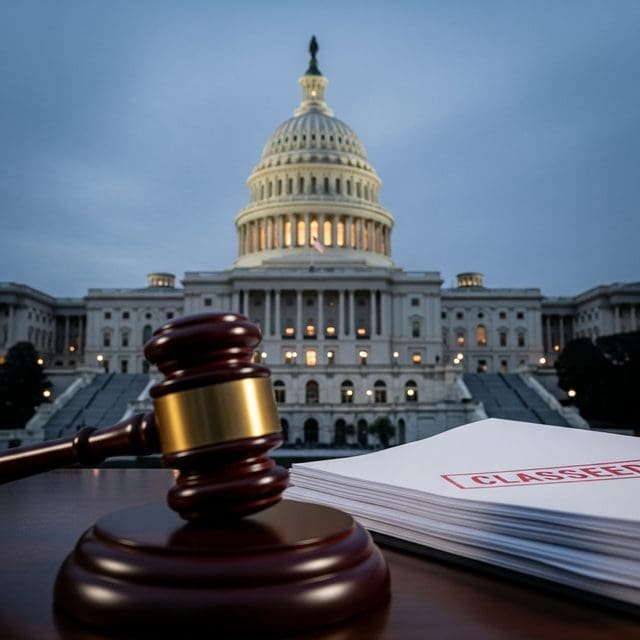
President Trump notified Congress of resumed hostilities with Iran, triggering a new 60-day window for military action as House Republicans advance a $95 billion defense and election security package.
The constitutional tug-of-war between the executive and legislative branches reached a new flashpoint this week as the White House moved to reset the clock on military operations in the Middle East. In a formal notification to Congress dated July 10, President Trump asserted that U.S. hostilities against Iran resumed on July 7, 2026. By classifying these actions as a new conflict rather than a continuation of previous engagements, the administration is effectively invoking a fresh 60-day window under the War Powers Resolution of 1973, allowing for sustained military operations without immediate congressional authorization.
This maneuver comes as Iran issued a stern warning on July 18, threatening wider regional operations and declaring that no political borders would be safe if U.S. strikes persist. The President’s letter to lawmakers argued the direction of military force was necessary to protect national security and foreign policy interests, a move that critics suggest bypasses the traditional role of Congress in declaring war. The strategic reset of the legal clock places the burden on a divided Capitol Hill to either acquiesce to the executive’s timeline or mount a legislative challenge to the administration’s authority before the 60-day period expires.
Simultaneously, the House Budget Committee is attempting to codify the administration’s policy priorities through a $95 billion reconciliation package. The blueprint, which advanced in a 20-14 party-line vote on July 16, allocates $73 billion for defense and intelligence over the next decade. While substantial, this figure notably pales in comparison to the $350 billion in new Pentagon funding previously sought by the White House, signaling a degree of fiscal friction even within the majority party. Republican leaders intend to use this vehicle to fund the Iran war efforts and replenish weapons stockpiles that have been depleted by ongoing regional tensions.
Beyond military hardware, the legislative package serves as a vehicle for significant domestic policy shifts. It includes $10 billion earmarked for election-related measures, specifically designed to incentivize states to adopt strict voter-ID laws consistent with the SAVE America Act. This follows a primetime address by the President on July 17, in which he alleged foreign interference in the 2020 election and declassified documents to support claims of a bureaucratic coverup. The President is expected to further amplify these claims in a scheduled speech regarding voting machine vulnerabilities, aiming to keep pressure on lawmakers to adopt the GOP’s election-integrity agenda.
The administration is also tightening the reins on the administrative state through aggressive personnel and regulatory shifts. The recent dismissal of U.S. Attorney Roger Rogoff in Seattle—despite his appointment by a panel of 17 judges—underscores the White House’s insistence on absolute prosecutorial control. Acting Attorney General Todd Blanche has asserted that presidential control over prosecutorial picks is a necessary component of executive power. Furthermore, the revival of the ‘public charge’ rule and a proposed $100,000 bond for green-card applicants signal a return to a strict interpretation of financial self-sufficiency for those seeking residency.
As Senate Majority Leader John Thune places House-passed security assistance for Ukraine and expanded Russian sanctions on the calendar, the broader legislative landscape remains dominated by the executive’s assertive posture. The Ukraine legislation provides $1.3 billion in security assistance, yet it must compete for floor time against the burgeoning conflict with Iran and the GOP’s domestic reconciliation priorities. Whether Congress will successfully assert its oversight role regarding the 60-day war powers window or the specific allocations of the $95 billion package remains the central question for the remainder of the summer session, as the administration continues to challenge the traditional ‘Beltway’ consensus on the limits of executive authority.

Miles Harrington serves as the Senior Correspondent for Federal Systems & Executive Power at Just Right News, where he brings a disciplined, constitutionalist lens to the inner workings of the American government. With a focus on the mechanics of the federal bureaucracy and the limits of executive authority, Harrington has established himself as a vital voice for readers who value transparency, accountability, and the preservation of the separation of powers.
A native of Richmond, Virginia, Harrington’s perspective is deeply rooted in the traditions of the Old Dominion. Growing up in a city defined by its historical significance and its role as a center of American jurisprudence, he developed an early appreciation for the foundational principles of the Republic. His upbringing in Richmond—a place where the legacy of the Founding Fathers is woven into the landscape—instilled in him a belief that the federal government should remain within its constitutional bounds. This background informs his skepticism of centralized overreach and his commitment to reporting on the ways in which the administrative state impacts the lives of everyday citizens.
In his current role, Harrington specializes in the complexities of federal systems. He doesn’t just report on the headlines of the day; he digs into the structural shifts within the executive branch that often go unnoticed by the mainstream press. Whether he is analyzing the implications of a new federal regulation or investigating the expansion of agency jurisdiction, his work is characterized by a rigorous adherence to the facts and a dedication to the rule of law.
Harrington is perhaps best known for his signature feature series, “How Washington Works.” Through this ongoing project, he demystifies the often-opaque processes of the nation’s capital, pulling back the curtain on the “Deep State” and the unelected officials who wield significant influence over national policy. By breaking down complex legislative maneuvers and executive orders, he empowers Just Right News readers to understand the true levers of power in Washington. His reporting serves as a necessary check on the federal government, ensuring that the actions of those in power are held up to the light of public scrutiny.
Now based in Washington, D.C., Harrington operates at the epicenter of the political world, yet he remains intentionally distanced from the “Beltway bubble.” His proximity to the halls of power allows him to maintain a robust network of sources across the federal landscape, but his heart remains in the principled conservatism of his Virginia roots. He views his role not merely as a reporter, but as a steward of the public trust, dedicated to providing the clarity and context that conservative voters need to navigate an increasingly complex political environment.
Through his sharp analysis and unwavering commitment to the truth, Miles Harrington continues to be a cornerstone of the Just Right News team. His work ensures that the principles of limited government and executive restraint remain at the forefront of the national conversation, providing a crucial service to those who believe in a government that is truly of, by, and for the people.