

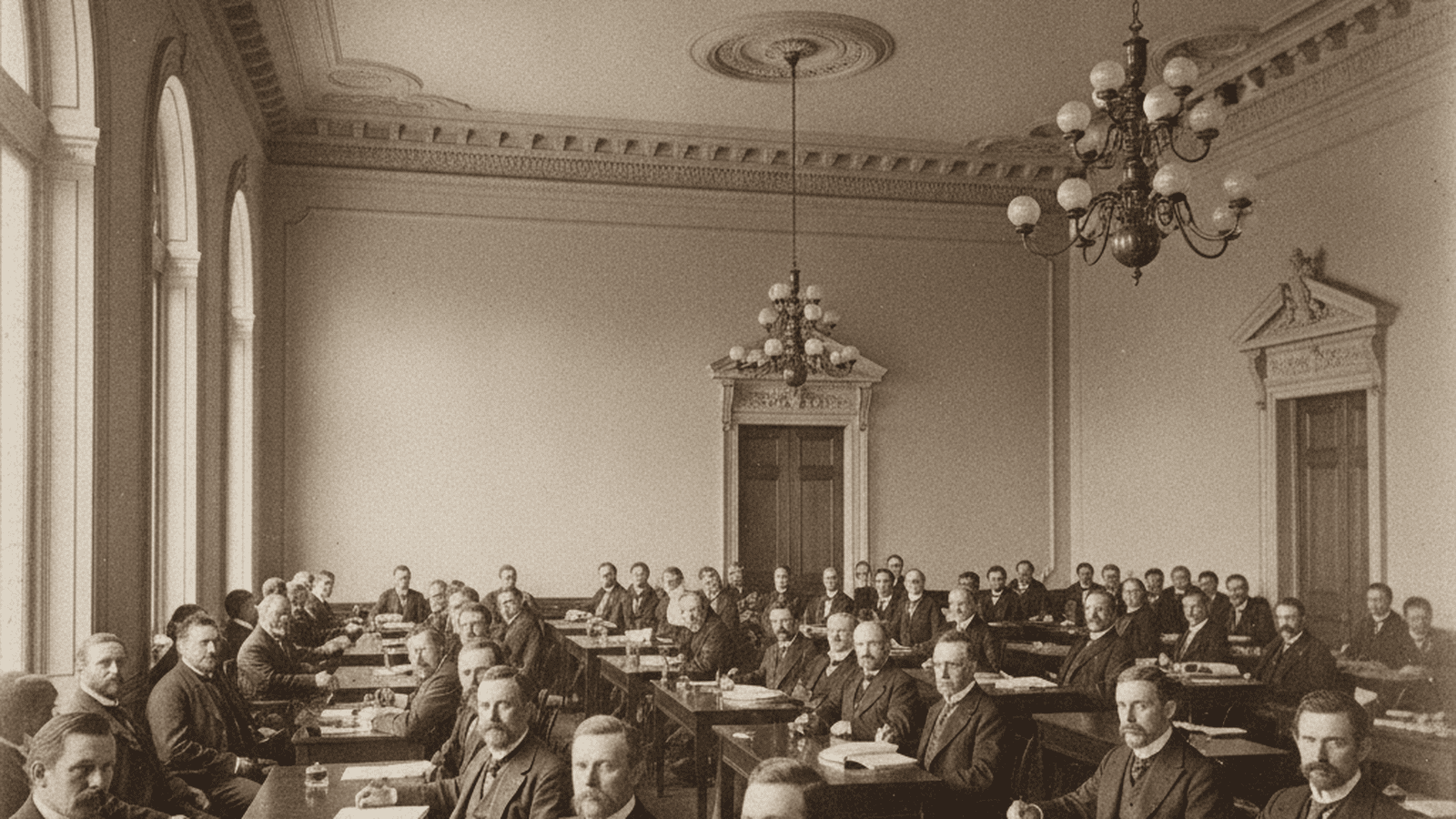
In 1890, Mississippi convened a constitutional convention specifically designed to strip African Americans of their voting rights. This “Mississippi Plan” utilized legal loopholes like literacy tests and poll taxes to bypass the 15th Amendment, setting a precedent for Jim Crow laws across the United States.
TLDR: The 1890 Mississippi Constitutional Convention systematically dismantled Black political power through the creation of the “Mississippi Plan.” By implementing poll taxes and literacy tests, the state bypassed federal protections, establishing a legal framework for disenfranchisement that was soon adopted by other Southern states for decades.
In the late summer of 1890, delegates gathered in Jackson, Mississippi, for a constitutional convention that would redefine the state’s political landscape for nearly a century. While the official purpose was to update the 1868 Reconstruction-era constitution, the underlying motivation was the systematic removal of African Americans from the electorate. This gathering marked the birth of the “Mississippi Plan,” a legal strategy designed to circumvent the Fifteenth Amendment of the United States Constitution.
The convention was presided over by Solomon Saladin Calhoon, a judge who openly advocated for white supremacy in the political process. Under his leadership, the delegates sought methods to disqualify Black voters that did not explicitly mention race, which would have triggered federal intervention. They focused on economic and educational barriers that disproportionately affected the formerly enslaved population and poor whites. The delegates were aware that the eyes of the nation were on them, yet they proceeded with a calculated precision that prioritized state sovereignty over federal civil rights protections.
One of the most effective tools introduced was the poll tax. By requiring citizens to pay a fee months in advance of an election and present a receipt at the polls, the state created a significant hurdle for low-income residents. Because many sharecroppers and laborers moved frequently or lacked liquid cash, this requirement effectively purged thousands from the voter rolls. The tax was cumulative in some jurisdictions, meaning a voter had to pay for all previous years they had missed, making the barrier insurmountable for many.
The convention also implemented a “literacy test” with a notorious loophole known as the “understanding clause.” This provision required a prospective voter to read a section of the state constitution or provide a “reasonable interpretation” of it when read aloud. Local registrars, who were almost exclusively white, held total discretion over what constituted a reasonable interpretation. This allowed them to qualify illiterate white voters while disqualifying highly educated Black citizens. The subjectivity of the test made it a powerful weapon for local officials to maintain political control.
Furthermore, the new constitution established a two-year residency requirement and disqualified individuals convicted of specific “petty crimes” perceived to be more common among the Black population, such as vagrancy or timber theft. These interlocking layers of bureaucracy and financial burden decimated Black political participation. In 1890, roughly 147,000 Black men were registered to vote in Mississippi; by 1892, that number had plummeted to fewer than 9,000. The political voice of the majority of the state’s population was silenced almost overnight.
The success of the Mississippi Plan did not go unnoticed by neighboring states. Throughout the 1890s and early 1900s, South Carolina, Louisiana, Alabama, and others adopted similar constitutional amendments. These “Jim Crow” constitutions created a solid political bloc in the South that resisted federal civil rights initiatives for generations. The United States Supreme Court even upheld these measures in the 1898 case Williams v. Mississippi, ruling that the provisions did not technically discriminate on the basis of race.
The legal framework established in Jackson remained largely unchallenged by the federal government for decades. It was not until the Supreme Court began chipping away at these provisions in the mid-20th century that the tide began to turn. The eventual passage of the Voting Rights Act of 1965 finally dismantled the remnants of the 1890 Mississippi Plan, restoring federal oversight to ensure that state-level procedural hurdles could no longer be used to deny the fundamental right to vote in the United States. This era of reform highlighted the necessity of federal intervention to protect constitutional rights when state governments actively work to undermine them.

Sophie Carter serves as a Staff Writer for Just Right News, where she anchors the outlet’s critical coverage of Elections, Influence, and Democracy Infrastructure. In an era where the mechanics of voting and the flow of political capital are under constant scrutiny, Sophie provides a steady, principled voice dedicated to the preservation of American institutional integrity and the rule of law.
Raised in Charlotte, North Carolina, Sophie’s perspective was forged in a community that balances rapid modern growth with a deep respect for tradition and civic duty. Growing up in the Queen City, she witnessed firsthand how a robust local culture depends on the trust between the citizen and the state. This upbringing instilled in her a foundational belief that the right to vote is a sacred trust—one that must be protected from both administrative overreach and the encroaching influence of special interest groups. Her reporting reflects these North Carolina roots, emphasizing the importance of community-led governance and the preservation of the individual’s voice in the face of nationalized political movements.
Now based in Atlanta, Georgia, Sophie operates from the heart of one of the nation’s most pivotal and contested political landscapes. Her location allows her to report from the front lines of the debate over election security, legislative reform, and the modernization of voting systems. For Sophie, the “infrastructure” of democracy is not merely a matter of machines and ballots; it is the collection of laws, people, and transparent processes required to maintain public confidence. Her work often highlights the necessity of clear, enforceable standards that ensure every legal vote is counted fairly and that the machinery of our republic remains accountable to the taxpayers who fund it.
Central to her work at Just Right News is her acclaimed feature series, “The Price of a Vote.” Through this ongoing project, Sophie explores the complex web of influence that shapes modern campaigns and policy decisions. She delves into how high-level lobbying, non-governmental organizations, and shifting bureaucratic regulations impact the weight of an individual citizen’s ballot. By examining the financial and structural pressures placed on the electoral process, she provides readers with a comprehensive look at the forces vying for control over the American political system.
Sophie’s approach to journalism is rooted in a commitment to the constitutional framework. She views her role as a watchdog for the voter, ensuring that the systems meant to serve the public remain transparent and free from corruption. Whether she is analyzing the implementation of new voting technologies or investigating the influence of outside money on state-level policy, her work is characterized by a rigorous adherence to facts and a refusal to succumb to the sensationalism that often plagues modern political reporting.
At Just Right News, Sophie Carter continues to be a vital resource for readers who value clarity, conviction, and a defense of traditional American values. Her deep ties to the Southeast and her specialized focus on the mechanics of our republic make her an essential voice in the ongoing conversation about the future of American self-governance. Through her reporting, she remains dedicated to the idea that a secure and honest electoral system is the bedrock of a free and prosperous society.