

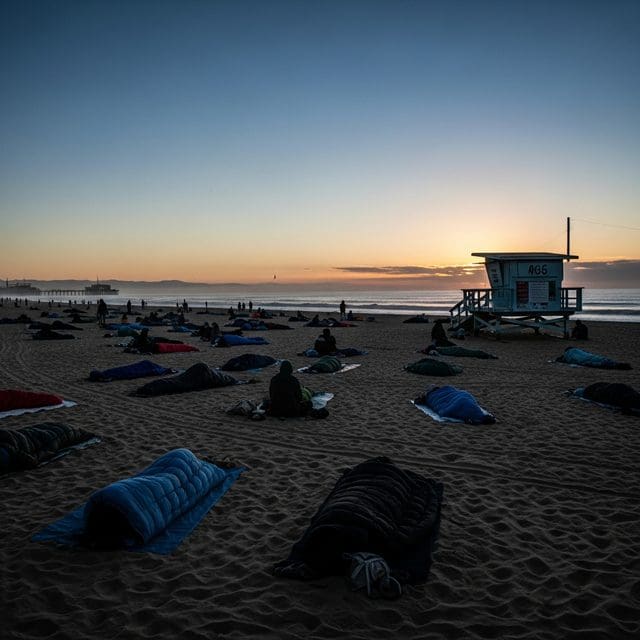
A viral video of ‘Sleeping Bag Beach’ highlights the friction between local enforcement and a federal housing bill currently stalled by executive conditions.
The shoreline of Santa Monica, a crown jewel of Southern California real estate, has become a flashpoint in the national debate over public space and property rights. A viral video captured by city council candidate Derrick Townsend, showing roughly 60 individuals sleeping in bags on the sand, has earned the area the moniker “Sleeping Bag Beach.” The footage has reignited a fierce debate over the city’s inability to maintain public order despite a multi-year emergency declaration.
Townsend’s reporting highlights a persistent challenge for local authorities caught between public safety and legal limitations. While Santa Monica tightened its anti-camping ordinance following the 2024 Supreme Court ruling in City of Grants Pass v. Johnson, current guidance requires officers to use a “totality of the circumstances” approach. This creates a regulatory gray zone where bedrolls are treated as evidence of a prohibited “camp facility,” yet officers must prioritize warnings and service referrals before issuing citations. For taxpayers, this cautious enforcement translates to a visible decline in the accessibility of public beaches.
This local crisis unfolds against a backdrop of significant federal friction. On June 23, 2026, the House passed a bipartisan housing affordability package in a 358-32 vote, aimed at easing supply constraints. However, the path to market-driven relief was blocked the next day when President Trump canceled the signing ceremony. The administration has conditioned the housing bill on the Senate’s passage of the SAVE America Act, holding housing policy hostage to unrelated legislative demands. This stalemate leaves municipalities without the federal framework intended to bolster housing pipelines and reduce cost-of-living pressures.
For the American taxpayer, the cost of this political maneuvering is measurable. Santa Monica has maintained a Local Homelessness Emergency since February 2023, re-ratified as recently as May 13, 2026. This status grants the city expanded authority to fund encampment cleanups and staff response teams. Yet, results remain inconsistent. Encampments at major corridors, such as Santa Monica and Westwood Boulevards, have repeatedly returned shortly after being cleared. This suggests that enforcement-only approaches struggle to achieve permanent results when the underlying housing shortage remains unaddressed by both local zoning and federal policy.
Regional efforts to align resources have yet to yield visible improvements. The LA County Executive Committee for Regional Homeless Alignment has been pushing for unified performance metrics, with June 2026 meetings focused on resource alignment. However, there is a notable disconnect between these bureaucratic discussions and the reality of “Sleeping Bag Beach.” Local reporting has largely failed to bridge the gap between vivid imagery of beach encampments and the specific housing pipeline numbers—such as motel conversions and shelter capacity—that would indicate genuine progress.
As long as the federal government prioritizes legislative leverage over housing reform, and local officials navigate a thicket of discretionary enforcement, coastal communities will bear the brunt of the crisis. The transformation of iconic public assets into makeshift shelters devalues local sovereignty and represents a failure to protect the interests of the law-abiding public. Without the passage of the stalled housing bill or a more rigorous application of existing camping bans, the scene at Santa Monica Beach is likely to become a permanent fixture of the California coast.

Deborah Cole serves as a Senior Correspondent for Just Right News, where she spearheads the network’s coverage of Housing, Infrastructure, and Mobility. With a career defined by a commitment to rigorous reporting and a focus on the fundamental pillars of American community life, Deborah brings a principled perspective to the complex issues that dictate how and where we live. Her work is grounded in the belief that sound policy, fiscal responsibility, and respect for private property are the essential foundations of a prosperous society.
Originally from Boston, Massachusetts, Deborah’s upbringing in one of the nation’s oldest and most historically significant cities deeply influenced her professional trajectory. Growing up amidst the architectural legacy and dense urban planning of New England, she developed an early appreciation for the importance of durable infrastructure and the role of local tradition in shaping neighborhoods. Her perspective is informed by the classic American values of her hometown—hard work, community cohesion, and a healthy skepticism of top-down bureaucratic mandates that often overlook the unique needs of individual citizens.
Today, Deborah operates from her base in Austin, Texas, a city that serves as a primary laboratory for her reporting. Austin’s rapid expansion and its status as a hub for innovation and migration provide her with a front-row seat to the most pressing challenges in modern infrastructure and housing. From the Lone Star State, she chronicles the tensions between rapid growth and the preservation of the American Dream, often highlighting how market-driven solutions and deregulation can address the housing shortages that plague many of the country’s metropolitan areas.
At Just Right News, Deborah is perhaps best known for her signature feature series, “Where We Live.” Through this platform, she explores the intersection of public policy and private life, moving beyond mere statistics to tell the stories of families, small business owners, and local developers. Her reporting frequently highlights the importance of mobility—not just in terms of transportation and transit, but as a vehicle for economic opportunity and social stability. She remains a staunch advocate for the taxpayer, consistently scrutinizing government spending on large-scale projects and advocating for transparency in how infrastructure dollars are allocated.
Deborah’s beat is more than just a collection of policy topics; it is an investigation into the physical and legal structures that allow families to flourish. Whether she is reporting on the impact of zoning laws on suburban development or the necessity of maintaining the nation’s highway systems, her work is characterized by a dedication to the facts and a respect for the constitutional principles that protect the rights of homeowners.
As a Senior Correspondent, Deborah Cole continues to be a vital voice for Just Right News, providing the audience with the clarity and context needed to navigate an ever-changing landscape. Her reporting ensures that the values of individual liberty and local sovereignty remain at the forefront of the national conversation regarding the future of our cities and towns. Through her tireless efforts, she remains committed to informing the public on the issues that hit closest to home.