

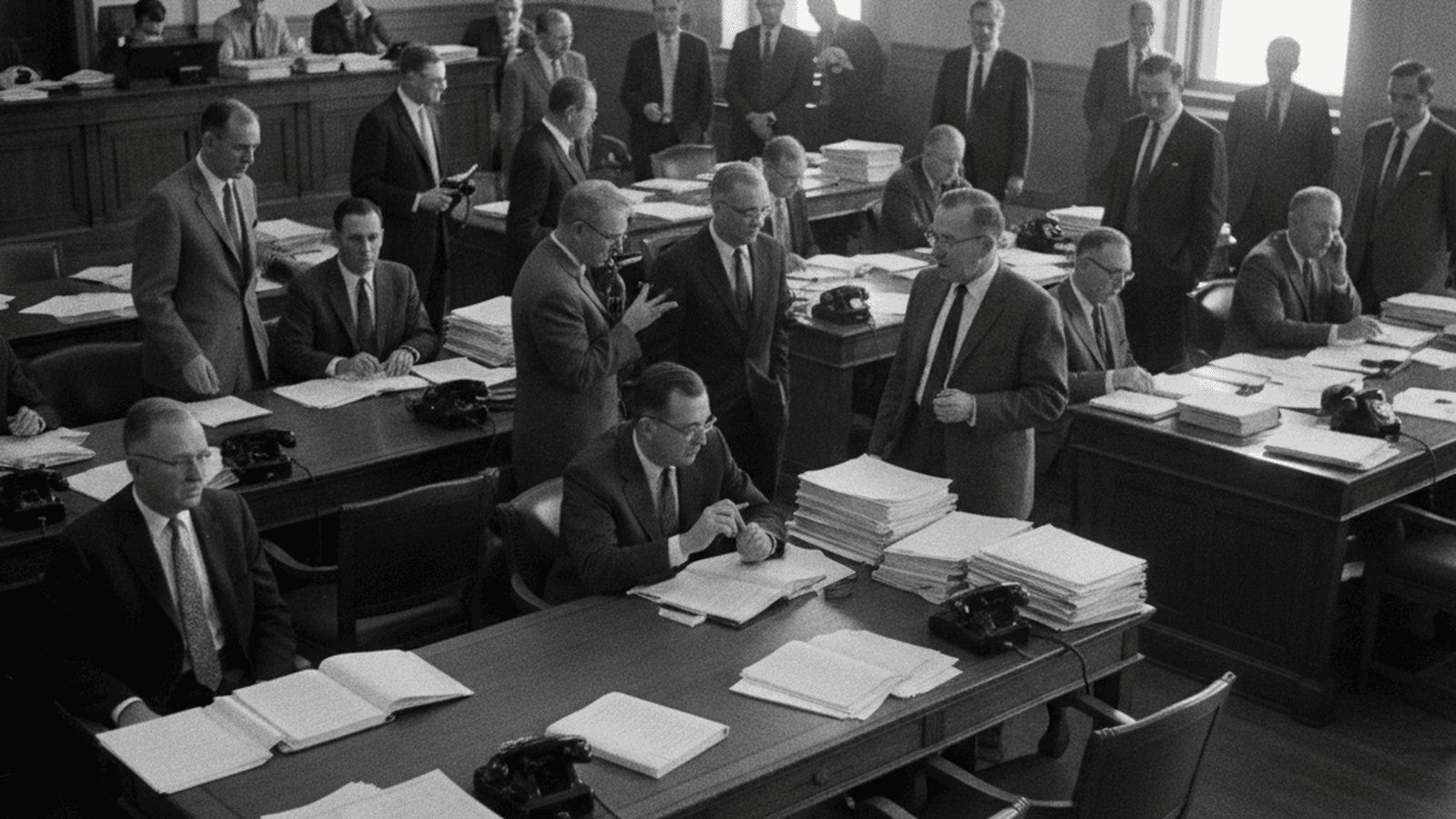
In 1964, federal court intervention forced Oklahoma to reapportion its legislative districts based on population, ending decades of rural dominance. This United States political event shifted the balance of power to urban centers and fundamentally realigned the state’s parliamentary structure.
TLDR: Following the Supreme Court’s “one man, one vote” mandate, federal courts intervened in Oklahoma’s 1964 redistricting process. The resulting reapportionment stripped rural counties of their disproportionate influence, empowering urban voters and permanently altering the legislative landscape of the Sooner State.
The 1964 reapportionment of the Oklahoma Legislature represents a watershed moment in the political evolution of the Sooner State. For the first half of the 20th century, Oklahoma’s legislative districts were frozen in time, reflecting a demographic reality that had long since vanished. As the state transitioned from a purely agrarian economy to one centered on the burgeoning metropolitan hubs of Oklahoma City and Tulsa, the political structure failed to keep pace. By the early 1960s, the malapportionment had reached a breaking point: sparsely populated rural counties, some with only a few thousand residents, wielded the same legislative influence as urban districts housing tens of thousands. This imbalance allowed a powerful coalition of rural lawmakers, known as the “Old Guard,” to control the state’s purse strings, consistently directing resources toward rural roads and agricultural interests while neglecting the infrastructure and educational needs of the growing cities.
The catalyst for a total systemic overhaul came from the federal judiciary. While the 1962 Supreme Court case Baker v. Carr opened the door for judicial review of redistricting, it was the 1964 landmark decision in Reynolds v. Sims that truly forced Oklahoma’s hand. The Court established the “one man, one vote” principle, asserting that the Equal Protection Clause of the Fourteenth Amendment required state legislative districts to be apportioned based on population. In Oklahoma, this legal battle played out through the case Moss v. Burkhart. When the state legislature, desperate to maintain the status quo, failed to produce a constitutional map that met federal standards, a three-judge federal panel took the extraordinary and unprecedented step of intervening directly. The court vacated all legislative seats and ordered a mid-term reapportionment, a move that sent shockwaves through the state’s political establishment and challenged the very notion of state legislative sovereignty.
The resulting 1964 election cycle was unlike any other in Oklahoma history. Under the court-mandated “Model G” plan, the legislative map was radically redrawn. Rural representation was slashed, and the delegations from Oklahoma and Tulsa counties nearly doubled. This was not merely a change in numbers; it was a purge of the traditional power structure. Long-tenured rural committee chairs, who had dominated the capitol for decades, suddenly found themselves in “monster districts” or forced to run against fellow incumbents. The 1964 elections ushered in a new generation of lawmakers—younger, more urban-centric, and often more professionalized. These new members were less beholden to the old-school patronage networks and more focused on the complexities of modern governance, including urban renewal, higher education funding, and the expansion of social services.
The realignment also had profound partisan implications. The rural dominance had been a cornerstone of the “Solid South” Democratic tradition in Oklahoma. As power shifted to the cities and suburbs, the political landscape became more competitive. Urban voters proved more willing to support Republican candidates or independent-minded Democrats, breaking the monolithic control of the rural Democratic machine. This shift paved the way for a more balanced two-party system in the decades to follow. Furthermore, the legislative process itself evolved from a system of informal rural handshakes to a more structured, committee-driven environment.
The legacy of the 1964 reapportionment is the foundation of modern Oklahoma government. It ensured that the state’s legislative body would be a true reflection of its people rather than its geography. While the transition was marked by intense legal friction and personal political tragedies for the “Old Guard,” it ultimately forced Oklahoma to modernize. The precedent of regular, population-based redistricting has since become a standard feature of the state’s political life, preventing the return of the extreme inequities that once defined the Great Plains’ parliamentary landscape.

Dylan Brooks serves as the Senior Correspondent for Statehouses and Local Governance at Just Right News, where he brings a principled, constitutionalist lens to the often-overlooked machinery of state-level politics. As the lead voice behind the acclaimed feature series “Fifty Laboratories of Power,” Dylan has dedicated his career to the idea that the most impactful governance happens closest to home. His reporting consistently champions the Tenth Amendment, exploring how individual states can serve as testing grounds for innovative, conservative policy solutions that prioritize personal liberty and fiscal responsibility.
A native of Des Moines, Iowa, Dylan’s journalistic philosophy was forged in the heart of the American Midwest. Growing up in a community where local school board meetings and town halls were the bedrock of civic life, he developed a deep appreciation for the “retail politics” of the heartland. This upbringing instilled in him a fundamental belief that the American experiment is best preserved when power is decentralized. He carries the values of his Iowa roots into every assignment, maintaining a healthy skepticism of federal overreach and a steadfast commitment to the concerns of everyday citizens over the interests of the administrative state.
Now based in Madison, Wisconsin, Dylan operates from one of the nation’s most pivotal political battlegrounds. His location in a state capital known for its rigorous policy debates allows him to provide Just Right News readers with a front-row seat to the legislative process. From Madison, he tracks the ripple effects of statehouse decisions on local municipalities, ensuring that the connection between high-level policy and community impact is never lost. His work often highlights the success of conservative governors and legislatures in fostering economic growth, protecting parental rights, and securing the integrity of local institutions.
As an African American man in the conservative media landscape, Dylan offers a vital perspective on how limited government and free-market principles empower individuals and families. He frequently reports on how deregulation and school choice initiatives provide new avenues for success in underserved communities, challenging the monolithic narratives often presented by legacy media outlets. Dylan’s work is characterized by a commitment to the facts and a refusal to shy away from the complex realities of modern governance.
Throughout his tenure at Just Right News, Dylan has become a trusted authority for readers who value a rigorous, principled approach to the news. Whether he is dissecting a complex state budget or profiling a local grassroots movement, his goal remains the same: to provide the American public with the information they need to hold their local leaders accountable. By focusing on the “Fifty Laboratories of Power,” Dylan Brooks ensures that the vital work being done in statehouses across the country receives the national attention it deserves, always through a lens that respects the traditions and sovereignty of the American people.