

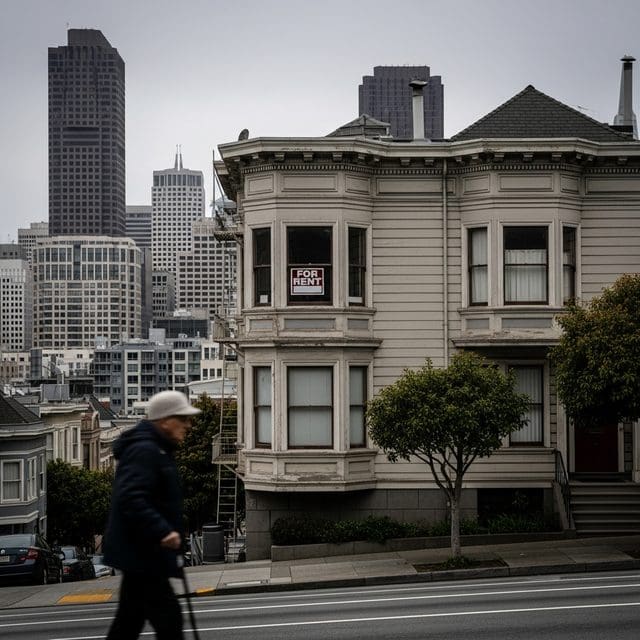
Diverging state and local rent caps create legal friction for Bay Area seniors as proposed federal budget cuts threaten housing stability for nearly 100,000 residents.
San Francisco’s housing market is entering a period of heightened friction as local rent control protections clash with statewide standards and looming federal austerity. While the city’s allowable annual rent increase for 2026 is crystallizing around a modest 1% to 1.4% for covered units, California’s statewide AB 1482 cap remains significantly higher at 6.3% through July, rising to 8.8% in August. This widening gap is increasingly manifesting in aggressive landlord-tenant disputes, particularly involving vulnerable seniors in rent-controlled units who represent the last vestiges of pre-boom affordability.
In Lower Nob Hill, the human cost of this regulatory divergence is on full display. A 92-year-old resident who has occupied her apartment for more than 40 years is currently fighting an eviction attempt based on claims of “clutter.” Paying just $281.42 per month in a 16-unit building, her case has drawn intense scrutiny toward the use of “just cause” provisions within the San Francisco Rent Ordinance. Nearby, another elderly couple is battling what their legal counsel describes as a retaliatory eviction following a reported rent hike attempt of nearly 90%. These cases highlight a desperate trend among some property owners to bypass local caps in favor of market rates or the more generous statewide limits.
The stability of the region’s housing stock is further threatened by shifting federal priorities and a tightening fiscal environment. The White House’s FY 2026 budget proposal suggests a staggering 44% reduction in HUD funding for the Bay Area, potentially slashing support from $2.9 billion to a mere $1.6 billion. The Urban Institute warns that such a contraction could leave over 90,000 local residents without essential housing vouchers or rental assistance. While core streams like Project-Based Rental Assistance and tenant-based vouchers remain stable in current HUD appropriations, the proposed cuts would gut the very programs designed to prevent a surge in homelessness.
Infrastructure and transit delivery also face scrutiny as fiscal responsibility becomes the watchword in Washington. New analysis from transit experts suggests that American subway projects, including those in high-cost corridors like the Bay Area, are plagued by inefficient design requirements, such as excessive cross-passages. These redundant structures drive up construction costs without providing proportional safety benefits, siphoning away taxpayer dollars that could otherwise bolster housing infrastructure. This bureaucratic overreach in transit planning mirrors the complexities of the housing market, where overlapping regulations often stifle supply while failing to protect the most vulnerable.
As the sunset of AB 1482 approaches in late 2026, regional investors and tenant advocates are bracing for a post-cap environment. The uncertainty is already prompting landlords to explore new rent strategies, while public housing authorities are tightening administrative controls. In Santa Rosa, the Housing Choice Voucher program has issued a mandatory update deadline of June 30, 2026, for all applicants. Failure to comply results in removal from the waiting list, a move that illustrates how local agencies are managing overwhelming demand with dwindling resources.
While San Francisco’s “Family Zoning Plan” seeks to increase housing variety as a long-term affordability strategy, the immediate reality for residents is one of rising costs and shrinking safety nets. Mortgage rates continue to move higher alongside a jump in inflation, further squeezing the middle class out of homeownership and back into a volatile rental market. For the seniors of Lower Nob Hill and the 90,000 residents facing the loss of federal support, the intersection of local rent disputes and federal budget cuts represents a looming crisis of displacement that market-driven zoning changes alone may not be able to solve.

Deborah Cole serves as a Senior Correspondent for Just Right News, where she spearheads the network’s coverage of Housing, Infrastructure, and Mobility. With a career defined by a commitment to rigorous reporting and a focus on the fundamental pillars of American community life, Deborah brings a principled perspective to the complex issues that dictate how and where we live. Her work is grounded in the belief that sound policy, fiscal responsibility, and respect for private property are the essential foundations of a prosperous society.
Originally from Boston, Massachusetts, Deborah’s upbringing in one of the nation’s oldest and most historically significant cities deeply influenced her professional trajectory. Growing up amidst the architectural legacy and dense urban planning of New England, she developed an early appreciation for the importance of durable infrastructure and the role of local tradition in shaping neighborhoods. Her perspective is informed by the classic American values of her hometown—hard work, community cohesion, and a healthy skepticism of top-down bureaucratic mandates that often overlook the unique needs of individual citizens.
Today, Deborah operates from her base in Austin, Texas, a city that serves as a primary laboratory for her reporting. Austin’s rapid expansion and its status as a hub for innovation and migration provide her with a front-row seat to the most pressing challenges in modern infrastructure and housing. From the Lone Star State, she chronicles the tensions between rapid growth and the preservation of the American Dream, often highlighting how market-driven solutions and deregulation can address the housing shortages that plague many of the country’s metropolitan areas.
At Just Right News, Deborah is perhaps best known for her signature feature series, “Where We Live.” Through this platform, she explores the intersection of public policy and private life, moving beyond mere statistics to tell the stories of families, small business owners, and local developers. Her reporting frequently highlights the importance of mobility—not just in terms of transportation and transit, but as a vehicle for economic opportunity and social stability. She remains a staunch advocate for the taxpayer, consistently scrutinizing government spending on large-scale projects and advocating for transparency in how infrastructure dollars are allocated.
Deborah’s beat is more than just a collection of policy topics; it is an investigation into the physical and legal structures that allow families to flourish. Whether she is reporting on the impact of zoning laws on suburban development or the necessity of maintaining the nation’s highway systems, her work is characterized by a dedication to the facts and a respect for the constitutional principles that protect the rights of homeowners.
As a Senior Correspondent, Deborah Cole continues to be a vital voice for Just Right News, providing the audience with the clarity and context needed to navigate an ever-changing landscape. Her reporting ensures that the values of individual liberty and local sovereignty remain at the forefront of the national conversation regarding the future of our cities and towns. Through her tireless efforts, she remains committed to informing the public on the issues that hit closest to home.