

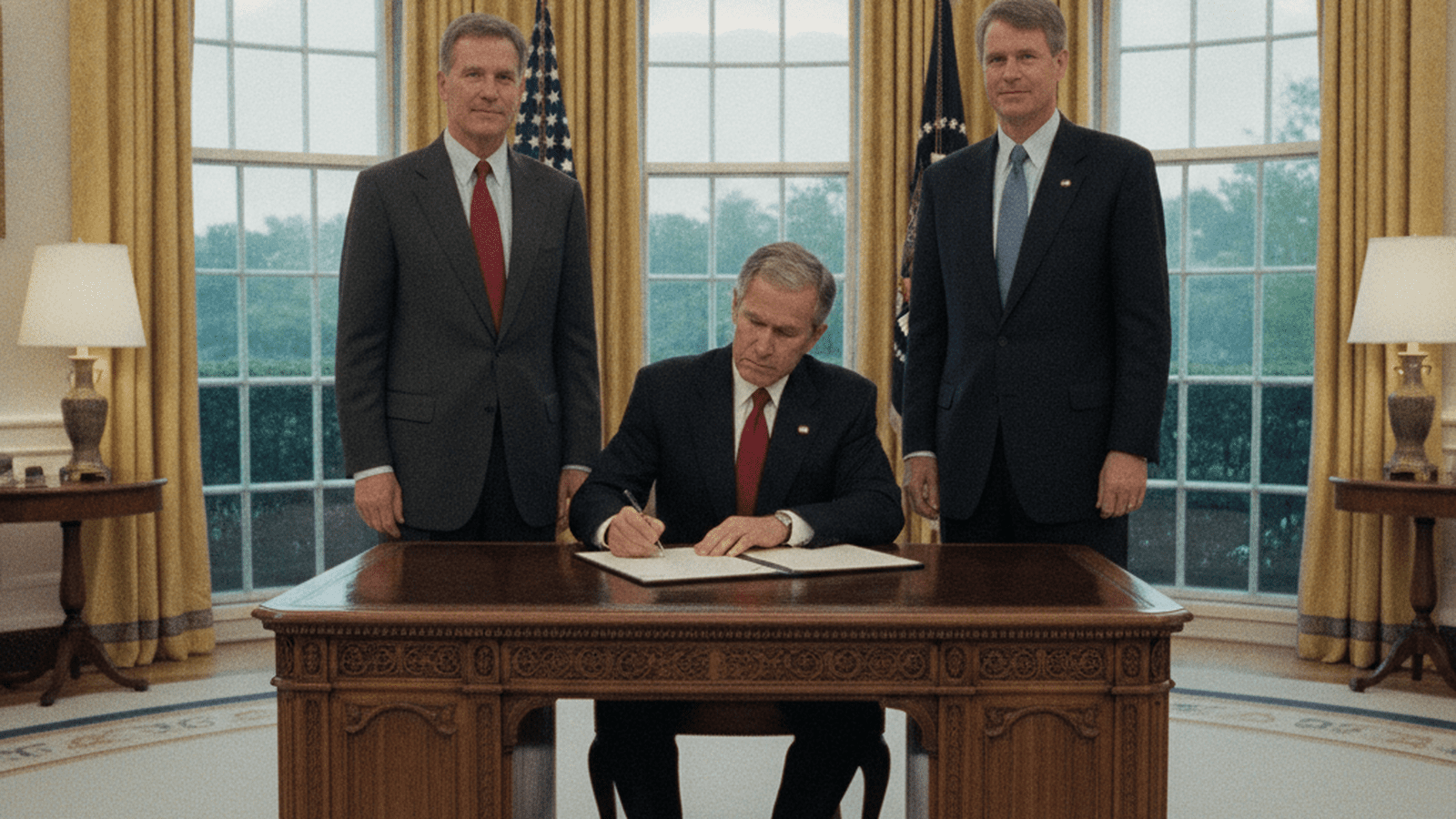
The Bipartisan Campaign Reform Act of 2002, commonly known as McCain-Feingold, was a landmark piece of United States legislation designed to reduce the influence of unregulated “soft money” in federal elections. It prohibited national political parties from accepting non-federal funds and restricted corporate-funded issue advertisements close to election dates.
TLDR: In 2002, the United States enacted the Bipartisan Campaign Reform Act to overhaul campaign finance laws. Led by Senators John McCain and Russ Feingold, the law banned soft money contributions to national parties and limited corporate-funded political ads. Subsequent Supreme Court rulings eventually dismantled several of its key provisions.
The turn of the millennium in the United States was marked by growing public concern over the influence of large, unregulated donations in federal elections. By the late 1990s, political parties had become increasingly reliant on “soft money,” which consisted of contributions made to political parties for “party-building” activities rather than specific candidates. Because these funds were not subject to federal limits, they allowed wealthy donors, corporations, and labor unions to exert significant influence over the political process. This environment set the stage for one of the most significant pieces of election reform in modern American history.
Senators John McCain, a Republican from Arizona, and Russ Feingold, a Democrat from Wisconsin, became the primary architects of a legislative response. Their partnership represented a rare moment of bipartisan cooperation in a Washington, D.C., that was becoming increasingly polarized. The proposed Bipartisan Campaign Reform Act (BCRA) sought to eliminate soft money at the national level and regulate the timing and funding of political advertisements. The bill faced stiff opposition from various interest groups and some members of congressional leadership who argued that it infringed upon free speech rights.
The legislative battle for the BCRA spanned several years, finally gaining momentum following the collapse of the Enron Corporation in early 2002. The scandal heightened public sensitivity toward corporate influence in government, providing the necessary political capital to push the bill through both chambers of Congress. On March 27, 2002, President George W. Bush signed the act into law. Although he expressed reservations about the constitutionality of certain provisions, he acknowledged the need to improve public confidence in the integrity of the electoral system.
The BCRA introduced two major changes to United States campaign finance law. First, it prohibited national political party committees from soliciting or spending soft money. This forced parties to rely on “hard money”—smaller donations from individuals and political action committees that were subject to strict federal limits and disclosure requirements. Second, the law prohibited corporations and unions from using their general treasury funds to pay for “electioneering communications.” These were defined as broadcast, cable, or satellite advertisements that referred to a federal candidate and were aired within 60 days of a general election or 30 days of a primary.
The implementation of the McCain-Feingold Act immediately altered the strategies of political campaigns and interest groups. While it successfully reduced the direct flow of unregulated cash to national parties, it also led to the proliferation of “527 groups.” These tax-exempt organizations, named after a section of the Internal Revenue Code, began to perform many of the advertising and mobilization functions previously handled by the parties. This shift demonstrated the difficulty of removing money from politics, as donors quickly found new channels to support their preferred causes and candidates.
The legal durability of the BCRA was tested almost immediately in the courts. In the 2003 case McConnell v. FEC, the Supreme Court upheld the majority of the law’s provisions, including the soft money ban. However, the judicial tide turned in later years. The landmark 2010 decision in Citizens United v. FEC struck down the restrictions on corporate and union independent expenditures, arguing that such spending was a protected form of political speech. While the ban on soft money contributions directly to parties remains in effect, the subsequent rise of Super PACs has largely bypassed the original intent of the 2002 reforms, leading to ongoing debates about the future of campaign finance in the United States.

Sophie Carter serves as a Staff Writer for Just Right News, where she anchors the outlet’s critical coverage of Elections, Influence, and Democracy Infrastructure. In an era where the mechanics of voting and the flow of political capital are under constant scrutiny, Sophie provides a steady, principled voice dedicated to the preservation of American institutional integrity and the rule of law.
Raised in Charlotte, North Carolina, Sophie’s perspective was forged in a community that balances rapid modern growth with a deep respect for tradition and civic duty. Growing up in the Queen City, she witnessed firsthand how a robust local culture depends on the trust between the citizen and the state. This upbringing instilled in her a foundational belief that the right to vote is a sacred trust—one that must be protected from both administrative overreach and the encroaching influence of special interest groups. Her reporting reflects these North Carolina roots, emphasizing the importance of community-led governance and the preservation of the individual’s voice in the face of nationalized political movements.
Now based in Atlanta, Georgia, Sophie operates from the heart of one of the nation’s most pivotal and contested political landscapes. Her location allows her to report from the front lines of the debate over election security, legislative reform, and the modernization of voting systems. For Sophie, the “infrastructure” of democracy is not merely a matter of machines and ballots; it is the collection of laws, people, and transparent processes required to maintain public confidence. Her work often highlights the necessity of clear, enforceable standards that ensure every legal vote is counted fairly and that the machinery of our republic remains accountable to the taxpayers who fund it.
Central to her work at Just Right News is her acclaimed feature series, “The Price of a Vote.” Through this ongoing project, Sophie explores the complex web of influence that shapes modern campaigns and policy decisions. She delves into how high-level lobbying, non-governmental organizations, and shifting bureaucratic regulations impact the weight of an individual citizen’s ballot. By examining the financial and structural pressures placed on the electoral process, she provides readers with a comprehensive look at the forces vying for control over the American political system.
Sophie’s approach to journalism is rooted in a commitment to the constitutional framework. She views her role as a watchdog for the voter, ensuring that the systems meant to serve the public remain transparent and free from corruption. Whether she is analyzing the implementation of new voting technologies or investigating the influence of outside money on state-level policy, her work is characterized by a rigorous adherence to facts and a refusal to succumb to the sensationalism that often plagues modern political reporting.
At Just Right News, Sophie Carter continues to be a vital resource for readers who value clarity, conviction, and a defense of traditional American values. Her deep ties to the Southeast and her specialized focus on the mechanics of our republic make her an essential voice in the ongoing conversation about the future of American self-governance. Through her reporting, she remains dedicated to the idea that a secure and honest electoral system is the bedrock of a free and prosperous society.